


Published on
Avoid a Rebuild in 18 Months: AI Agent Frameworks for Production
The right AI agent framework depends entirely on the shape of your workload: pick a graph-based, durable runtime like LangGraph for long-running, auditable workflows; reach for a role-based system like CrewAI when you need fast multi-agent business automation; and use a handoff or session SDK, such as the OpenAI Agents SDK or Microsoft Agent Framework, when you want tight integration with an existing cloud stack. Whichever pattern you choose, three filters decide whether it survives contact with production: governance enforcement, observability depth, and reliability testing under real fault conditions.
TL;DR:
Graph-based durable workflows are ideal for long-running, multi-system processes that require checkpointing and audit trails, with LangGraph being a key example.
Role-based systems like CrewAI focus on fast deployment of specialized agent teams, suitable for quick prototypes and straightforward automation tasks.
Handoff and session-based frameworks such as OpenAI Agents SDK excel in embedded product assistants that need lightweight, integrated solutions within existing cloud environments.
Reliable production requires governance enforcement, end-to-end observability, and fault testing, not just demo-level functionality, with frameworks needing native support for these features.
Architecture selection should prioritize the workload’s complexity and durability needs over feature lists, with real-world testing guiding the best framework choice for long-term stability.
BRDGITTurn AI Strategy Into ExecutionBRDGIT helps teams assess AI readiness, identify practical opportunities, and build the roadmap, systems, and skills to move forward.Explore BRDGIT
Table of Contents
What Do AI Agent Frameworks Actually Do?
Which Architecture Pattern Fits Your Workload?
What Should a Production-Readiness Checklist Include?
How Do You Choose the Right Framework for Your Team?
How BRDGIT Helps Teams Move From Framework Choice to Working System
Why Architecture Beats Model Swaps for Agent Reliability
Sources
FAQ
What Do AI Agent Frameworks Actually Do?
An AI agent framework is the software layer that turns a language model into something that can act, remember, and recover. It is not the model. It is the scaffolding around the model: the code that decides which tool gets called, what state persists between steps, and what happens when a call fails halfway through a multi-step task.
Strip away the marketing and every serious framework is providing some combination of the same primitives:
Agents — the reasoning units that decide what to do next, often specialized by role or task.
Tools — the functions, APIs, or retrieval systems an agent can call.
Sessions — the conversational or task-scoped memory that ties a sequence of turns together.
Workflows — the graph or sequence that defines how agents and tools hand off work.
Guardrails — policy checks that block or reroute unsafe or out-of-scope actions.
Checkpoints — saved state that lets a workflow resume after a crash, timeout, or human review.
Tracing — the telemetry trail that shows exactly what an agent did, in what order, and why.
The split that matters most for engineering teams is durable execution versus session-scoped execution. A durable framework checkpoints state at each step, so a workflow that fails on step 14 of 20 restarts at step 14, not step 1. That distinction sounds minor until you are running a claims-processing pipeline that takes 40 minutes and touches six external systems. Session-scoped frameworks, by contrast, treat state as living in memory for the length of a conversation or a short task. They’re lighter and faster to prototype with, but they are not built to survive a server restart mid-task.
Language stack and provider alignment shape your options more than most teams expect going in. LangGraph and CrewAI are Python-first, with LangGraph also offering a JavaScript implementation. The OpenAI Agents SDK and Microsoft Agent Framework lean into their respective ecosystems: OpenAI’s SDK is optimized for teams already standardized on OpenAI models and tool-calling conventions, while Microsoft Agent Framework integrates cleanly with Azure identity, Azure AI Foundry, and .NET or Python codebases. Google’s Agent Development Kit (ADK) does the same for teams on Vertex AI. Pydantic AI, built by the team behind the Pydantic validation library, targets Python developers who want strict typed outputs without adopting a full orchestration platform. Mastra fills a similar niche for the TypeScript and Node.js ecosystem, which the Python-heavy frameworks mostly ignore.
Two emerging protocols matter for anyone worried about lock-in: Model Context Protocol (MCP) standardizes how agents connect to tools and data sources, and Agent-to-Agent (A2A) protocols aim to let agents built on different frameworks hand off tasks to one another. Neither is universally adopted yet, but both reduce the cost of a framework decision made today being wrong in eighteen months.
Which Architecture Pattern Fits Your Workload?
Every framework on the market is really an implementation of one of four architectural patterns. Match the pattern to the job before you evaluate specific tools, because the wrong pattern will fight you no matter how well the framework is built.
1. Graph-based durable workflows. These model an agent system as a directed graph of nodes and edges, with state checkpointed at every transition. LangGraph is the clearest example of this pattern: it supports streaming execution, human-in-the-loop interrupts, and resumable state, which analyst comparisons point to as the reason graph-based runtimes suit long-running workflows that need to survive interruptions. If your workflow runs for minutes or hours, touches multiple systems, and needs an audit trail regulators or auditors might actually ask for, this is your pattern. LangChain, the library LangGraph builds on for tool integrations and model abstractions, often sits underneath these graphs as the connective layer to models and retrieval systems.
2. Role-based or “crew” patterns. CrewAI structures agents as a team with defined roles, similar to how you’d staff a project: a researcher, a writer, a reviewer, each with a scoped responsibility and the ability to hand off to the next. This pattern optimizes for developer velocity. You can stand up a working multi-agent prototype in an afternoon. The trade-off is that role-based systems generally offer less granular control over exactly how state persists between steps than graph-based systems do, which matters less for a marketing-content pipeline and matters enormously for a loan-underwriting pipeline.
3. Handoff and session-based models. The OpenAI Agents SDK and, in a different way, Microsoft Agent Framework both center on lightweight session objects and explicit handoff logic between agents. These are built for scenarios where an agent lives inside a product experience, such as a support assistant that hands a billing question to a specialized sub-agent, rather than a batch workflow running unattended. They tend to be the fastest path to shipping an agent inside an existing application, particularly when you are already committed to a single model provider’s ecosystem.
4. Typed, durable execution. This is the newest and least crowded category. Pydantic AI applies strict input/output typing to agent responses, catching malformed outputs before they propagate downstream. Separately, Temporal-style durable execution, an approach some teams bolt onto any of the above frameworks, guarantees that a workflow’s state is persisted at every step regardless of which orchestration layer sits on top. Teams building financial or healthcare workflows, where a malformed tool call or a silently dropped step is a compliance incident rather than a bug ticket, gravitate here.
Pro Tip: Don’t pick an architecture pattern by reading feature comparison charts. Build the smallest possible version of your actual workflow, five to ten nodes, using two different patterns, and time how long each takes to get from empty repository to a working demo. The pattern that fights you least under real conditions is usually the right one, regardless of what the documentation promises.
Here’s a rough mapping for common situations:
Use case | Recommended pattern | Representative framework |
|---|---|---|
Long-running, auditable, multi-step workflow | Graph-based durable | LangGraph |
Fast multi-agent business automation prototype | Role-based / crew | CrewAI |
Embedded assistant inside a single-vendor product | Handoff / session | OpenAI Agents SDK |
.NET or Azure-native enterprise workflow | Handoff / session | Microsoft Agent Framework |
Vertex AI or Google Cloud-native deployment | Graph or handoff | Google ADK |
Strict schema validation on agent outputs | Typed / durable | Pydantic AI |
TypeScript / Node.js product team | Typed / durable | Mastra |
Document-heavy retrieval-augmented workflows | Graph-based durable | LangGraph with LangChain retrieval |
Every one of these frameworks appears repeatedly in comparative analyses of open-source agent tooling, and none of them wins across every category. Provider alignment, developer velocity, and durability trade against each other constantly, which is exactly why the architecture decision has to come before the vendor decision, not after.
What Should a Production-Readiness Checklist Include?
A framework that demos well on a laptop is not the same thing as a framework ready for a customer-facing workload. The gap between the two is governance, observability, and reliability testing, and most teams skip straight past all three because none of them show up in a “getting started” tutorial.
Governance has to be enforced by the framework, not hoped for from the model. Relying on a language model’s own safety training as your only control is a mistake teams keep making, largely because it works fine right up until it doesn’t. Framework-native governance means deterministic policy checks that run outside the model: a rule that blocks a refund tool from firing above a certain dollar amount, a fail-closed gate that halts execution rather than guessing when a policy check errors out, and explicit mapping against known failure classes like the OWASP Agentic Top 10. The data on this is not subtle: agents that hit high pass rates under ideal conditions dropped notably under a minor task perturbation, showing a significant reliability swing that appears because the governance relied on model behavior instead of framework-level enforcement.

Observability means end-to-end tracing, not console logs. You need to see every tool call, every token spent, and every decision branch an agent took, ideally exported to a tracing stack you already use. Tools like LangSmith and LangFuse have become the default here because they capture the trace and cost dimensions together, though current observability stacks still tend to lack enforced resource budgets alongside the trace data, which means budget enforcement is usually something your team has to layer on top rather than something you get out of the box.
Reliability testing means breaking things on purpose before your users do it for you, a step made easier by tools like the AI Crawlability Audit that help ensure agentic access and fault injection are well understood. This is the part almost nobody does before their first production incident.
Inject rate limits and artificial timeouts and watch whether the agent retries with backoff or fails silently.
Run the identical task 20 times and measure how much the output and the cost vary run to run.
Cap the token and tool-call budget and see what breaks first: accuracy or the budget itself.
Confirm every human-in-the-loop gate actually halts execution rather than just logging a warning and continuing.
Benchmarks built specifically for this, like AgentSLABench, profile agents across 16 task environments under declared resource budgets, tracking latency, cost, peak memory, and CPU time alongside success rate. The metric that matters most here is Efficiency-Adjusted Success Rate, EASR, which penalizes an agent that succeeds only by burning unlimited tokens and retries. A framework that scores well on raw accuracy but collapses on EASR is not production-viable, no matter what its demo looked like.
Reliability under stress: Fault-injection testing from ReliabilityBench found that a modest perturbation (ɛ=0.2) dropped pass@1 from 96.9% to 88.1%, and identified rate-limiting faults as the single largest contributor to that drop. If your evaluation process doesn’t include deliberate rate-limit injection, you are almost certainly overestimating your agent’s real-world reliability.
Fold these checks into your CI pipeline rather than treating them as a one-time pre-launch audit. Architecture choices, not model swaps, tend to be what drives reproducibility problems, a point worth sitting with before you spend a sprint upgrading a model to fix a bug that was never about the model.
How Do You Choose the Right Framework for Your Team?
Selection gets simpler once you rank your criteria instead of comparing feature lists side by side. Work through these in order, because each one eliminates candidates faster than the last:
Primary use case. Long-running and auditable, or fast and conversational? This alone cuts your shortlist in half.
Language stack alignment. A brilliant Python framework is a liability on a TypeScript team, and vice versa. Mastra exists precisely because Node.js shops got tired of bridging to Python runtimes.
Persistence and durability needs. Does a crash mid-workflow cost you a retry, or a compliance incident?
Observability requirements. Can the framework export traces to the stack your on-call team already watches?
Governance and compliance requirements. Does your industry require an audit trail, human sign-off gates, or documented policy enforcement?
Cost profile. What does a single agent run cost at your expected volume, not at demo volume?
When you’re deep enough into evaluation to be talking to vendors or reading documentation closely, ask direct questions rather than trusting the sales page:
What exactly gets checkpointed, and how granular is recovery after a mid-workflow failure?
Is policy enforcement deterministic and fail-closed, or advisory and model-dependent?
What tracing formats does the framework export natively, and does that match your observability stack?
Does the framework ship a test harness, or documented guidance for chaos-style fault injection?
What’s the licensing model, and are you locked into a specific cloud provider’s hosting?
A rough decision flow: if you need long-running durable workflows, start with graph-based tools. If you need to prototype a multi-agent business automation fast, start role-based. If you’ve already standardized on a cloud provider and are comfortable trading some portability for tighter integration, a vendor SDK is a reasonable trade, provided you go in with eyes open about the lock-in.
Red flags that should stop a framework selection cold: no tracing story at all, no durable checkpointing mechanism, no test harness or documented approach to chaos testing, and tool connectors that are closed or proprietary with no export path. Any one of these is a workaround. Two or more together is a rebuild waiting to happen twelve months from now.
How BRDGIT Helps Teams Move From Framework Choice to Working System
Picking a framework is the easy part. Getting a governed, observable, tested agent into production is where most teams stall, and it’s the gap BRDGIT works inside every day.
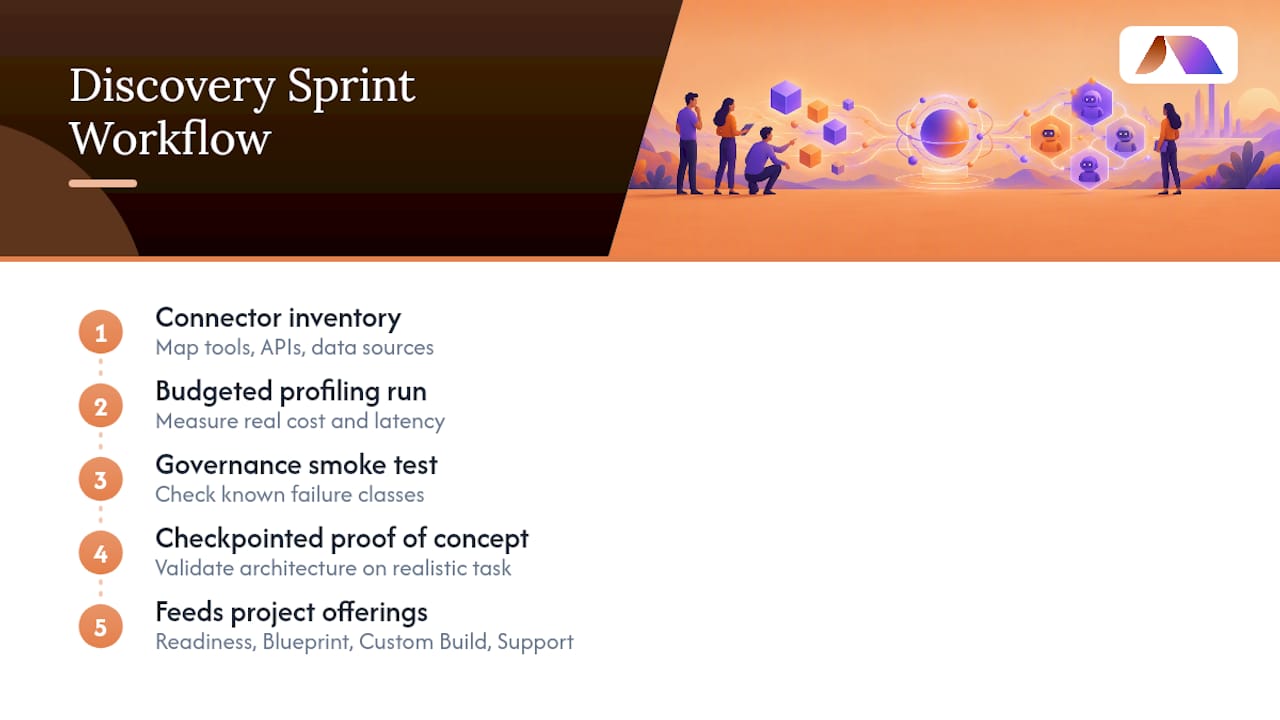
The discovery sprint typically starts with a connector inventory: every tool, API, and data source the agent needs to touch, mapped before a line of orchestration code gets written. From there, a small budgeted profiling run establishes real cost and latency numbers, not demo numbers, followed by a governance smoke test against known failure classes and a quick checkpointed proof of concept to validate the architecture holds up under a realistic task.
That work feeds directly into BRDGIT’s project offerings: an AI Readiness Assessment to establish where your team actually stands, an AI Blueprint to map the roadmap, a Custom Agent Build for the system itself, and Managed AI Support once it’s live. For teams that need engineering hands without a full-time hire, Fractional Engineer Services put an experienced AI engineer on your team for exactly as long as the build requires. For deeper technical execution on the checkpointing, tracing, and testing work described above, that’s where AI Engineer Services and Machine Learning Engineering come in.
If you’ve read this far and still aren’t sure which architecture fits your workflow, that uncertainty is normal, and it’s worth resolving before you write production code, not after. BRDGIT’s guide to scaling AI agents in the enterprise covers the operational patterns that come after the framework decision.
Why Architecture Beats Model Swaps for Agent Reliability
Teams chasing agent reliability tend to reach for the same lever first: swap the underlying model. It rarely works, and the research on multi-agent systems explains why. Evaluation suites built to standardize agent testing across frameworks have found that architecture, supervisor topology, checkpointing strategy, how state gets passed between agents, dominates reproducibility and resource profile far more than which model sits behind the calls.
That has a direct operational consequence: the money belongs in profiling, config versioning, and instrumenting agents as services with real SLOs and SLIs, borrowing directly from site reliability engineering, not in a third round of model benchmarking. An agent without an error budget and a runbook for its most common failure mode is not a production system, no matter how good its outputs look in a demo.
Before you commit to any framework, run a budgeted profile and a governance smoke test first. If it survives fault injection and stays inside its cost and latency budget, you’ve learned more about production fit than a month of feature comparisons would tell you. If it doesn’t, you’ve saved yourself a rebuild.
— Team BRDGIT
Sources
For deeper validation, AgentSLABench covers resource-aware profiling, ReliabilityBench documents fault-injection results, and MAESTRO standardizes cross-framework telemetry. Microsoft’s Agentic Top 10 governance guidance covers policy enforcement in depth, and BRDGIT’s own agent-consistency guide applies these ideas practically.
AgentSLABench: resource-aware evaluation for autonomous AI agents (arXiv)
FAQ
What Are the Top AI Agent Frameworks Right Now?
The frameworks appearing most consistently across production comparisons in 2026 are LangGraph, LangChain, the OpenAI Agents SDK, Microsoft Agent Framework, CrewAI, Google ADK, Pydantic AI, and Mastra. Each targets a different architecture pattern, from graph-based durable workflows to role-based crews to typed execution, so the “best” one depends entirely on your use case rather than a universal ranking.
What Are the Main Types of AI Agents?
AI agents are commonly grouped by how they handle state and control: reactive agents that respond without memory, deliberative agents that plan multiple steps ahead, role-based agents that operate as part of a coordinated crew, and durable or graph-based agents that checkpoint state across long workflows. Most production systems in 2026 combine several of these patterns rather than relying on a single type.
Is ChatGPT an Agent or a Language Model?
ChatGPT is built on a large language model, not an agent framework itself. It becomes agent-like when paired with tool-calling, memory, and orchestration, capabilities that frameworks like the OpenAI Agents SDK, LangGraph, or CrewAI are specifically built to provide around a model.
What Are the Top AI Agents People Actually Use?
Rather than individual “agents,” most production deployments in 2026 are built on frameworks that let teams assemble their own: LangGraph for durable workflows, CrewAI for role-based automation, and the OpenAI Agents SDK or Microsoft Agent Framework for product-embedded assistants. The agent itself is custom; the framework underneath it is what gets chosen off the shelf.
How Do I Choose Between a Role-Based and a Graph-Based Framework?
Choose role-based frameworks like CrewAI when you need fast prototyping and clear task decomposition across a small team of specialized agents. Choose graph-based frameworks like LangGraph when your workflow runs long, needs to recover from interruptions, or requires an audit trail of every step taken.



