Published on
What Is Industrial AI Integration: A 2026 Guide
TL;DR:
Industrial AI integrates models into manufacturing by analyzing live sensor data to automate decisions. Successful deployment depends on a reliable data foundation, effective governance, and operator trust. Scaling requires standardized processes, reusable data assets, and infrastructure built to replicate across multiple sites.
Industrial AI integration is the practice of embedding AI models directly into physical industrial operations, where those models analyze live sensor data from operational technology systems and trigger actions under human oversight. This is not basic automation with a new label. The difference is consequential: traditional programmable logic controllers follow fixed rules, while AI adds adaptive, data-driven decision-making that responds to conditions those rules never anticipated. Understanding AI in manufacturing starts with recognizing that IoT sensor networks act as the nervous system supplying real-time telemetry that makes every AI decision possible. Deployments range from weeks for simple vision inspection applications to many months for complex, multi-site projects with custom models and deep system integration.
What is industrial AI integration and how does it work in manufacturing?
The data flow begins at the operational technology layer. PLCs, SCADA systems, and manufacturing execution systems generate continuous streams of process data. AI models ingest that data in real time and return outputs: alerts, setpoint adjustments, quality flags, or automated work orders. The interaction is bidirectional. The AI reads the plant; the plant responds to the AI.

The architecture that makes this possible is hybrid by design. Edge inference runs on hardware located close to the machine, keeping latency low enough for time-critical decisions. Cloud infrastructure handles model training, fleet analytics, and longer-horizon optimization. Affordable edge GPUs have matured enough in 2026 to make this architecture accessible to mid-size manufacturers, not just large enterprises.
Common applications of industrial AI include:
Predictive maintenance: Vibration, temperature, and acoustic sensors feed models that flag equipment degradation before failure occurs.
Visual quality inspection: Camera systems paired with computer vision models catch surface defects at line speed, replacing manual sampling.
Process optimization: AI models adjust process parameters in real time to hold output within tighter tolerances than fixed control logic allows.
Energy management: Models identify consumption anomalies and recommend load-shifting actions to reduce utility costs.
Pro Tip: Before selecting an AI use case, map which OT data streams are already clean, timestamped, and accessible. The use case that wins is rarely the most exciting one. It is the one with the best data already in place.
What does a roadmap for industrial AI integration look like?
A 6-step roadmap structures the path from concept to operating AI. Each step has a distinct objective and a measurable deliverable.
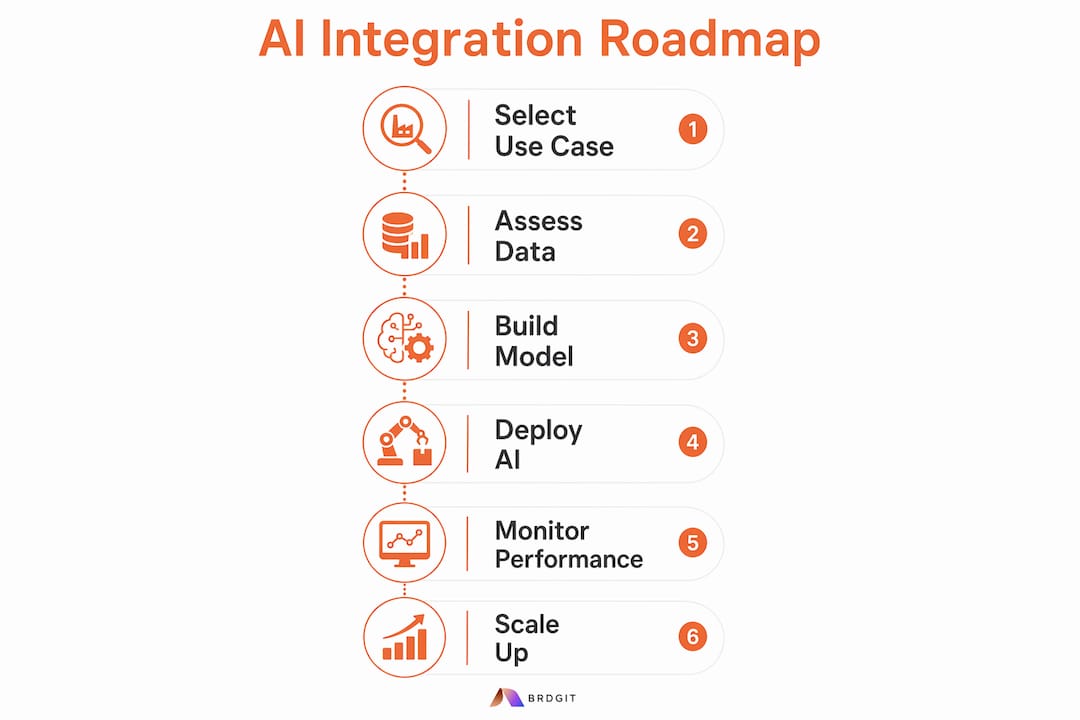
Step | Objective | Key Deliverable |
|---|---|---|
1. Select use cases | Identify high-impact, data-ready opportunities | Prioritized use case backlog |
2. Build OT/IT data foundation | Create reliable, unified data access | Operational data pipeline |
3. Design production-ready models | Build models that work under real plant conditions | Validated model with performance KPIs |
4. MLOps industrialization | Automate model deployment, monitoring, and retraining | CI/CD pipeline for AI models |
5. Governance | Define ownership, audit trails, and decision rights | AI governance policy |
6. Replicable operating model | Package the solution for deployment on new lines or sites | Deployment playbook |
Skipping step two is the most common and costly mistake. Poor data foundations cause deployment delays that stretch past 12 months and produce failures within the first three months of go-live. The data foundation is not a technical prerequisite. It is the project itself.
Operational ownership matters as much as the technical build. Each AI application needs a named process owner, a defined KPI, and a feedback loop that surfaces model drift before it becomes a production problem. For a broader view of AI implementation steps, the governance and ownership elements apply across industries, not just manufacturing.
Pro Tip: Assign a process owner to every AI model at the design stage, not after go-live. Models without owners decay. The plant keeps running; the AI quietly stops being right.
What are the biggest challenges in industrial AI integration?
The main challenge has shifted from building AI models to integrating them with legacy OT systems that were never designed for external data access. Most AI project failures trace back to this integration layer, not to the models themselves.
The specific obstacles manufacturing leaders encounter most often include:
Proprietary OT protocols: Older PLCs and SCADA systems communicate over protocols like Modbus, PROFINET, or OPC-UA. Connecting these to modern AI infrastructure requires protocol translation and, in many cases, a unified data namespace to avoid custom point-to-point integrations that break under load.
Integration complexity: Connecting AI to legacy OT systems lacking modern APIs creates “integration hell.” Projects built on fragile custom connectors can take over a year and still fail when a firmware update changes the data format.
Operator trust: AI does not forgive organizational ignorance. If operators do not understand what a model is telling them or why, they ignore it. Ignored models stop improving because the feedback loop breaks.
Cybersecurity exposure: Bridging OT and IT networks expands the attack surface. Regulations like the NIS2 Directive in Europe impose specific obligations on operators of critical infrastructure, and similar frameworks are tightening globally.
The software-only misconception: Business leaders often treat industrial AI as a software project. It is not. The physical environment, the organizational structure, and the human workflows are all part of the system.
How do you scale industrial AI across multiple plants?
Scaling is where most industrial AI programs stall. A pilot that works on one line does not automatically transfer to another. The reason is almost always infrastructure, not intelligence.
The path to scale requires treating AI integration as product development rather than project delivery. Reusable data products and MLOps pipelines are the foundational assets. A data product is a curated, documented dataset with defined ownership and a refresh schedule. An MLOps pipeline automates the steps from model training to production deployment. Without both, every new site requires a full rebuild.
A practical scaling sequence looks like this:
Standardize definitions and KPIs across all sites before deploying anywhere new. Inconsistent definitions of “downtime” or “defect” make cross-site comparison meaningless.
Build a deployment playbook from the first successful site. Document every integration decision, configuration choice, and operator training step.
Establish role-based training programs for operators, maintenance technicians, and quality teams. Each role needs a different mental model of what the AI does and what it does not do.
Connect AI outputs to enterprise systems such as ERP and supply chain platforms. Plant-floor AI that cannot inform procurement or scheduling decisions delivers only a fraction of its potential value.
Measure replicability as the primary scaling KPI. Deploying a solution on a new line within weeks, not months, signals a mature AI operating model. If each new deployment still takes six months, the infrastructure is not ready to scale.
AI at scale consistently fails when organizations treat each plant as a standalone project. The shared infrastructure investment pays off at the third or fourth site, not the first.
Key Takeaways
Industrial AI integration delivers lasting value only when the data foundation, governance, and human workflows are built with the same rigor as the AI models themselves.
Point | Details |
|---|---|
Define the architecture first | Hybrid edge and cloud design balances real-time decisions with model training at scale. |
Data foundation is non-negotiable | Poor OT/IT data pipelines cause deployment failures within three months of go-live. |
Governance prevents model decay | Every AI model needs a named owner, a KPI, and a feedback loop from day one. |
Operator trust must be earned | Training and daily usage routines determine whether AI insights reach operational decisions. |
Replicability signals maturity | Deploying on a new line within weeks, not months, is the true measure of a scaled AI program. |
The uncomfortable truth about industrial AI integration
We have seen manufacturers invest significantly in AI pilots that produce impressive demo results and then quietly disappear from the plant floor within six months. The pattern is consistent. Leadership treats the pilot as proof of concept. The operations team treats it as someone else’s project. No one owns the model after go-live. The data pipeline drifts. The model stops being accurate. The operators stop trusting it. The project ends without anyone formally canceling it.
The industrial artificial intelligence benefits that get cited in industry reports, improved throughput, reduced unplanned downtime, tighter quality tolerances, are real. We have seen them materialize. But they require a level of organizational commitment that most companies underestimate at the start. The AI is not the hard part. The hard part is building the data infrastructure, the governance structure, and the operational routines that keep the AI honest over time.
What we recommend to every manufacturing leader starting this work: spend more time on your data foundation than you think you need to, and less time on model selection than you want to. The model is replaceable. A broken data pipeline is a six-month delay. Training your factory teams to use AI outputs in their daily decisions is not a soft skill exercise. It is the difference between a model that runs and a model that works.
The manufacturers who are pulling ahead in 2026 are not the ones with the most sophisticated models. They are the ones who built the infrastructure to deploy the next model in weeks and the culture to act on what it tells them.
— Team BRDGIT
BRDGIT’s approach to industrial AI integration
Manufacturing leaders who are serious about AI integration need more than a software vendor. They need experienced people who understand both the OT environment and the AI architecture required to connect them.
BRDGIT provides fractional engineering support built specifically for industrial organizations moving from AI curiosity to real execution. That means helping teams build reliable data foundations, design governance structures, run operator training programs, and deploy AI solutions that replicate across sites without starting from scratch each time. For companies that cannot justify a full-time AI team, fractional expertise gives you the depth you need at the stage you are actually in. If you are ready to move past the pilot phase, BRDGIT is built for exactly that work.
FAQ
What is industrial AI integration in simple terms?
Industrial AI integration is the practice of connecting AI models to factory systems so they can read live sensor data and trigger operational responses under human oversight. It adds adaptive decision-making on top of traditional automation.
How long does industrial AI integration take to deploy?
Deployment timelines range from weeks for simple vision inspection applications to many months for complex, multi-site projects with custom models and deep OT/IT integration.
What causes most industrial AI projects to fail?
Most failures trace back to poor OT/IT data integration rather than AI model quality. Fragile custom connectors and missing unified data namespaces are the primary culprits, not the algorithms.
What is the role of IoT in industrial AI integration?
IoT sensor networks supply the real-time telemetry that AI models depend on. Without reliable, timestamped sensor data from the plant floor, AI models have nothing meaningful to analyze or act on.
How do you scale industrial AI beyond a single pilot?
Scaling requires reusable data products and MLOps pipelines, standardized KPIs across sites, and a deployment playbook built from the first successful implementation. Replicating a solution on a new line within weeks is the benchmark for a mature AI program.