


Published on
Merchandisers: Six Stage AI SKU Rationalization Without a Data Scientist
AI-driven SKU rationalization uses structured data and scoring to identify which products to protect, review, or delist, and it delivers lower carrying costs and improved gross margin when we run it as a governed pilot rather than a one-time cleanup. The fastest path to results is to scope a small category, clean the underlying data, and let a composite score surface candidates for human review before any delisting happens.
TL;DR:
Ensuring high data quality is critical; missing cost or margin information in more than 10% of SKUs requires correction before scoring begins.
A composite score that includes velocity, margin contribution, inventory days, return rate, substitution risk, and strategic value is essential for accurate SKU rationalization.
Human oversight remains vital, with collaboration modes optimized based on SKU volatility; full automation suits stable items, while augmentation benefits low-frequency, high-impact SKUs.
Cross-functional governance involving merchandising, finance, and supply chain sharing a single ranked list improves decision trust and implementation success.
Running pilots on small categories with clear success metrics and integrating scoring into inventory management systems reduces risks and accelerates scaling.
BRDGITMove From AI Ideas To ExecutionBRDGIT helps merchandising teams identify practical AI opportunities, build clear roadmaps, and implement systems that support better decisions.Explore BRDGIT
Table of Contents
A practical AI-driven SKU rationalization workflow
Preparing and structuring data so AI gives usable recommendations
Defining rationalization criteria and building a composite score
Human-AI collaboration and governance for rationalization decisions
Protecting halo SKUs and managing substitution risk
Quantifying ROI and KPIs to measure success
Implementation checklist for a safe pilot and scale path
Integrating AI SKU rationalization with inventory and supply chain systems
Case studies in AI-powered SKU rationalization
Evaluation metrics for AI model performance in SKU rationalization
Where AI-driven SKU rationalization is headed
What teams get wrong and how to win faster
How BRDGIT supports SKU rationalization pilots
FAQ
Sources
A practical AI-driven SKU rationalization workflow
A rationalization pilot moves through six stages, and skipping any of them tends to produce a list that nobody trusts.
Scope and align. Pick one category or warehouse, then get merchandising, finance, and supply chain to agree on what “success” means before any data moves.
Gather and integrate data. Pull SKU master records, sales history, cost, promotions, and returns into one working dataset.
Engineer features and pick KPIs. Translate raw transactions into the variables the scoring model actually needs, such as margin contribution per SKU and days of inventory on hand.
Model and score. Rank every SKU in scope using a composite score, not a single metric.
Tag and route for review. Assign each SKU a decision tag, protect, review, or delist, and route anything ambiguous to a human.
Pilot, measure, iterate. Run the first round on a limited set, measure the result, and adjust weights before expanding.
The teams that get this right treat the ranked list as a starting point for conversation, not a verdict:
Finance checks that margin assumptions reflect current cost, not last year’s.
Supply chain flags lead-time risk before anything gets delisted.
Merchandising confirms the list does not touch a known basket driver.
Preparing and structuring data so AI gives usable recommendations
An AI model is only as useful as the inputs it gets, and most rationalization pilots stall on data quality rather than modeling choices. Before scoring anything, assemble these fields:
SKU master data: category, subcategory, supplier, and attributes.
Time-series sales: at least 12 to 24 months where available, aggregated weekly or monthly.
Promotional history: so a temporary spike does not look like organic demand.
Cost and margin data: landed cost, not just list price.
Returns and lead times: both affect true carrying cost.
New launches need separate handling since they lack sales history. A common approach is to exclude SKUs under 90 days old from the scoring pass and review them manually instead. Halo behavior, where one SKU drives purchases of others, gets labeled using basket co-occurrence before scoring begins, and possible substitutes get flagged so the model does not recommend cutting the only option a customer has.
Pro Tip: Run a data completeness check before scoring anything: if more than 10% of SKUs in scope are missing cost or margin data, fix that gap first rather than letting the model guess.
Defining rationalization criteria and building a composite score
A single metric like unit velocity will mislead a rationalization project, because a low-volume SKU can still be the most profitable item in a category. A composite score blends several dimensions instead:
Velocity: units or revenue per period relative to category peers.
Margin contribution: gross profit dollars, not just margin percentage.
Inventory days: how long cash sits on the shelf.
Return rate: a proxy for quality or fit problems.
Substitution risk: whether removing the SKU pushes demand to a competitor instead of a sibling product.
Strategic value: new launches, loss leaders, or contractual commitments that should not be scored like everything else.
Weighting can be rule-based, where merchandising sets fixed weights by category, or data-driven, where a regression or lightweight machine learning model learns which dimensions predict post-rationalization outcomes. Validation rules should block any delist recommendation on a SKU that contributes more than a set margin threshold or appears in a top basket-affinity cluster.
Human-AI collaboration and governance for rationalization decisions
A field experiment spanning roughly 1,900 SKUs found that the right mix of human and AI input depends on the product itself, and three collaboration modes produced different effects on forecast accuracy and inventory outcomes: automation, adjustable automation, and augmentation. Full automation suits stable, high-volume SKUs where the model has strong historical signal. Adjustable automation, where a human can override a recommendation, fits moderate-volatility items. Augmentation, where a human leads and the model advises, works best for low-frequency, high-impact SKUs where the data history is thin.
The research behind this comes from a controlled field study that measured inventory and forecast outcomes directly rather than relying on self-reported satisfaction, which gives the finding more weight than typical vendor claims.
Governance mechanics should include:
An approval gate before any delist action ships, with a named approver.
A short explanation attached to every scored recommendation, not just a number.
An audit trail logging who approved what and when.
Defined roles: merchandising owns the call, finance validates margin, supply chain validates lead time and replenishment impact.
Protecting halo SKUs and managing substitution risk
Basket affinity analysis identifies which low-velocity SKUs still drive attachment sales, so a candle that rarely sells on its own but appears in 40% of baskets containing a top seller deserves a protect tag regardless of its individual score. Model and tag-based protections exclude these SKUs from automated delist recommendations entirely.

Where removal is still necessary, customer selection and incentivization strategies help manage the transition. In a packaged gas supply chain study, heuristic customer-selection methods for guiding demand toward retained SKUs outperformed random selection by 10 to 20%, and the same heuristic beat a more complex mixed-integer optimization extension by 7% across tested cases.
Pro Tip: Monitor substitution for at least one full sales cycle after any delist action: a SKU that looks successfully removed can quietly erode a neighboring product’s basket share within weeks.
Quantifying ROI and KPIs to measure success
Four KPIs carry most of the signal in a rationalization pilot: carrying cost reduction, gross profit recovery, inventory turns, and fill rate. Track them with a holdout group, where a comparable category or store cluster skips rationalization for the same period, so the measured lift reflects the intervention rather than seasonal noise.
KPI | What it measures | Typical measurement window |
|---|---|---|
Carrying cost reduction | Dollars freed from reduced inventory holding | 1 to 2 quarters |
Gross profit recovery | Margin dollars retained or regained post-cut | 1 to 2 quarters |
Inventory turns | Speed of inventory movement | Quarterly |
Fill rate | Service level maintained after SKU changes | Monthly |
A cross-functional SKU rationalization program documented in a case study of a national restaurant chain and its distributor reported $6.7 million in combined savings, underscoring how much value sits in supplier alignment, not just the scoring model. Report results biweekly during the pilot and monthly once the program stabilizes.
Implementation checklist for a safe pilot and scale path
A scoped pilot beats a company-wide rollout on the first attempt every time, because it lets you catch scoring errors before they touch revenue at scale.
Scope the pilot to one category or location with 200 to 2,000 SKUs, running for 8 to 12 weeks.
Build the runbook for actioning delists: who pulls the SKU, who notifies the supplier, who updates replenishment systems.
Communicate early with suppliers and internal stakeholders before any SKU disappears from a shelf or catalog.
Set rollback triggers, such as a fill-rate drop below an agreed threshold, that pause further cuts automatically.
Review and expand scope only after the pilot’s KPIs clear their targets for two consecutive reporting cycles.
Integrating AI SKU rationalization with inventory and supply chain systems
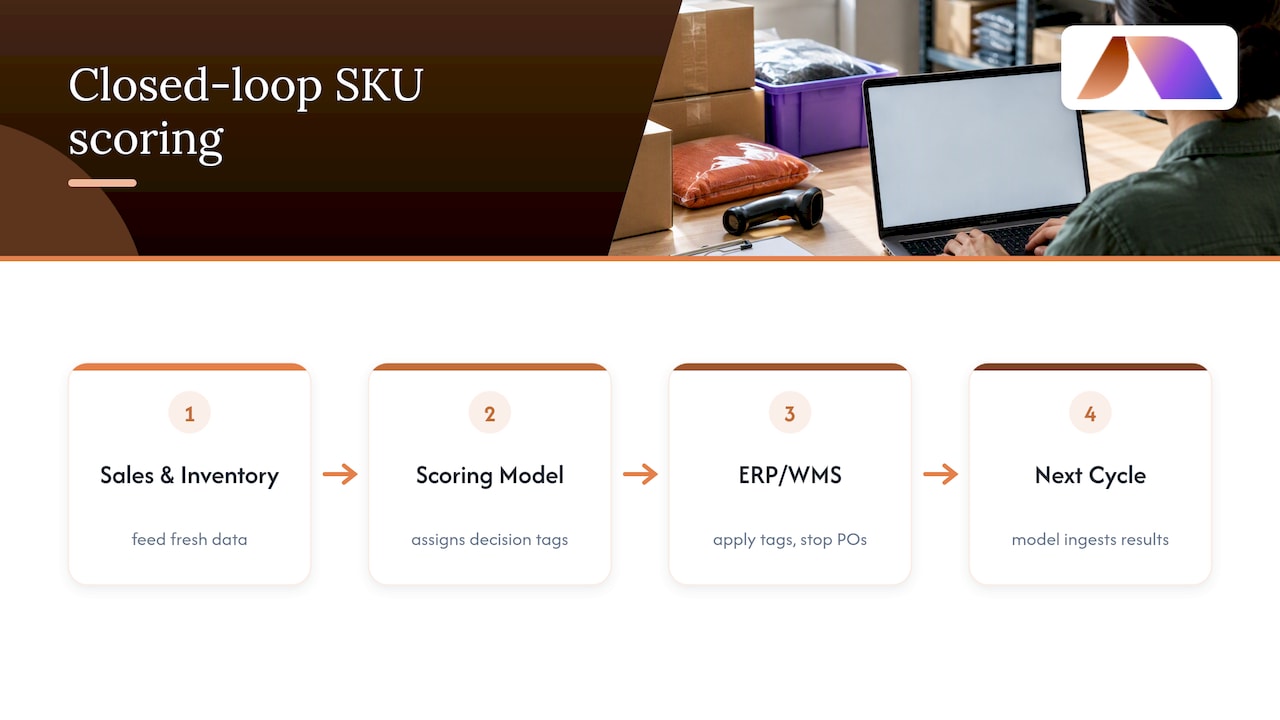
A rationalization score means little if it lives in a spreadsheet disconnected from the systems that actually move inventory. The scoring output needs to feed directly into replenishment planning, so a SKU tagged for delist stops generating purchase orders automatically rather than relying on someone remembering to update a setting.
Most mid-sized teams connect rationalization scoring to their existing enterprise resource planning or warehouse management system through a scheduled data feed rather than a full platform replacement. The scoring model pulls fresh sales, cost, and inventory data on a weekly or monthly cadence, and the decision tags write back into the inventory system as flags that supply chain planners can see alongside their normal replenishment screens.
Lead-time and supplier data deserve particular attention here, since a SKU that looks like a clean delist candidate on margin alone might carry a long replenishment lead time or a minimum order quantity that makes a partial cut impractical. Supply chain systems that already track these constraints should feed them back into the scoring model as a validation layer, not an afterthought.
The practical goal is a closed loop: sales and inventory data flow into the scoring model, decision tags flow back into the planning system, and the next scoring cycle picks up the results of the last round of changes. Teams that build this loop manually at first, using a scheduled export and import rather than a custom integration, tend to validate the approach faster and with less engineering overhead before committing to a deeper systems connection.
Case studies in AI-powered SKU rationalization
The clearest documented case comes from a cross-functional, cross-firm rationalization project at a national restaurant chain and its distributor, where researchers identified seven propositions for sustainable SKU reduction built around supplier collaboration and cross-functional alignment. The project’s reported $6.7 million in combined savings came not from the scoring model alone but from the governance structure around it: finance, merchandising, and supply chain operating from the same ranked list with shared accountability for the outcome.
A separate study in a packaged gas supply chain focused on a narrower but equally practical problem: once a SKU is marked for rationalization, which customers should be steered toward substitute products, and how. The heuristic approach developed there outperformed both random customer selection and a more computationally expensive optimization model, suggesting that a well-designed heuristic can beat a more complex system on practical outcomes, not just speed.
Both cases point to the same lesson: the scoring model identifies candidates, but the surrounding process, supplier communication in one case, customer incentivization in the other, determines whether the savings actually materialize. Teams that treat the AI output as the finish line rather than the starting point tend to see smaller, less durable gains than the figures above suggest.
Evaluation metrics for AI model performance in SKU rationalization
Judging whether a rationalization model is working requires metrics beyond the business KPIs covered earlier. On the modeling side, track prediction accuracy for the features driving the score, such as how closely forecasted demand for a borderline SKU matched what actually happened after a decision was made. A model that consistently overestimates demand for SKUs it recommends protecting will quietly inflate the “protect” list and erode the savings the pilot was meant to capture.
Precision and recall on the decision tags themselves matter more than headline accuracy. If a model tags a SKU for delist and a human reviewer overturns that call more than occasionally, that is a signal the scoring weights need adjustment, not that human review is slowing the process down. Tracking the override rate by category gives a concrete, auditable measure of where the model’s confidence doesn’t match merchandising judgment.
Stability matters too: a scoring model that produces a substantially different ranked list from one month to the next, without a corresponding change in underlying sales or cost data, is likely overfitting to short-term noise. Comparing rank order correlation between consecutive scoring runs catches this before it causes a delist decision to reverse itself a month later.
Finally, tie model evaluation back to the holdout testing described earlier: the real test of a scoring model isn’t how elegant its output looks, but whether the category it touched outperformed the comparable category that didn’t, on the KPIs that matter to the business.
Where AI-driven SKU rationalization is headed
The clearest near-term shift is toward adjustable automation becoming the default mode rather than the exception, since the field evidence on human-AI collaboration shows that letting humans override model recommendations on moderate-volatility SKUs consistently outperforms either pure automation or pure manual review. Expect more vendor tools to build that override capability into the interface by default instead of treating it as an advanced setting.
Composite scoring itself will likely get more granular, incorporating substitution risk and basket affinity as first-class inputs rather than a manual check layered on after the fact, since both significantly affect whether a delist decision holds up in practice. As more mid-sized teams run pilots and document results, the customer-selection and incentivization techniques proven in narrower supply chain contexts are likely to get adapted more broadly into general retail and distribution use cases.
The bigger shift, though, is organizational rather than technical: teams that build the cross-functional governance structure now, with finance, merchandising, and supply chain sharing one ranked list and one approval process, will be positioned to adopt better models later without re-litigating who owns the decision every time the technology improves.
What teams get wrong and how to win faster
The two most common mistakes are rushing in with dirty cost data and ignoring substitution risk until after a delist already shipped. The fast win is almost always the same: a tightly scoped pilot that protects top-basket SKUs from day one. Fractional AI support can shorten that pilot timeline considerably by handling the data engineering merchandising teams usually lack in-house.
— Team BRDGIT
How BRDGIT supports SKU rationalization pilots
We built our services around the gap most merchandising teams hit: the scoring logic is manageable, but the data engineering, integration, and governance structure around it usually is not, especially without a dedicated data science hire. Our AI Readiness Assessment tells you honestly whether your data and systems can support a rationalization pilot before you commit budget to one.

From there, our relevant services can help automate data pulls and scoring pipelines, provide dashboards for sharing live KPI results, and supply fractional engineering capacity without a full-time data science hire.
A readiness assessment followed by a scoped pilot is the sequence we recommend most often. Visit our fractional engineering page to see how that support works in practice.
FAQ
What is SKU rationalization?
SKU rationalization is the process of reviewing a product assortment to decide which items to keep, review, or discontinue, usually based on sales performance, margin, and inventory cost. The goal is a leaner, more profitable assortment without losing the products that drive basket sales.
What is the 10/20-70 rule for AI?
Definitions of this rule vary across sources and it is not tied to a single authoritative framework for SKU rationalization specifically. A commonly cited version splits effort roughly into data and infrastructure work, process and workflow design, and the model or algorithm itself, with most of the effort going to the first two categories rather than the model.
How do you use AI for inventory control?
AI supports inventory control by forecasting demand, flagging slow-moving stock, and scoring SKUs on metrics like velocity, margin, and inventory days to recommend what to protect, review, or delist. The approach works best as a governed pilot with human review gates rather than a fully automated system, since human-AI collaboration research shows the right mix depends on the product itself.
Will supply chain management be replaced by AI?
AI is changing how supply chain and merchandising teams make decisions, but the documented success cases depend on cross-functional human involvement, not automation replacing the function. Programs that paired AI scoring with supplier collaboration and finance and merchandising alignment, like the restaurant chain case study, reported their largest gains from that collaboration, not from removing people from the process.



