


Published on
Gain 19.1 Percentage Points With Prompt Engineering Training for Teams
The fastest way to get usable prompt engineering skills is a structured, hands-on course that forces repeated, requirement-focused practice with scored feedback, not a weekend of watching tutorials. Look for three non-negotiables: hands-on practice with real prompts, role-specific labs that mirror your actual job, and measurable feedback that tells you where your prompts fail. Similar programs designed for operational teams show what this looks like when training is tied to outcomes instead of certificates.
TL;DR:
Hands-on prompt engineering training must include real prompts, role-specific labs, and measurable feedback to build true skill.
Courses that emphasize requirement structuring and iterative feedback significantly outperform those focused solely on syntax or vocabulary.
Achieving proficiency typically takes two to three months of deliberate practice, with mastery of prompt governance requiring closer to six months.
Certification alone is less valuable than a portfolio of graded assessments and real workflow projects for demonstrating actual prompt skills.
Effective training is increasingly embedded within workflows, pairing skill-building with operational support rather than relying solely on generic coursework.
BRDGITbrdgit.aiTurn Prompt Skills Into AI ExecutionBRDGIT helps teams assess readiness, build practical AI roadmaps, train people, and support implementation with experienced fractional AI talent.Explore AI execution support
Table of Contents
What Are the Main Types of Prompt Engineering Training?
How Do You Choose a Good Prompt Engineering Course?
What Training Methods Actually Improve Prompt Skills?
What Does a Realistic Learning Timeline Look Like?
Do Prompt Engineering Certifications Actually Matter for Your Career?
What Skills Does a Good Prompt Engineering Course Actually Teach?
How Much Does Prompt Engineering Training Cost?
How Do Prompt Engineering Training Providers Compare?
Do You Need Coding Skills to Learn Prompt Engineering?
How BRDGIT Trains Teams to Turn Prompts Into Real Assets
Ready to Turn Prompt Skills Into Operational Results?
Sources
FAQ
What Are the Main Types of Prompt Engineering Training?
Course format determines what you actually walk away with, and the differences are bigger than most marketing pages admit. A self-paced video course teaches you prompt patterns. It rarely teaches you to apply them under pressure with a real task in front of you.
Cohort-based programs add structure and accountability. You move through material on a schedule with peers and an instructor, which tends to produce better follow-through than self-paced formats where completion rates are notoriously low. University-affiliated bootcamps take this further: UMass Boston’s prompt engineering program runs as a six-week cohort with live weekly sessions, portfolio projects, and career coaching. A similar structure appears in California’s upskilling program at CSUMB, which bundles portfolio building and resume support into a short certificate track.
Here’s how the formats break down by what they reliably deliver:
Self-paced courses: Best for learning terminology and prompt patterns; weak on accountability and real feedback; typically 10 to 20 hours of content.
Cohort programs: Live sessions, peer accountability, instructor access; usually 4 to 8 weeks; better completion rates.
Bootcamps: Intensive, project-heavy, often includes a capstone tied to a real workflow; 6 to 12 weeks.
University certificates: Carry more institutional weight for a resume; combine cohort structure with career services; often the highest price point.
Micro-workshops: Short, focused sessions (sometimes just a few hours across multiple days) aimed at rapid literacy gains rather than mastery.
The tradeoff is consistent across all of them: more structure and instructor access costs more money and more calendar time. Cheap, fast options teach vocabulary. Expensive, slower ones teach judgment.
How Do You Choose a Good Prompt Engineering Course?
Course landing pages all sound similar, so you need a checklist that cuts through the marketing language. Here’s what actually separates a course that builds skill from one that just hands you a certificate:
Deliberate practice with scoring. Does the course give you multiple attempts at real prompting tasks with feedback on each attempt, or just one graded quiz at the end?
Role-specific labs. A course built for developers teaches different evaluation criteria than one built for marketing or operations managers, since the definition of a “good” prompt output shifts by job function.
An explicit evaluation rubric. Look for language about scoring prompts on clarity, requirement coverage, and output alignment. This tells you the instructor has a defined standard, not a vague sense of “good prompts.”
Instructor and syllabus transparency. A published syllabus with named modules beats a vague list of buzzwords.
A real refund policy and fixed schedule. Cohort start dates and refund terms signal a program that has run before and knows its own logistics.
Pro Tip: Before enrolling, ask the provider for a sample graded assignment. If they can’t show you one, the course probably doesn’t score work the way it claims to.
What Training Methods Actually Improve Prompt Skills?
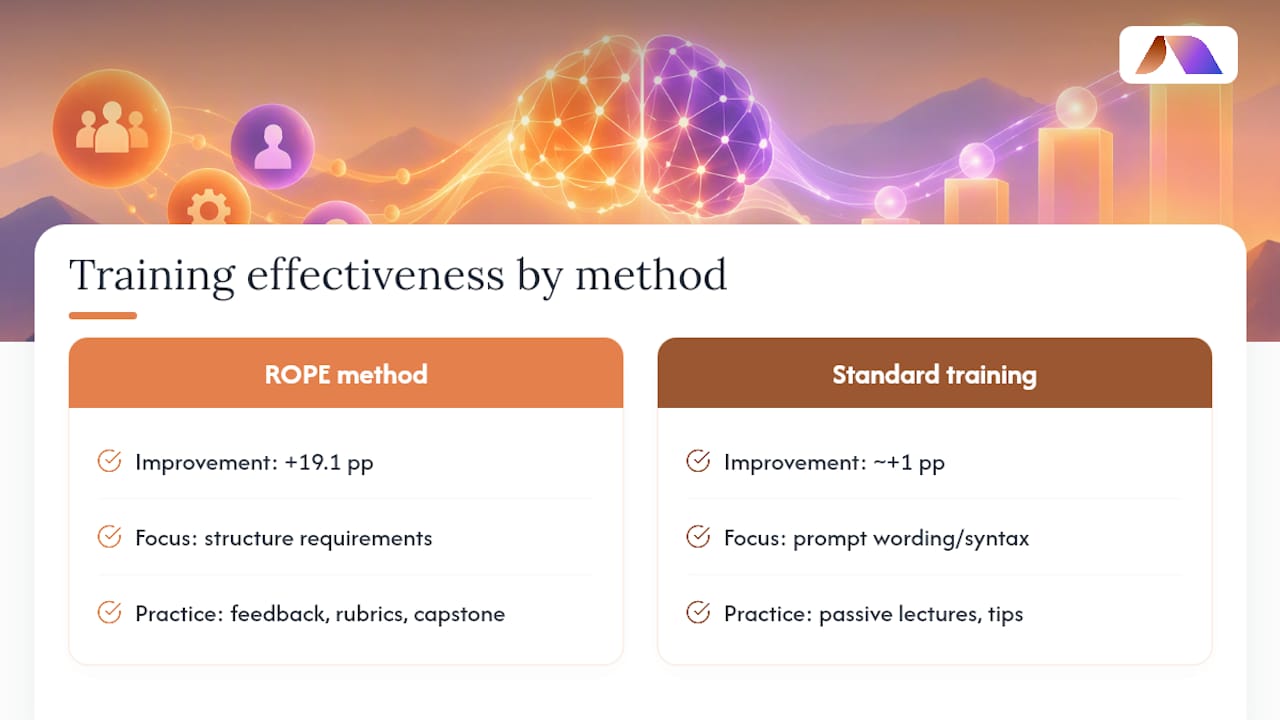
Most prompt engineering content teaches syntax: how to format an instruction, which words trigger better output, how to humanize AI text for clearer and more effective communication. That is not what moves the needle. A randomized study on requirement-oriented prompt engineering, known as ROPE, found that training people to extract and structure task requirements before writing a prompt produced dramatically larger gains than conventional prompt-writing instruction.
Participants trained with the ROPE method improved their overall prompt quality scores by roughly 19.1 percentage points from pre-test to post-test. Participants who received standard prompt training improved by about 1 percent over the same period, according to the ROPE research.
That gap is the whole argument for choosing a course carefully. A program that teaches you to restate a task’s requirements systematically, rather than just tweak wording, produces measurably better output. This tracks with the broader idea of Generative AI Literacy, which identifies prompt optimization as one of five core workplace competencies tied to job performance, not a side skill for hobbyists.
Course features that operationalize this kind of deliberate practice include instructor or automated feedback on iterative graded tasks, rubric-based self-scoring frameworks that let you rate your own prompts on clarity and requirement coverage, and coached capstone projects where a real workflow gets evaluated by a human. Research on interactive coaching methods shows that forcing learners to articulate and refine requirements with immediate feedback speeds up skill acquisition compared to passive lecture-style learning. A systematic taxonomy of prompting techniques gives instructors a shared vocabulary for structuring that practice into a real curriculum instead of an ad hoc list of tricks.
What Does a Realistic Learning Timeline Look Like?
Skill builds in stages, and skipping ahead rarely works. Here’s a role-aware timeline that matches how deliberate practice research says skills actually form:
Weeks 0 to 2: Learn core prompt patterns and templates. Get familiar with the taxonomy of techniques (few-shot, chain-of-thought, role framing) without worrying about mastery yet.
Weeks 2 to 8: Deliberate practice against scored tasks. Write prompts for realistic scenarios, get feedback, revise, repeat. This is where the ROPE-style gains show up.
Months 2 to 3: Role-specific workflow projects. Build a portfolio piece tied to your actual job, whether that’s a customer service script, a data analysis prompt chain, or a content workflow.
Month 6 and beyond: Governance and lifecycle management. Learn how prompts get versioned, reviewed, and rolled out across a team, not just written by one person.
A motivated beginner can reach solid working competence inside two to three months of consistent practice. Reaching a point where you can train others, or manage prompt governance for a team, usually takes closer to six months of applied use.
Do Prompt Engineering Certifications Actually Matter for Your Career?
A completion certificate proves you finished a course. It does not prove you can write a prompt that survives contact with a messy, real business problem. Employers increasingly know the difference, which means the credential itself carries limited weight compared to demonstrated evidence of skill.
The stronger signal is a portfolio: scored assessments you can show, a capstone project tied to a real workflow, or a case study describing a problem you solved with a specific prompting approach. Roles that value this skill span a wide range, from AI-focused content roles to workflow automation specialists to internal tooling analysts. Salary expectations vary enormously by industry, seniority, and whether “prompt engineering” is a standalone job title or one skill folded into a broader technical or operations role, so treat any single salary figure you see online with caution. What is a certificate program’s actual test says less about you than what you built while earning it.
What Skills Does a Good Prompt Engineering Course Actually Teach?
A serious curriculum covers four distinct skill areas, and courses that skip any one of them leave gaps. Prompt design patterns come first: few-shot examples, chain-of-thought structuring, role and persona framing, and constraint-setting. These are the building blocks documented across the taxonomy of prompting techniques that most serious programs draw from.
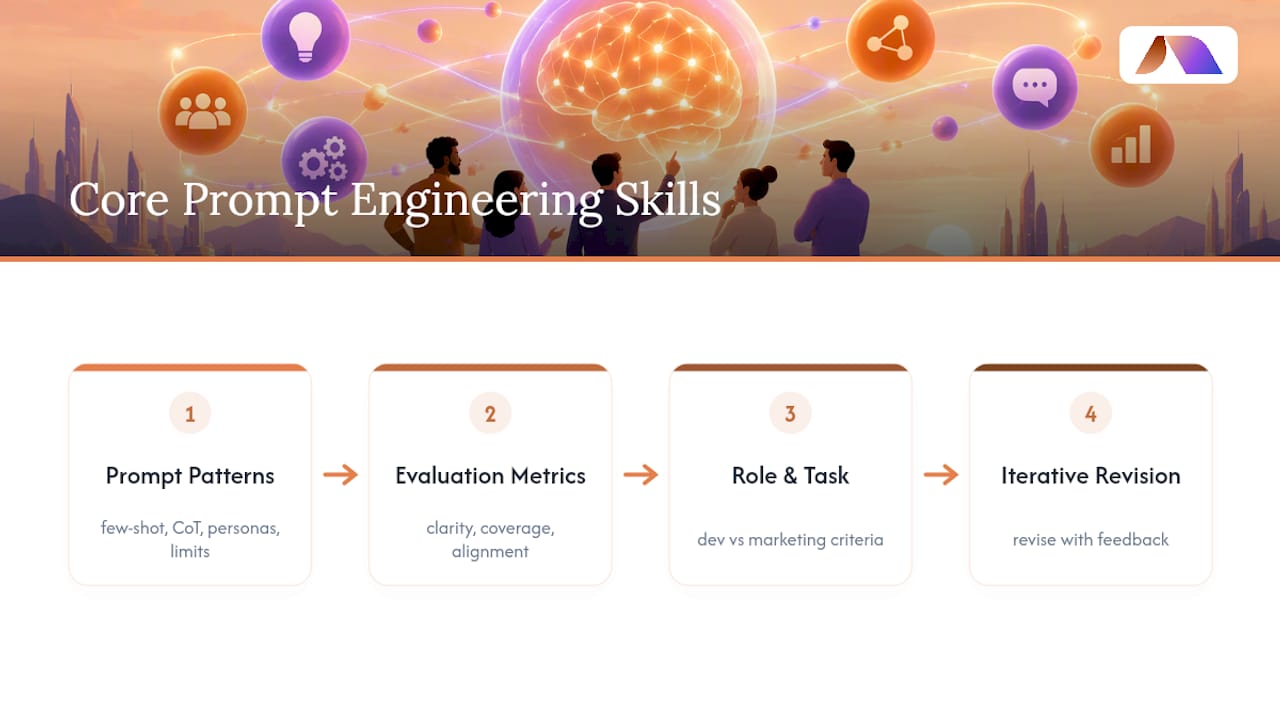
Evaluation metrics matter just as much, and get skipped more often. Learners need a way to score their own output on clarity, requirement coverage, and alignment with the intended task. Structured prompt evaluation frameworks reduce the tendency to blame inconsistent results on “the model being unpredictable” when the real issue is an underspecified prompt.
Role and task framing is the third pillar: a developer writing prompts to generate code needs different evaluation criteria than a marketing manager writing prompts for campaign copy. Training that ignores this distinction produces generic skills that transfer poorly to a specific job.
Last comes iteration, the discipline of treating a first prompt as a draft rather than a final answer. Learners who practice revising prompts against feedback, rather than accepting the first output, show the strongest gains in controlled training studies. This is the mechanical core of what separates a one-off ChatGPT session from actual prompt engineering training for teams that need repeatable results.
How Much Does Prompt Engineering Training Cost?
Prices scale roughly with structure and instructor access, and the range across the market is wide. Free and low-cost self-paced content exists in abundance, mostly video courses and reading lists that teach vocabulary but skip scored practice. Mid-tier online courses with some structure and light instructor interaction typically run in the low hundreds of dollars.
Cohort-based bootcamps and university-affiliated certificate programs sit at the higher end, often running into four figures, reflecting live instruction, career coaching, and portfolio-building support bundled into the price. Micro-workshops, like brief clinic-style sessions run over a few hours across multiple days, sit at the lower end of the cost spectrum while still producing measurable literacy gains for people who need a fast baseline rather than deep mastery.
Payment options generally include upfront payment, installment plans for higher-priced bootcamps, and occasional employer sponsorship for programs positioned as workforce development. If your organization is evaluating training as a line item rather than an individual purchase, it’s worth asking whether a program offers team pricing or a scoped engagement instead of per-seat licensing, since per-seat costs for structured programs add up fast across a department. Some training work is typically scoped as part of a broader engagement rather than sold as a fixed-price course, which matters if your goal is embedding the skill into a team’s actual workflow rather than issuing individual certificates.
How Do Prompt Engineering Training Providers Compare?
Providers cluster into three broad categories, and each serves a different need. General online learning platforms offer broad catalogs of self-paced prompt engineering content. These are useful for building baseline vocabulary cheaply but rarely include scored feedback or role-specific labs, which the ROPE research suggests matters more than pattern memorization.
University-affiliated bootcamps, like the programs run through UMass Boston and CSUMB, sit in the middle. They combine cohort structure, live instruction, and career services with an institutional name that carries weight on a resume. Expect six to eight week timelines and higher price points than pure self-paced options, with portfolio projects as a standard deliverable.
The third category is applied, workplace-embedded training, where the goal isn’t a certificate at all but measurable change in how a team actually works. This is where consulting-style engagements differ from course platforms: instead of a fixed curriculum, training gets built around your organization’s actual tools, workflows, and role definitions. Some providers operate in this category, pairing training with fractional AI engineering support so prompt skills get applied directly to operational tasks rather than practiced on generic sample problems. For teams that already know they need training tied to specific workflows rather than a general certificate, this model tends to close the gap faster than a standalone course.
Do You Need Coding Skills to Learn Prompt Engineering?
No, and this is one of the more persistent misconceptions about the field. Prompt engineering is a language and reasoning skill, not a programming discipline. You need comfort with clear written communication, basic familiarity with how large language models generate output (that they predict likely continuations rather than “understand” in a human sense), and enough patience to iterate on a task through multiple drafts.
Some advanced applications, like chaining prompts through an API or building automated evaluation scripts, benefit from basic scripting knowledge. But foundational and even intermediate prompt engineering training rarely requires it. What actually predicts success is domain knowledge: someone who deeply understands a workflow, whether that’s legal contract review, manufacturing scheduling, or customer support, will write better prompts for that domain than someone with strong coding skills but no context for the task.
If you’re evaluating your own readiness, the more useful question isn’t “do I know how to code” but “can I clearly describe what a good outcome looks like for this specific task.” That skill, sometimes called requirement articulation, is exactly what ROPE-style training is designed to sharpen, and it’s a skill nearly anyone can build with the right practice structure regardless of technical background.
How BRDGIT Trains Teams to Turn Prompts Into Real Assets
We built our training approach around a simple observation: most enterprise prompt training fails because it teaches generic patterns disconnected from actual workflows. Some approaches combine readiness assessments, role-specific labs, and fractional engineers who stay embedded after training ends. The most common pitfall we see is treating a workshop as a finish line instead of the start of a governance process. Prompts that aren’t maintained decay fast as tools and tasks shift.
— Team BRDGIT
Ready to Turn Prompt Skills Into Operational Results?
Most prompt engineering courses stop at the certificate. BRDGIT is built for the step after that: turning trained skills into working systems your team actually uses. An engagement typically starts with an AI Readiness Assessment to identify where prompt-driven workflows will save the most time, followed by role-specific training and, where teams need ongoing support, fractional engineers who help maintain and refine prompts as your tools and tasks change. This is where BRDGIT differs from a standalone course: training is scoped around your actual operations, not a generic curriculum built for any employer. If your team has already tried a course and hit a wall turning it into real workflow change, start with an AI Readiness Assessment and see what a scoped engagement actually looks like for your operation.
Sources
What Should We Engineer in Prompts? Training Humans in Requirement-Driven LLM Use
Generative Artificial Intelligence Literacy: Scale development and its effect on job performance
FAQ
How do I become a certified prompt engineer?
There is no single universal certification body for prompt engineering, so “certified” usually means completing a structured course, often through a university-affiliated bootcamp like UMass Boston’s program, that issues a completion credential. What matters more to employers is a portfolio of scored assessments and real workflow projects, which is why choosing a course with graded practice matters more than the certificate title itself.
How long does it take to learn prompt engineering?
Basic competence with core patterns takes about two to eight weeks of consistent, deliberate practice with feedback. Reaching job-ready fluency for role-specific tasks typically takes two to three months, and managing prompt governance for a team takes closer to six months of applied use.
What’s the salary of a prompt engineer?
Salary varies widely depending on industry, seniority, and whether prompt engineering is a standalone role or one skill within a broader technical or operations position, so any single figure quoted online should be treated cautiously. Building a demonstrable portfolio tends to matter more for compensation negotiations than a course certificate alone.
Can ChatGPT teach me prompt engineering?
ChatGPT can help you experiment with prompt patterns and get instant feedback on individual attempts, but it does not provide the structured, scored, deliberate practice that research shows produces the largest skill gains, like the roughly 19 percentage point improvement seen with ROPE-style training. Use it as a practice partner alongside a structured course, not a replacement for one.



