


Published on
Read First, Write Back: Human AI for Manufacturing Scheduling Planners
AI scheduling can deliver smarter, faster, and more resilient production schedules by proposing ranked, explainable moves while leaving final approval to planners. Research points to real gains in schedule quality and planner time, but the technology only performs when paired with clean data, an architecture that separates fast dispatch from slower reasoning, and governance that keeps a human signing off on every change.
TL;DR:
AI scheduling performs best when paired with clean, normalized data and a separate fast dispatch system from slower reasoning modules.
Benchmarks show an average relative percentage deviation of 6.09% in scheduling quality, with a focus on measurable KPIs like makespan and throughput.
A staged, sandboxed pilot with role-based approval, clear KPIs, and shadow mode testing offers the most reliable path to success.
Explainability through ranked recommendations and an evidence trail is vital for trust and governance in human-AI scheduling teams.
Integration with real-time sensor data and complex shop-floor systems should be considered a second phase after core architecture proves its value.
BRDGITTurn AI Scheduling Ideas Into ActionBRDGIT helps manufacturing teams assess readiness, identify practical opportunities, build roadmaps, and implement AI with ongoing support.Explore BRDGIT.ai
Table of Contents
What AI production scheduling actually is
Research and architectures behind human-in-the-loop scheduling
Benefits and metrics worth tracking in a pilot
Step-by-step implementation checklist for a pilot
Trust, security, and governance controls that matter
Limitations and failure modes to plan for
Case studies and industry examples worth studying
Comparing AI scheduling tools and platforms
Data quality challenges specific to scheduling AI
Future trends shaping AI in manufacturing scheduling
Integration beyond ERP and MES: SCADA and IoT
Our take on practical AI scheduling projects
How we can help you run a pilot
FAQ
Sources
What AI production scheduling actually is
Traditional scheduling runs on fixed rules or a planner’s spreadsheet logic: if a machine frees up, assign the next job by priority code. AI production scheduling adds a layer that evaluates many possible sequences against live conditions and ranks them by predicted outcome, rather than following one static rule set.
A few technique families dominate current practice. Heuristic methods combined with machine learning refine dispatch rules using historical outcomes. Hyper-heuristics select among several heuristics depending on shop conditions. Deep reinforcement learning (DRL) trains an agent to choose actions that minimize delay or idle time over a simulated horizon. More recently, large language models (LLMs) are being used to synthesize or adjust scheduling policies in plain language, with the underlying execution still handled by deterministic code.
A detail that matters more than the algorithm choice: most workable deployments treat the AI layer as read-first, with write-back to the enterprise resource planning (ERP) or manufacturing execution system (MES) happening only after planner approval. The ERP or MES stays the system of record, which avoids a disruptive replacement project and keeps accountability where it already lives.
Research and architectures behind human-in-the-loop scheduling
Three threads of recent research address the problems that have historically killed AI scheduling pilots: myopic decisions, latency, and results nobody can reproduce.
ReflecSched, a 2025 architecture for dynamic flexible job-shop scheduling, uses hierarchical reflection: an LLM-powered module reasons over the schedule at a strategic level and then refines decisions through layered feedback instead of committing to a single pass.
Statistic: ReflecSched’s best-performing variants achieved an average RPD of 6.09% on the GEN-Bench benchmark suite, outperforming prior baselines on rank and win-rate metrics. A lower relative percentage deviation (RPD) means the generated schedule sits closer to the best known solution for that problem instance.
A second direction, described in research on asynchronous agentic scheduling, uses a dual-stream design: a reactive low-latency heuristic handles sub-millisecond dispatch decisions while a slower deliberative stream reasons over longer horizons and validates rule changes in a sandbox before they reach the live system.
Staged pipelines, a pattern documented in procurement-focused research, reserve deterministic code for arithmetic and normalization and call a model only for judgement calls, which cuts both fabrication risk and compute cost.
The throughline across all three: keep the parts that must be exact and fast running on conventional code, and reserve the model for the parts that genuinely require reasoning.
Benefits and metrics worth tracking in a pilot
The honest answer to “does this work” depends entirely on what you measure and over what window. A pilot without defined KPIs produces opinions, not evidence.
Makespan, the total time to complete a defined batch of jobs, shows whether sequencing decisions are actually tightening the schedule.
Throughput and on-time delivery rate reveal whether gains in makespan translate into output that matters to customers.
Relative percentage deviation (RPD) benchmarks your schedule against a known-good or optimal solution for the same problem instance.
Scheduler time-to-plan, how long a planner spends building or adjusting a schedule, often shows the fastest and most visible improvement.
Statistic: ReflecSched’s benchmark results showing a 6.09% average RPD give a useful reference point: a pilot that moves meaningfully toward that range, on your own benchmark suite, suggests the architecture is adding real value rather than noise.
Run comparisons in shadow mode first, letting the AI propose schedules alongside the existing process without acting on them, then compare outcomes over a fixed window before any A/B test with live write-back.
Step-by-step implementation checklist for a pilot
Treat the first pilot as a controlled experiment, not a rollout.
Run a readiness assessment and pick a bounded scope. Choose one product family or one line rather than the whole plant, and confirm the data needed to model it actually exists.
Prepare and normalize data. Pull ERP, MES, bill of materials, and routing data into a consistent format, and keep the ERP as the system of record with a read-first approach.
Design a staged pipeline with sandbox validation. Separate deterministic calculation steps from model-driven judgement steps, define acceptance criteria up front, and build an audit trail that records why each recommendation was made.
Run shadow and parallel tests, then move to supervised write-back. Measure KPIs over a defined window, adjust rules based on what you observe, and only then allow write-back under role-based approval.
Pro Tip: Start the sandbox with your worst week of the last year, not your average week: if the system handles your known disruptions well, routine weeks take care of themselves.
Trust, security, and governance controls that matter
Planners do not reject AI scheduling because the math is wrong. They reject it because they cannot see why a recommendation was made or who can override it.
Explainability comes from ranked recommendations paired with a short evidence trail, not a single “best” answer with no reasoning attached.
Security and IP protection often require local model execution or a private network conduit, especially where routing and BOM data reveal competitive information.
Governance means role-based approval gates, a defined exception workflow for edge cases, and atomic rule deployments that can be rolled back without touching unrelated parts of the schedule.
NIST’s AI for Manufacturing initiative frames this directly: AI-assisted scheduling works best as a human-AI teaming technology, where the system surfaces ranked options and explanations while a person retains decision authority.
Pro Tip: Require every AI-generated schedule change to carry a one-line, plain-language reason: if your model cannot produce one, it is not ready for write-back.
Limitations and failure modes to plan for
Millisecond-level dispatch decisions, like reassigning a machine the instant it faults, cannot wait on a model call. That work has to stay with reactive heuristics running inline, with slower deliberative reasoning updating the rules those heuristics follow rather than making every decision itself.
Single-prompt, unstructured agent designs carry their own risks: fabricated outputs, answers that are not reproducible from one run to the next, and brittleness when an ERP schema or field name changes without warning. Research on dual-stream scheduling addresses this by decoupling the reactive and deliberative paths so a slow or faulty reasoning step never blocks the production floor.
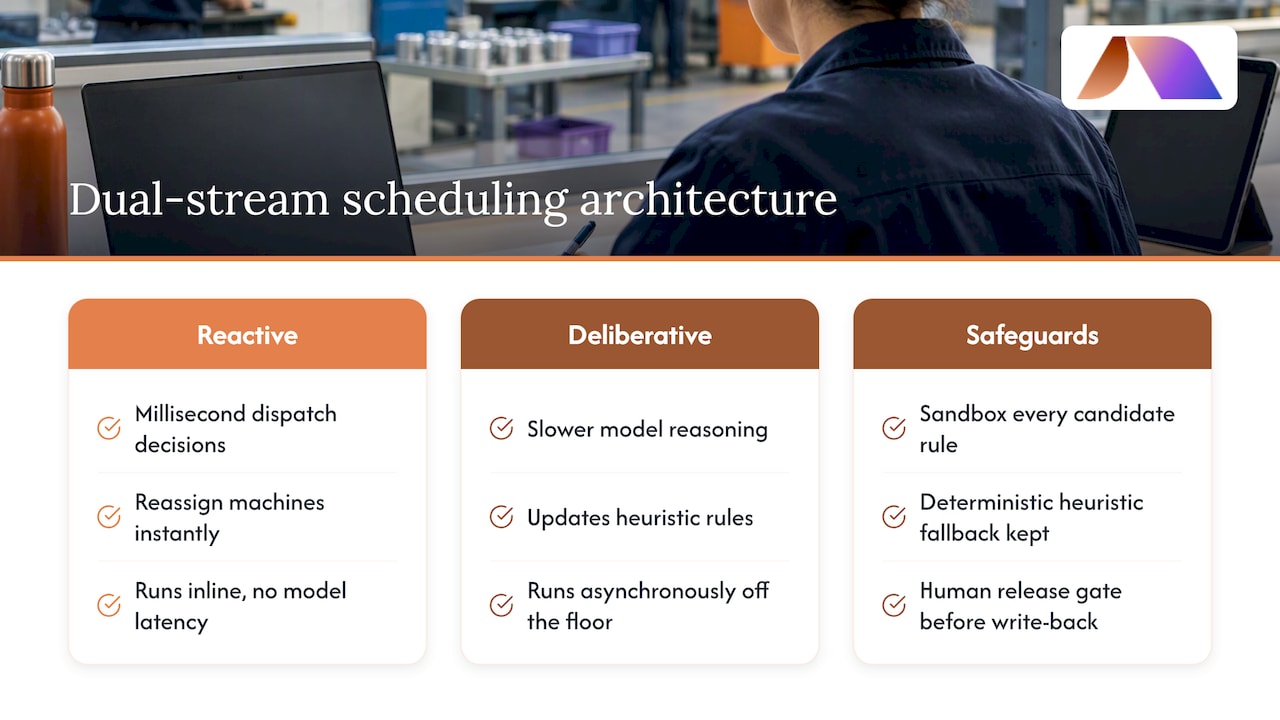
The practical mitigations are consistent across the research: sandbox every candidate rule before it goes live, keep a deterministic heuristic as a fallback when the model layer is unavailable or uncertain, and never remove the human release gate on write-back, regardless of how well the pilot has performed.
Case studies and industry examples worth studying
Public, named case studies with disclosed benchmark figures remain rare in manufacturing scheduling AI, which is itself a useful data point: most organizations treat scheduling logic as competitive information and do not publish specifics. What is published tends to come from academic benchmark work rather than named plant deployments.
The clearest documented example is ReflecSched’s evaluation on the GEN-Bench suite, a dynamic flexible job-shop scheduling benchmark designed to simulate the kind of disruptions real shops face: machine breakdowns, rush orders, and changing due dates. The architecture’s hierarchical reflection approach produced measurable RPD improvements against established baselines, which gives planners a reference point even without a named factory attached to the result.
The procurement-focused staged pipeline research offers a second kind of evidence: not a scheduling deployment specifically, but a demonstration that the staged architecture pattern, deterministic code plus model judgement, produces repeatable results in a manufacturing-adjacent operational task. That matters because reproducibility is the exact property planners need before they trust a scheduling recommendation enough to act on it.
For now, the realistic approach is to treat benchmark research as the evidence base for architecture choices, and to validate your own pilot’s results against your own historical schedules rather than searching for a published case study that matches your exact process. A well-run shadow-mode pilot against your own data is more informative than someone else’s press release.
Comparing AI scheduling tools and platforms
The market splits into a few broad categories rather than a single competitive set. Established MES and advanced planning and scheduling (APS) vendors have added optimization modules that layer heuristic or ML-based sequencing onto existing modules, which suits teams that want AI capability without a new system of record. Point solutions focused specifically on scheduling optimization offer deeper algorithmic capability (DRL, constraint programming, hyper-heuristics) but typically require integration work to connect to your existing ERP or MES. A newer category, LLM-assisted scheduling agents built on architectures like hierarchical reflection or dual-stream reasoning, is still mostly in research and early pilot stages rather than mature commercial product.
Rather than ranking named products, the more useful comparison for a planner is architectural: does the tool keep your ERP or MES as the system of record, or does it want to become the new source of truth? Does it separate low-latency dispatch logic from slower reasoning, or run everything through a single model call? Does it produce an explainable, ranked set of recommendations with an evidence trail, or a single opaque output?
Our own view, covered in more detail in the implementation checklist above, is that the architecture questions matter more than the vendor name. A tool that nails the algorithm but forces a rip-and-replace of your MES creates more operational risk than a modest optimization layer that respects your existing systems. Evaluate any platform, built in-house or purchased, against the staged pipeline and read-first, write-back pattern described earlier before committing budget.
Data quality challenges specific to scheduling AI
Scheduling AI is only as good as the data describing your shop floor, and manufacturing data has specific failure patterns that generic AI advice does not cover. Routing data often reflects how the process was designed years ago, not how it actually runs today, after informal workarounds and tribal-knowledge adjustments accumulated. BOM data can lag behind engineering changes, especially in make-to-order environments where variants multiply faster than documentation keeps up.
Timestamp quality is a frequent, underestimated problem. If MES events are logged inconsistently, with gaps when operators forget to scan or clock a job, the AI layer trains on a distorted picture of actual cycle times and bottlenecks. Machine downtime data is similarly uneven: planned maintenance is usually well recorded, but unplanned stoppages and micro-stops often are not, which skews any model trying to predict realistic availability.
The practical response is not to wait for perfect data, which never arrives, but to scope the pilot to the subset of the shop where data quality is already strongest, typically a line with reliable MES scanning and stable routings. NIST’s Digital Thread roadmap frames this as a prerequisite rather than a nice-to-have: connecting lifecycle data across systems is foundational to any real-time scheduling use case, not an optional enhancement layered on afterward. Treat the first pilot’s data cleanup work as part of the project scope, not a delay to it.
Future trends shaping AI in manufacturing scheduling
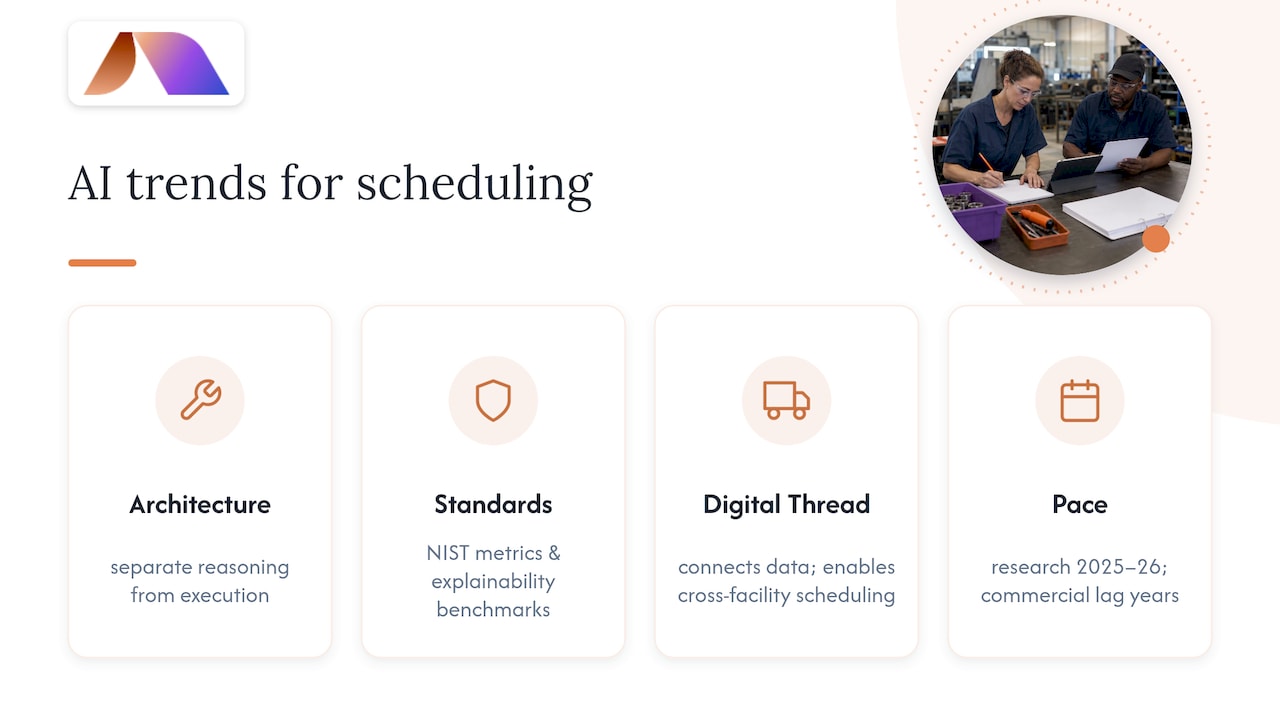
The clearest trend in current research is architectural rather than algorithmic: the field is moving away from single-model, single-prompt designs toward layered systems that separate reasoning from execution. Hierarchical reflection and asynchronous dual-stream approaches both reflect this shift, and we expect more research to follow the same pattern of decoupling slow reasoning from fast, reliable execution.
A second trend is the growing role of standards and measurement frameworks. NIST’s AI for Manufacturing program is actively developing human-AI teaming metrics and explainability benchmarks, which signals that buyers will increasingly expect vendors to demonstrate measurable, auditable performance rather than relying on marketing claims about intelligence or automation.
Digital Thread initiatives, connecting product and process data across its full lifecycle, are likely to make multi-plant and multi-tier supply chain scheduling more tractable, since AI scheduling tools need consistent, connected data to reason across more than a single line or facility. As that connective data infrastructure matures, scheduling AI should extend from single-line pilots toward cross-facility coordination, though that capability depends entirely on the underlying data integration work happening first.
We would caution against reading too much speed into this timeline. The research behind hierarchical reflection and dual-stream architectures is recent, much of it published in 2025 and 2026, and commercial maturity typically lags academic benchmarks by a few years. Planners evaluating tools today should expect steady, incremental capability gains rather than a sudden leap to fully autonomous scheduling.
Integration beyond ERP and MES: SCADA and IoT
Most discussions of AI scheduling integration stop at the ERP and MES layer, but supervisory control and data acquisition (SCADA) systems and shop-floor IoT sensors introduce a separate set of problems. SCADA systems typically run on older protocols and were built for monitoring and control, not for feeding structured data into an optimization model, which often means a translation or middleware layer is required before scheduling AI can use machine-level signals at all.
IoT sensor data, when available, adds granularity that ERP and MES data alone cannot provide: real-time machine status, vibration or temperature trends that predict an impending stoppage, and actual cycle times rather than planned ones. That granularity is valuable to a scheduling model, but it also multiplies the data quality and normalization work described earlier, since sensor data arrives at a different frequency and format than transactional ERP records.
The practical implication for a pilot is to treat SCADA and IoT integration as a second-phase expansion, not a first-pilot requirement. A scheduling pilot that proves its value using ERP and MES data alone, read-first and with planner approval on every write-back, builds the trust and track record needed before adding the complexity of real-time sensor feeds. Rushing to incorporate every available data source before the core architecture is validated tends to slow a pilot down without improving its early results.
Our take on practical AI scheduling projects
We treat AI scheduling the way the research treats it: a decision-support layer, not an autonomous replacement for the planner. Every engagement we run starts with a readiness assessment, not a tool purchase, because the data and governance gaps usually matter more than the choice of algorithm.
We build staged pipelines with sandbox validation and measurable KPIs before anyone touches write-back permissions. Human release gates stay in place throughout, because the research is consistent on this point: the planner, not the model, carries final authority.
— Team BRDGIT
How we can help you run a pilot
If you are weighing an AI scheduling pilot, we offer a practical starting point rather than a platform to buy and configure alone. We offer AI readiness assessments, blueprint services that turn assessments into roadmaps, and staff implementation work including sandbox validation through supervised rollout.

For teams that want deeper technical grounding on agentic workflow design and sandbox validation before engaging anyone, this practical guide to agentic workflows and this operations playbook for AI agents cover governance and AgentOps patterns that complement the approach described above.
The next concrete step is a conversation about scope: which line, what data you already have, and what a bounded pilot would need to prove value. Visit BRDGIT to start a readiness assessment, or review our fractional engineering options if you already know you need hands-on implementation support.
FAQ
Is there an AI for scheduling?
Yes, several research architectures and commercial tools now apply AI to production scheduling, ranging from machine-learning-enhanced heuristics to LLM-powered systems like ReflecSched that use hierarchical reflection to refine schedules. Most practical deployments pair the AI layer with human approval before any change reaches the live schedule.
What is the best scheduling software for manufacturing?
There is no single best tool. The right choice depends on whether a solution keeps your ERP or MES as the system of record, separates fast dispatch logic from slower reasoning, and produces explainable, ranked recommendations rather than a single opaque output.
What are the five main stages of production scheduling?
Definitions vary across industries, but a common version covers: demand and order intake, capacity and resource planning, detailed sequencing, dispatch and execution, and monitoring with rescheduling as disruptions occur. AI scheduling tools typically focus their contribution to the sequencing and rescheduling stages.
How is AI used in manufacturing operations?
Beyond scheduling, AI supports predictive maintenance, quality inspection, and demand forecasting, often drawing on the same ERP, MES, and sensor data used for scheduling. NIST’s AI for Manufacturing initiative frames these as human-AI teaming applications, where the system proposes options and a person retains final decision authority.
What makes an AI scheduling pilot likely to succeed?
Pilots succeed when scoped to a single line or product family, built on clean, normalized ERP and MES data, and tested in shadow mode before any write-back permissions are granted. Clear KPIs like makespan, throughput, and relative percentage deviation let you judge the pilot on evidence rather than impression.



