


Published on
Lock Down LLM Security in 24–72 Hours for Security Teams: Gateway, Sandbox, KMS
Adopt a defense-in-depth posture built around a centralized LLM Security Gateway, treat every model output as untrusted until validated, and enforce least privilege across model weights, tools, and agent capabilities. In the short term, deny unnecessary egress from inference subnets, rotate any exposed keys, and enable structured audit logging promptly. These three moves align with OWASP’s LLMSVS guidance and give your team a defensible baseline fast.
TL;DR:
Hardening the integration layer by validating inputs, enforcing least privilege, and logging all model outputs minimizes the most common security risks.
Using a centralized security gateway, isolating models with transparent provenance, and denying unnecessary egress effectively contain threats at deployment.
Limiting agent autonomy with explicit human approval, sandboxing tool execution, and enforcing strict schemas significantly reduces agentic misuse risks.
Implementing step-by-step immediate measures such as egress denial, key rotation, and logging can quickly improve security posture within days.
Following OWASP and SSDF guidelines ensures controls are proportionate, verifiable, and prioritized based on the organization’s model supply chain and deployment context.
BRDGITTurn LLM Security Into ActionBRDGIT helps teams assess AI readiness, build practical roadmaps, and implement secure AI systems with experienced support.Visit BRDGIT
Table of Contents
The top LLM security risks your team needs to understand
Core best practices by control domain
Securing agents and tool integrations
Hardening your deployment for production
Detecting LLM incidents and responding fast
Governance and supply chain controls that hold up to audit
Your 24-72 hour and week-1 hardening checklist
How BRDGIT maps these controls to a real engagement
Why integration-layer defenses are the highest-leverage investment
Put these practices into production with BRDGIT
FAQ
Sources
The top LLM security risks your team needs to understand
Most production incidents trace back to a small set of failure modes, and the application and integration layer, not the model itself, is where attackers do the most damage. Akamai’s analysis of integration-layer risk found defenders are losing ground precisely where outputs cross into downstream systems and agent tooling, which is why hardening the plumbing around a model matters as much as hardening the model.
The risks worth tracking in any threat model include:
Prompt injection: malicious instructions hidden in user input or retrieved content hijack the model’s behavior.
Insecure output handling: downstream systems trust model output as safe code, markup, or commands without validation.
Training data poisoning: corrupted or adversarial data shifts model behavior during fine-tuning or retrieval.
Model denial of service: resource-exhausting prompts or queries degrade availability for legitimate users.
Supply chain vulnerabilities: compromised base models, plugins, or open-source dependencies introduce hidden risk.
Sensitive information disclosure: models leak training data, system prompts, or other users’ context through responses.
Insecure plugins and agents: tool integrations grant excessive permissions or execute untrusted instructions.
Public vulnerability records back this up. NVD’s record for CVE-2025-58764 documents an agentic tool flaw where untrusted input could trigger execution before a trust dialog ever appeared, a textbook case of integration-layer failure rather than a model weakness.
Core best practices by control domain
Group your mitigations by where they sit in the stack, then prioritize the ones that close the widest gaps first.
Infrastructure: segment inference workloads into private VPCs, enforce mTLS between services, use customer-managed keys (CMKs), and automate patching for every host touching the model.
Data: track provenance for training and fine-tuning data, scrub PII before it reaches a prompt, minimize context windows to only what’s needed, and isolate per-tenant indexes in retrieval-augmented generation (RAG) systems.
Application and integration: write strict system prompts that constrain scope, validate every input and output against a schema, run output through data loss prevention (DLP) filters, and never grant a model direct credential to a downstream system.
Operations: scan for secrets in CI/CD pipelines, maintain software bill of materials (SBOM)-style artifacts for models and dependencies, and automate dependency and patch workflows rather than relying on periodic manual review.
OWASP’s LLM guidance recommends exactly this kind of layered control set, pairing schema validation and output DLP with restricted agent permissions rather than relying on any single safeguard.
Pro Tip: Treat your system prompt as a security boundary, not a style guide, and version it the same way you version code.
Securing agents and tool integrations
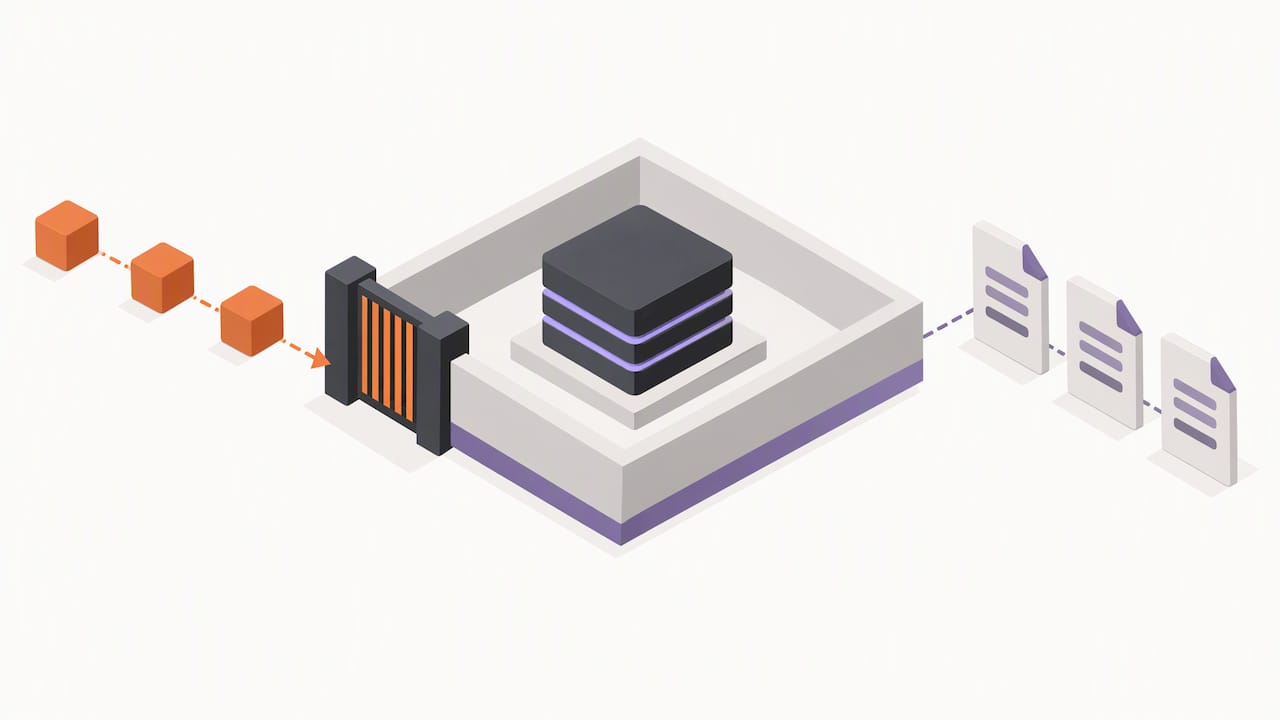
Agents fail differently than static LLM calls because they can chain actions, invoke tools, and act with a level of autonomy that turns a bad output into a real-world consequence. The safest posture limits what an agent can do before it ever gets the chance to misuse it.
Apply a “rule of two”: an agent that processes untrusted input should not also hold the ability to take an unreviewed high-impact action, a pattern CISA’s agentic AI guidance frames as defense-in-depth across the AI lifecycle.
Minimize the functionality exposed to any single tool and enforce strict input and output schemas on every call.
Require explicit human confirmation before an agent executes a high-impact action, and run tools in the calling user’s own context rather than an elevated service account.
Sandbox tool execution, rate-limit calls, and wire in circuit breakers that halt an agent loop showing abnormal behavior.
Capability budgeting, giving each agent a fixed, auditable set of permissions rather than broad standing access, turns a theoretical control into something you can actually measure during a review.
Hardening your deployment for production
A centralized LLM Security Gateway gives you one place to enforce input guards, output filters, and policy decisions instead of scattering controls across every service that calls a model. Industry deployment patterns consistently point to this gateway pattern as the single enforcement point that also keeps raw diagnostics and stack traces from leaking implementation details to end users.
Beyond the gateway, a few configuration choices do most of the remaining work:
Sandbox inference workloads and set egress to deny-by-default, routing any necessary update traffic through dedicated management subnets.
Use customer-managed keys with automated rotation and least-privilege key policies, so a compromised key has a short useful life and limited blast radius.
Issue short-lived credentials through service identities, enforce mTLS between every hop, and microsegment the network so a compromised component cannot reach unrelated systems.
Treat any model without transparent provenance as a black box and isolate it more aggressively, limiting context and disabling retention by default, a precaution CISA’s guidance recommends for agentic services lacking clear lineage.
Teams running models outside a managed cloud can find additional hardening patterns in this offline AI security guide, which covers sandboxing choices specific to air-gapped deployments, and in this overview of sovereign deployment options for teams weighing private hosting against cloud inference.
Detecting LLM incidents and responding fast
Audit logs for LLM systems need a different shape than typical application logs. Store structured hashes and metadata about each request rather than raw prompts, since a log file full of unredacted prompts becomes its own exfiltration risk the moment it reaches a shared observability platform.
Feed structured, metadata-only logs into your existing SIEM so LLM activity sits alongside the rest of your security telemetry.
Watch for output anomalies, unusual embedding-space queries that resemble probing, and usage spikes that cross a defined rate threshold.
Preserve forensic artifacts the moment you suspect an incident: request metadata, tool invocation records, and model version identifiers, before any rotation or redeploy overwrites them.
Contain quickly: revoke affected keys, isolate the inference node, freeze agent tool permissions, and validate backup integrity before restoring service.
One documented example worth internalizing: CVE-2025-58764 shows an agentic tool executing untrusted input before a trust prompt ever appeared, the kind of gap that structured logging and tool sandboxing catch before it becomes a breach.
Governance and supply chain controls that hold up to audit
Security leaders need a way to apply controls proportionally rather than treating every model the same way. NIST’s SSDF Community Profile for generative AI recommends exactly that: a risk-based approach tailored to whether your organization is a model producer, a system producer, or an acquirer, with practices adapted to fit each role.
Require provenance, versioning, and SBOM-style artifacts for any model you deploy, and treat opaque or undocumented models as higher risk by default.
Evaluate open-source components continuously, automate dependency scanning, and maintain a coordinated vulnerability disclosure workflow rather than an ad hoc one, consistent with CISA’s open-source security guidance.
Map LLMSVS controls directly into acceptance testing and procurement criteria so a new vendor or model has to clear the same bar your internal systems do.
Vet supply chain exposure across your training and deployment pipeline the way you would any other vendor risk, a discipline covered in this cloud security guide for supply chain vendors.
Your 24-72 hour and week-1 hardening checklist
Work through this in order, and resist the urge to skip ahead to governance before the immediate exposure is closed.
Today: deny unnecessary egress from the inference subnet, enable structured logging, and rotate any keys that have ever touched a prompt or log file.
This week: deploy gateway policy rules for input and output filtering, add output DLP, enforce schema validation on every tool call, and add secret scanning to CI/CD.
Week one: run a provenance check on every deployed model, scan dependencies against known vulnerabilities, and require human approval before any agent takes a high-impact action.
Each step closes a gap the earlier sections describe, and together they move you from exposed to defensible without waiting on a full architecture overhaul.
How BRDGIT maps these controls to a real engagement
An AI Readiness Assessment is where gaps are typically found: ungated agent permissions, missing provenance records, no gateway enforcing policy consistently. From there, an AI Blueprint turns findings into a prioritized roadmap, and a Custom Agent Build applies capability budgeting and schema validation from day one rather than retrofitting them later. Ongoing support services keep the gateway, logging, and rotation policies maintained after launch, so hardening doesn’t quietly decay once the initial project ends.
Why integration-layer defenses are the highest-leverage investment
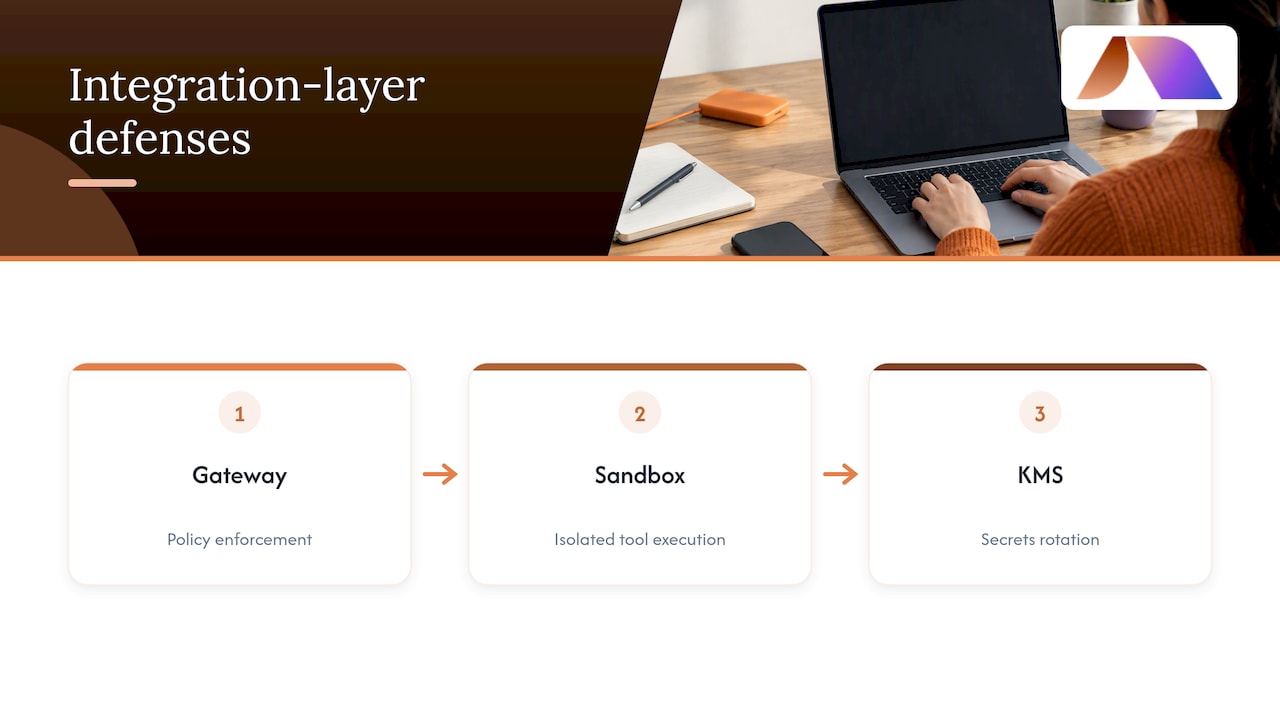
We keep coming back to the same conclusion: the gateway, the schema validator, and the audit log catch more real incidents than any amount of model-level tuning ever will. Model-only mitigations address a narrower slice of risk than the integration layer where prompts, tools, and outputs actually collide with production systems.
A risk-based SSDF approach, applied honestly rather than as a checkbox exercise, forces the right conversations about ownership and acceptance criteria. Pull the checklist above, run it this week, and treat a readiness assessment as the fastest path to clarity on what’s actually exposed.
— Team BRDGIT
Put these practices into production with BRDGIT
We built our services around the exact gaps this guide surfaces: unclear provenance, missing gateway enforcement, agents with more autonomy than oversight. An AI Readiness Assessment gives you a prioritized view of where you stand against the controls above, and a pilot through our Custom Agent Build or Workflow Crew offerings shows what hardened, production-ready looks like before a full rollout.

A readiness assessment maps your current exposure against OWASP and SSDF-style controls.
A pilot delivers a working, sandboxed implementation with gateway and logging already in place.
Ongoing support through our Fractional Engineer Services keeps rotation, monitoring, and governance maintained after launch.
If your team needs engineering capacity without a full-time hire, our fractional engineers can pick up implementation or ongoing support based on where you are today. Start with the AI Readiness Assessment and work from there.
FAQ
What is prompt injection and how do I defend against it?
Prompt injection happens when malicious instructions embedded in user input or retrieved content override a model’s intended behavior. Defenses include strict system prompts, input validation, and treating all retrieved content as untrusted before it reaches the model, as OWASP’s LLM guidance recommends.
Why does schema validation matter for LLM outputs?
Schema validation forces model output into a predictable, checkable structure before any downstream system acts on it, which closes the insecure output handling gap that attackers exploit most often. Without it, a system may execute code, commands, or markup generated by the model as if a trusted developer wrote it.
What does model provenance mean and why does it matter?
Model provenance is documented lineage covering training data sources, fine-tuning history, and version changes for a given model. NIST’s SSDF Community Profile recommends treating models without clear provenance as higher risk and applying stricter isolation and context limits to them.
When should an agent require human approval before acting?
An agent should require explicit human confirmation before any high-impact action, such as sending funds, deleting data, or modifying production systems, rather than acting autonomously on untrusted input. This pairs with capability budgeting and the “rule of two” principle CISA’s agentic AI guidance describes for limiting what any single agent can do unsupervised.
Does BRDGIT offer help implementing these security controls?
Yes, our AI Readiness Assessment and Custom Agent Build services map directly to the controls in this guide, and our Fractional Engineer Services can maintain gateway, logging, and rotation policies after launch. Pricing for these engagements is available on request through BRDGIT.



