


Published on
Cut LLM Costs 40–80%: Engineering First LLM Cost Optimization Playbook
Most teams can cut LLM spend by 40 to 80 percent without touching output quality, but only if they pull levers in the right order… Start by metering every call, then apply prompt and semantic caching, then batching, then routing to cheaper models. Distillation, quantization, and self-hosting come last, after you’ve validated every earlier swap against production traffic. Skip the measurement step and you’re optimizing blind.
TL;DR:
Measure token volume, cost per call, and traffic distribution across features, models, and time to identify where expenses are highest before implementing changes.
Prioritize prompt and system prompt compression, caching strategies, and routing techniques that significantly reduce token use with minimal risk.
Avoid costly self-hosting or complex model finetuning until you validate early gains from layering caching, batching, and prompt optimization.
Build a proper validation environment with real production data to ensure quality is maintained during each optimization step.
Engage fractional AI engineers to establish observability, validation, and stepwise implementation, reducing internal workload and accelerating cost savings.
BRDGITbrdgit.aiMake LLM Cost Optimization PracticalBRDGIT helps teams measure AI usage, identify opportunities, build roadmaps, and provide fractional AI support for stepwise implementation.Explore AI execution support
Table of Contents
Where LLM Costs Actually Come From
What to Measure Before You Touch Anything
The Optimization Levers, Ranked by Risk and Payoff
How to Roll This Out Without Breaking Production
Why Fractional Engineering Speeds This Up
Get Fractional AI Engineers Who’ve Solved This Before
The Part of This Nobody Budgets For
Sources
FAQ
Where LLM Costs Actually Come From
LLM bills rarely surprise people because of volume. They surprise people because of composition. Understanding what you’re actually paying for is the first move in any llm cost optimization effort, and it’s usually skipped in favor of jumping straight to “switch to a cheaper model.”
Providers bill separately for input and output tokens, and output tokens typically cost several times more than input tokens depending on the model. A verbose model that writes 800 tokens instead of 200 to answer the same question isn’t just slower. It’s quietly tripling your bill on that call alone. This is why prompt engineering that encourages concise responses often beats model swapping as a first move.
The bigger, less obvious cost driver is repetition. A system prompt of substantial length gets sent on every single call, even when the user’s actual question is very short. Add a retrieval-augmented generation pipeline that stuffs a large amount of retrieved context into each request, and your “simple chatbot” is now paying for significant token overhead before it processes a single word of the actual question.
Other cost sources hide in plain sight:
Embedding calls for every document chunk during ingestion and every query at retrieval time
Retry logic that silently doubles or triples token spend when a call times out or returns malformed output
Provider markups on top of raw compute, which vary by model tier and region
Self-hosted infrastructure costs (GPU rental, idle capacity, orchestration overhead) that don’t show up on an API invoice but show up on a cloud bill
A team running a high volume of requests per day with a long system prompt and substantial RAG context is paying for hundreds of millions of tokens of overhead monthly before counting a single user query. That’s the number that should trigger a review of context engineering practices, not just model selection.
What to Measure Before You Touch Anything
You cannot optimize what you haven’t measured, and this is the step teams most often skip because it feels like overhead instead of progress. Cost reduction that starts before instrumentation is guesswork wearing an engineering hat.
The minimum viable metrics set includes tokens in and tokens out per call, cost per call, cost broken down by feature or team, cache hit rate, the distribution of traffic across model tiers, and a quality score tied to each of those slices. Without the last one, you’ll optimize your way into a cheaper product nobody wants to use.
The architecture that makes this tractable is a centralized gateway or proxy sitting between your application and every model provider you use. Every call passes through it, gets tagged with metadata (which feature triggered it, which team owns it, which model served it), and gets logged before the response returns. Pluralsight’s guidance on LLM metering frames this correctly: you meter before you manage, because attribution is what turns a vague sense that “AI is expensive” into a specific finding that one internal tool accounts for 60 percent of your total spend while serving 8 percent of your users.
A useful first dashboard slices spend three ways: by feature, by model, and by time of day. That third slice matters more than people expect.
Feature-level cost reveals which product surfaces are worth optimizing versus which are rounding errors
Model-level cost shows whether you’re routing appropriately or defaulting everything to your most expensive option
Time-of-day patterns expose whether you’re paying premium rates during predictable peak windows that could shift to cheaper, cached, or batched processing
Pro Tip: Tag every call with a feature ID and a request-type label before you write a single optimization. Retrofitting attribution after you’ve already deployed five cost-cutting changes means you’ll never know which one actually worked.
The Optimization Levers, Ranked by Risk and Payoff
Once you can see where the money goes, the actual work of llm cost optimization comes down to six levers. Apply them roughly in this order, because each one reduces the risk and increases the payoff of the next.
Prompt and system prompt compression. Audit your system prompts for redundant instructions, verbose formatting rules, and examples that no longer match current model behavior. Most system prompts written a year ago carry dead weight. Trim them, then run your evaluation set to confirm quality holds. This is close to zero risk and often yields a 10 to 30 percent reduction in input tokens with a day of work.
Provider prompt and prefix caching. Most major providers now support caching for repeated prompt prefixes, meaning the fixed portion of your prompt (system instructions, tool definitions, static context) gets billed at a steep discount on subsequent calls within a caching window. Because this is the same prefix by definition, correctness risk is minimal. Pluralsight’s metering research notes prefix caching can cut costs on the cached portion by 50 to 90 percent, which is the single highest-leverage change most teams haven’t turned on yet.
Semantic response caching. This goes beyond exact-match caching to catch requests that are worded differently but mean the same thing, using vector similarity to find and reuse prior responses. Redis reports cache hit rates in production workloads ranging from roughly 40 to 73 percent for repetitive query patterns like customer support or internal documentation lookups. The risk here is staleness: cached answers can go out of date, so set a time-to-live that matches how often the underlying information changes.
Batching and batch APIs. For workloads that don’t need real-time responses, submitting requests in bulk to a provider’s batch endpoint typically runs at half the cost of synchronous calls. Nightly report generation, bulk classification, and content tagging jobs are natural fits. The trade-off is turnaround time, usually hours instead of seconds.
Model routing and cascade routing. Send simple, high-confidence queries to a smaller, cheaper model and escalate only the queries that need a flagship model’s reasoning. Premai’s research on routing strategies shows routing alone can produce 30 to 70 percent cost reductions depending on traffic mix, and cascade approaches documented in recent routing research can approach flagship-level accuracy on many task distributions at a fraction of the cost. Build a classifier or rule-based router, then run a shadow test where both the router’s chosen model and the flagship model answer the same query so you can measure quality drift before flipping traffic over.
Distillation, finetuning, quantization, and self-hosting. These carry real operational cost and belong last. Distilling a smaller model on your own labeled outputs, or finetuning a task-specific model for a narrow job like classification or extraction, pays off when call volume is high and the task is repetitive enough to justify the training investment. Quantized self-hosted models can beat API pricing at scale, but only once you’ve accounted for GPU costs, on-call burden, and the engineering time to maintain infrastructure that a provider used to manage for you.
Applied together, this sequence is why LeanLM’s research puts combined savings from routing, caching, distillation, compression, and quantization at roughly 50 to 90 percent for enterprise workloads, and why a documented production case study reported a 67 percent cost reduction using exactly this cache, batch, route, self-host sequencing. If you’re still deciding between hosted APIs and self-hosting for a new workload, it’s worth reading through the trade-offs in choosing the right model for the job before committing infrastructure budget either direction.
How to Roll This Out Without Breaking Production
Every lever above needs a validation step before it touches real users, and the rollout plan matters as much as the lever itself.
Build an evaluation set from actual production traffic, not synthetic test cases. Pull a representative sample of 100 to 500 real queries across your highest-volume features. Label the correct or acceptable outputs and use this as your regression test for every future change.
Design experiment templates for each lever type. For caching, test multiple similarity thresholds and measure both hit rate and the rate of incorrect cache matches. For routing, test multiple confidence thresholds on the classifier and measure how often it escalates correctly. For compression, test multiple prompt lengths against the same eval set.
Deploy with a dark launch first, running the new logic in parallel with production without affecting user-facing responses, so you can compare cost and quality side by side. Move to a canary release covering 5 percent of traffic once dark-launch metrics look clean, then progress to full rollout with an automatic fallback that reverts to the previous behavior if quality metrics drop below a set threshold.
Put governance in place before scaling. Set a monthly budget per feature or team, alert when spend crosses 80 percent of that budget, assign clear ownership for each cost center, and schedule a recurring review, monthly is reasonable, to catch drift as usage patterns and model pricing change.
Pro Tip: Build your fallback trigger around quality metrics, not just cost. A cheaper model that’s technically online but producing garbage will pass an uptime check and fail your users.
Governance tools matter here too. Teams that pair this rollout plan with structured budget tracking, whether through a dedicated AI budget template or a broader project cost control system, catch spend drift months before it shows up as a surprise on a quarterly invoice.
Why Fractional Engineering Speeds This Up
Most engineering teams know the levers described above. What they lack is bandwidth to build the evaluation harness, run the shadow tests, and own the rollout without pulling focus from product work already on the roadmap. That gap is where BRDGIT’s fractional engineering model earns its place.
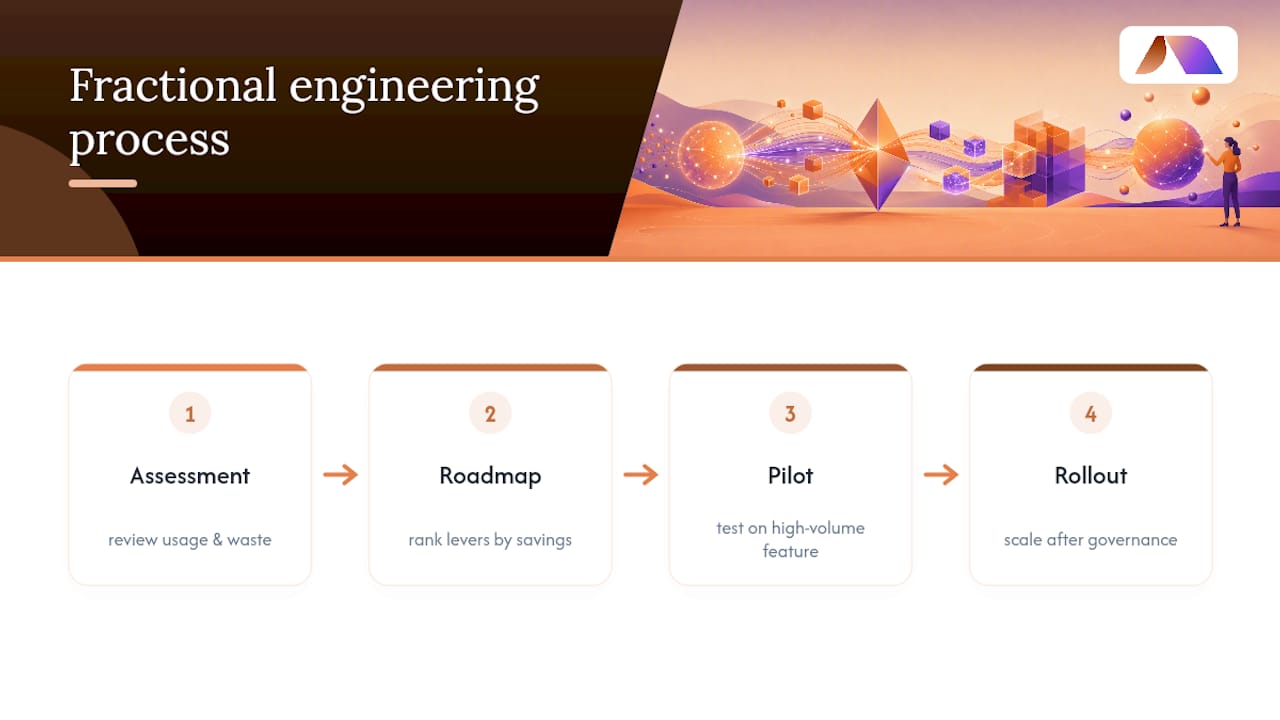
Engagements often start with an assessment: a review of current LLM usage, token attribution, and the biggest sources of waste in a specific pipeline. That feeds a prioritized roadmap ranking levers by expected savings and implementation risk, matching the sequencing logic above but tuned to your actual traffic and architecture. From there, a pilot implementation, often a single high-volume feature, proves out caching or routing changes against a real evaluation set before anything scales further.
This model fits best when a team has the technical judgment to know optimization is needed but not the internal capacity to build the validation harness and cross-team governance that safe rollout demands. A fractional engineer can carry that build without becoming a permanent headcount line.
Get Fractional AI Engineers Who’ve Solved This Before
Cutting LLM spend without breaking quality is a problem fractional AI engineers are built to solve, and it starts with a much narrower question than “which model should we use.” It starts with what your current pipeline is actually spending money on.

Clients typically seek three outcomes: lower monthly LLM spend, a governance structure so costs don’t creep back up, and a repeatable process the internal team can run without ongoing hand-holding. A typical engagement moves through an assessment of current usage and waste, a pilot on one high-impact feature to prove the approach, and either a clean handoff to your team or an ongoing fractional retainer if you need continued engineering depth. Because fractional AI engineering works on a project and retainer basis rather than requiring a full-time hire, teams get experienced AI engineering judgment sized to the actual scope of the problem, not an org chart addition. If your team is staring at an LLM bill that’s grown faster than anyone budgeted for, the BRDGIT fractional engineers page is the place to start that conversation and scope an assessment.
The Part of This Nobody Budgets For
Every team we talk to wants the caching win or the routing discount. Almost none of them budget for the evaluation harness that makes those wins safe to ship. That’s backwards. Gartner’s 2026 forecast puts worldwide AI spending in the trillions, and the teams still solvent in three years won’t be the ones who found the cheapest model. They’ll be the ones who built observability and validation infrastructure once and reused it for every optimization since. Routing logic, cache layers, and eval sets compound. Prioritize the experiment that gives you a measurable, repeatable ROI, not the one that sounds impressive in a slide deck.
— Team BRDGIT
Sources
Meter before you manage: How to cut LLM costs with metering — Pluralsight
LLM token optimization: speed up apps and reduce costs — Redis
LLM cost optimization: 8 strategies that cut API spend by 80% — Premai
FAQ
What Are the 4 Pillars of Cost Optimization?
For LLM systems specifically, the four practical pillars are observability (metering and attribution), caching (prefix and semantic), routing (sending queries to the right model tier), and validation (an evaluation set that confirms each change preserves quality).
How Can Teams Reduce LLM Costs by 90 Percent?
The largest reported reductions come from combining multiple levers rather than one, layering prompt compression, prefix and semantic caching, model routing, and quantization together, which LeanLM’s benchmarks place in the 50 to 90 percent range depending on workload.
Which LLM Is the Most Cost-Effective?
There’s no single answer because cost-effectiveness depends on task complexity, not just per-token pricing. The bigger lever is routing simple queries to smaller, cheaper models and reserving flagship models for tasks that actually need their reasoning depth.
How Much Does 1 Million Tokens Cost With an LLM?
Pricing varies widely by provider and model tier, with input and output tokens billed at different rates and output typically costing more, so the only reliable figure is whatever your specific provider’s current published rate card states for the exact model you’re calling.



