


Published on
Document Review for Law Firms Needs an AI Audit Trail
Document review is the attorney-led process of examining, classifying, and preparing documents for production, centered on responsiveness, privilege, and confidentiality. The single best-practice claim worth internalizing: pair a documented, attorney-supervised protocol with validation sampling and audit logging, and where the dataset justifies it, layer AI-assisted triage on top of human judgment rather than in place of it.
TL;DR:
Agree on search methods, validation targets, metadata, and production formats during the Rule 26(f) conference; missing custodians or data sources can create costly gaps.
Use TAR for large, relatively uniform datasets, and treat GenAI scoring as an independent second signal; send disagreements between systems to attorney review.
Validate results with random, diversity, threshold, or keyword stratified samples, estimate recall and precision with confidence intervals, and retain prompt histories and audit logs.
Small disputes may finish within weeks, while reviews involving multiple custodians can take several months; large matters with rolling deadlines may run longer.
BRDGITbrdgit.aiBuild a Defensible AI Review WorkflowBRDGIT helps law firms assess AI readiness, identify review opportunities, and build practical roadmaps for AI-assisted document workflows.Explore BRDGIT’s AI approach
Table of Contents
What document review means and why civil procedure shapes it
How document review works from collection through production
Where TAR, GenAI, and hybrid workflows fit in a modern review
Building a review protocol that holds up under challenge
What document review costs and how long it takes
Staffing, quality checkpoints, and the controls that sustain accuracy
How to pilot GenAI in review without losing defensibility
Our view on applied AI adoption in document review
How BRDGIT helps firms pilot and scale AI-assisted review
FAQ
Sources
What document review means and why civil procedure shapes it
Document review is the mechanism by which litigants sort through electronically stored information and paper records to decide what gets produced, what gets withheld, and why. The objectives underneath every protocol include identifying responsive material, protecting privileged communications, and preserving confidentiality where a protective order applies. Document review exists specifically to let parties sort and analyze relevant documents so they can make those calls before production deadlines arrive.
Civil procedure does not leave review methodology to chance. Early planning under Rule 26(f) pushes counsel to address production formats, metadata fields, search protocol, and validation methods well before a single document gets coded. Discovery involving electronically stored information requires exactly this kind of advance coordination, and the Rule 26(f) conference is where proportionate, usable productions get negotiated rather than litigated after the fact. Proportionality under Rule 26(b)(2)© reinforces the same point: the scope of review should match the needs of the case, not the size of the available budget.
Review gets triggered by predictable events. A request for production in active litigation, a regulatory inquiry, an internal investigation into misconduct, or a second request in a merger review all demand the same discipline, even though the stakes and timelines differ sharply. What stays constant is that counsel cannot delegate judgment entirely to a vendor or a platform. Someone with legal training has to own the privilege calls, the responsiveness line, and the validation sign-off, because those decisions carry consequences a project manager cannot absorb on the firm’s behalf.
How document review works from collection through production
Every review follows a sequence, even when the tools and team size change dramatically between a small employment dispute and a multidistrict antitrust case.
Collection and preservation: identify custodians, map data sources (email infrastructure guide, chat, shared drives, mobile devices), and issue a litigation hold before anything gets altered or deleted.
Processing and culling: run OCR on scanned documents, deduplicate near-identical files, thread email conversations, and extract metadata so reviewers see dates, senders, and file types without opening every document manually.
Search and early culling: apply keyword lists, concept search, or AI-assisted triage to narrow the dataset before human reviewers touch it, cutting volume without cutting rigor.
Review and coding: tag documents by issue, flag privilege candidates for a closer look, apply redactions where confidential or privileged content sits alongside responsive material, and route edge cases to senior reviewers.
Production: generate load files, apply Bates numbering, confirm the agreed production format (native, TIFF, or PDF), and deliver on the schedule negotiated at meet-and-confer.
Collection often decides the fate of everything downstream. Missing a custodian or a data source means gaps surface later, sometimes mid-deposition, which is far more expensive to fix than getting the scope right at the start. Processing deserves more attention than it typically gets: deduplication and threading alone can cut reviewable volume substantially, since email chains often repeat the same content across dozens of messages.
Search strategy is where early AI triage earns its place. Running a large language model or a classifier over the culled set to flag likely responsive or privileged documents before human eyes see them lets reviewers spend their time on the harder calls instead of the obvious ones. Redaction and privilege review deserve dedicated passes rather than being folded into general coding, because a reviewer rushing through issue tags is more likely to miss a privileged attachment buried inside a responsive thread. Production, finally, is a logistics exercise built on decisions made weeks earlier: get the format and numbering conventions agreed in writing before the first batch goes out the door.
Where TAR, GenAI, and hybrid workflows fit in a modern review
Technology-assisted review, often called predictive coding, has become an established approach in litigation. A trained model ranks documents by likely responsiveness based on attorney coding decisions on a seed set, then propagates those judgments across the full population. It works best on large, relatively homogeneous datasets where keyword search alone produces too much noise and too little precision.
Generative and agentic AI operate differently and add capabilities TAR was never built for. Agentic systems can plan and execute multi-step tasks autonomously, chaining search, analysis, and summarization into a single workflow rather than requiring a human to orchestrate each step, a shift researchers at LSE describe as a meaningful departure from static, single-task search tools. In document review terms, that means a GenAI layer can summarize a custodian’s email history, score documents against multiple issue tags simultaneously, and surface a draft case narrative, work that previously required a team of contract attorneys reading sequentially.
The strongest workflows combine several layers rather than betting on one technology:
Metadata filters remove obviously irrelevant date ranges or file types before anything else happens.
Clustering groups conceptually similar documents so reviewers see patterns instead of isolated files.
TAR ranks the remaining population by responsiveness likelihood.
GenAI issue scoring adds a second, independent signal for substantive categorization and privilege flagging.
Pro Tip: Run GenAI issue scoring as a second opinion alongside TAR rankings rather than a replacement for them: disagreement between the two is often where the most interesting documents live.
None of this changes who makes the final call. Validation sign-off and privilege determinations stay with attorneys, full stop. AI can narrow the field and suggest a label, but the decision that a document is privileged, or that a batch of similar documents clears the responsiveness bar, has to rest with someone who can defend that judgment under oath if challenged.
Building a review protocol that holds up under challenge
A defensible review starts with a written protocol, circulated and discussed before large-scale coding begins, not drafted retroactively to explain decisions already made. That protocol belongs in the Rule 26(f) conversation, where counsel can address search methodology, validation thresholds, and production format before opposing counsel has a reason to challenge them later. Courts and practice guidelines consistently expect this kind of early cooperation, including designation of a liaison who can explain the review systems in use.
Sampling is the backbone of validation. A few approaches cover most situations:
Random sampling estimates overall recall and precision across the full reviewed population.
Diversity sampling pulls documents that look different from anything the model has seen, catching edge cases a purely random sample might miss.
Threshold sampling checks the documents sitting right at the responsiveness cutoff, where misclassification is most likely.
Keyword-stratified sampling verifies that documents containing specific high-risk terms were coded consistently.
A Relativity case study of a GenAI-assisted review illustrates the pattern well: the team narrowed an initial collection using issue-based prompts, iterated on those prompts against sample sets, and validated results through sampling before scaling the same workflow across a much larger population.
Recall and precision, estimated with confidence intervals on a sampled subset, remain the standard way to demonstrate that a review met its validation target, as the Relativity workflow shows. Where a validation target is contested, those statistics are usually what settles the argument.
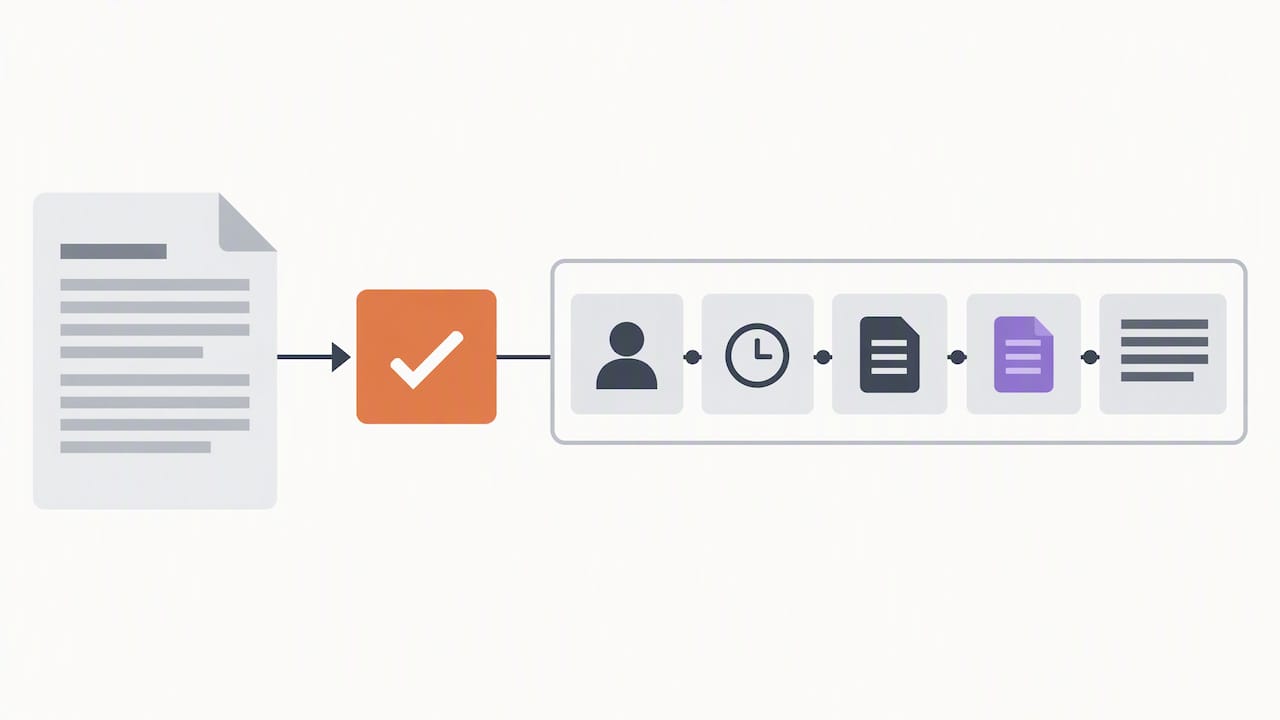
Documentation closes the loop. Audit logs recording who reviewed what, when, and under what protocol, plus a record of GenAI prompt iterations and the reasoning behind them, give a firm something concrete to point to if a privilege call or a responsiveness determination gets challenged months later.
What document review costs and how long it takes
Cost and timeline in document review track a handful of variables, and clients generally want those named rather than buried in a blended hourly estimate.
Dataset size and richness drive the baseline: a terabyte of mixed email, chat, and shared-drive content takes longer to process and review than a tightly scoped set of contracts.
Number of issues matters as much as volume, since each additional tag or category adds decision points per document.
Privilege intensity in regulated industries or matters involving in-house counsel tends to slow review substantially, because every borderline document needs a closer look.
Deadline structure, including rolling productions and court-ordered milestones, shapes staffing decisions more than raw volume does.
Small reviews around a discrete dispute can move in weeks. Mid-size reviews spanning multiple custodians can take several months when privilege review is involved. Large, multi-custodian matters can extend well beyond that, particularly with rolling production deadlines.
AI-assisted triage changes the math, but not for free. Narrowing a population before human review begins can meaningfully reduce reviewer hours, as the Relativity case study demonstrates, but that gain depends on upfront prompt engineering and validation work that has to happen before the time savings materialize. Presenting this tradeoff candidly at meet-and-confer, including the validation steps planned and the timeline they add at the front end, tends to build more trust with opposing counsel and the court than a bare cost estimate ever will.
Staffing, quality checkpoints, and the controls that sustain accuracy
Review quality depends on structure as much as talent. A workable staffing model puts a senior attorney over the protocol and privilege calls, a review team handling first-pass coding, and a project manager or tech lead running the search and production mechanics day to day.
Calibration sessions before review starts align reviewers on how to apply issue tags and privilege standards to the same set of sample documents.
Iterative spot-sampling throughout the review catches drift before it spreads across thousands of documents.
Inter-rater reliability checks compare how different reviewers code the same documents, flagging inconsistency early rather than at the end.
Runbooks and documented calibration outcomes give new reviewers a reference point and give the firm a record if methodology gets questioned later.
Chain-of-custody recordkeeping ties the whole structure together. Knowing exactly which version of a document a reviewer saw, what protocol governed that review, and who signed off on the final coding is what makes a review defensible rather than merely fast.
How to pilot GenAI in review without losing defensibility
Start narrow. Pick one matter, one issue category, or one custodian’s email as the pilot scope, and define success metrics (recall target, time saved, cost per document) before running a single prompt.
Prompt design is iterative by nature: draft a prompt, test it against a sample set, refine based on where it missed, and log every version along with the reasoning for the change. Structured, tree-based document parsing keeps every AI-generated answer traceable to an exact location in the source document, which matters enormously if a coding decision gets challenged.
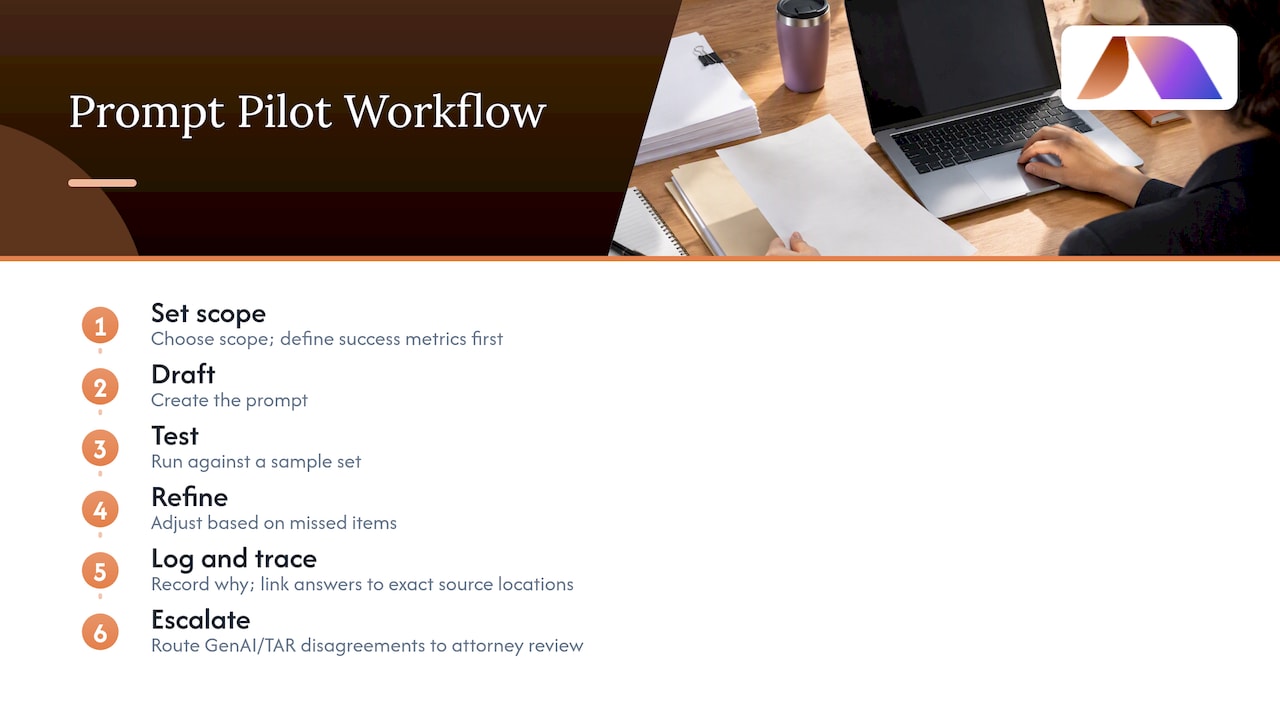
Pro Tip: Set a clear escalation rule before the pilot starts: any document where the GenAI score and the TAR ranking disagree gets routed automatically to attorney review, no exceptions.
Our view on applied AI adoption in document review
We favor staged adoption over wholesale platform bets: a readiness assessment first, a narrow pilot second, and validated scaling only once the sampling results hold up. That sequence protects defensibility far better than a vendor demo ever will, because it forces the documentation habits, prompt logs, audit trails, and attorney sign-off points to exist before volume scales. The firms that get the most out of GenAI-assisted review are the ones that treat validation as the product, not the paperwork.
— Team BRDGIT
How BRDGIT helps firms pilot and scale AI-assisted review
We work with legal teams at the stage where AI adoption decisions actually get made: before the platform purchase, not after. An AI Readiness Assessment tells you where your data, workflows, and staffing can support a GenAI pilot and where they cannot yet. From there, our Workflow Crew and Custom Agent Build engagements can support turning a validated pilot into a repeatable process, while Fractional Engineer Services can provide AI engineering support as the review scales.

We typically engage at several points:
Pilot design, including scope, success metrics, and validation protocol.
Scaling a validated pilot into a production workflow with documented controls.
Ongoing fractional support so the system keeps working as caseloads and data sources change.
If your firm is evaluating GenAI for its next large review, a readiness assessment can help explore what a defensible rollout might look like for your caseload.
FAQ
What is document review in a law firm?
Document review is the process by which attorneys and trained reviewers examine collected documents to determine which are responsive to a discovery request, which are privileged, and which need redaction before production. The process exists to sort through relevant documents in litigation, investigations, or regulatory matters under attorney supervision.
How much does it cost for a lawyer to review a document?
Cost depends on dataset size, the number of issues being coded, and how much privilege review the matter requires, so firms typically quote a range tied to those factors rather than a flat per-document rate. Review platforms and fractional AI-assisted triage can lower that cost for larger datasets, but only after upfront validation work is complete.
How long does it take a lawyer to review documents?
Small reviews often finish in a matter of weeks, while mid-size reviews spanning multiple custodians commonly take several months when privilege review is involved. Larger, multi-custodian matters with rolling production deadlines can extend well beyond that timeline.
Can I get a legal document review online?
Many firms now run parts of document review through cloud-based platforms that support remote attorney access, GenAI-assisted triage, and secure document hosting, provided an attorney oversees responsiveness and privilege calls. The underlying legal standards for privilege, confidentiality, and validation apply the same way regardless of whether review happens on-site or through a remote platform.



