
Published on
Best InitializeAI.com Alternatives for Enterprise AI in 2026
TL;DR:
The top enterprise AI strategy alternatives include Accenture, Databricks, 7 Layer Solutions, BRDGIT.ai, and LongShot AI, each addressing different organizational gaps. Selecting the best platform depends on AI readiness, governance needs, and the complexity of business workflows rather than brand recognition. BRDGIT offers a flexible approach through fractional AI engineers for organizations seeking practical execution without long-term commitments.
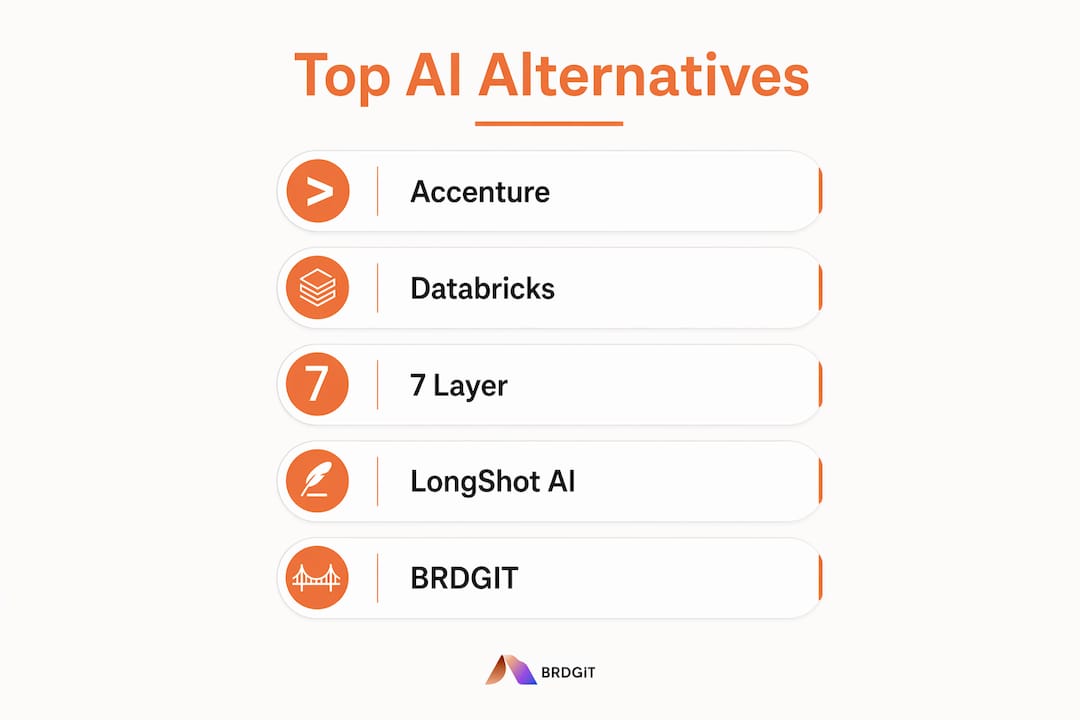
The strongest initializeai.com alternatives for enterprise AI strategy and execution in the U.S. are Accenture, Databricks, 7 Layer Solutions, BRDGIT.ai, and LongShot AI. Each one addresses a distinct gap that enterprise buyers run into when evaluating InitializeAI’s consulting and pilot model. Here is where they land:
Accenture — Large-scale AI transformation with integrated governance and deployment across global enterprises
Databricks — Unified data and AI platform best suited for data-centric organizations building and deploying models at scale
7 Layer Solutions — Agentic and multi-step workflow orchestration with strong policy enforcement and auditability
BRDGIT.ai — Fractional AI talent and governance-first execution for enterprises that need real AI delivery without full-time hires
LongShot AI — Content-heavy AI automation and creative workflow integration for enterprise marketing and communications teams
These five represent meaningfully different approaches to the same problem: moving an organization from AI curiosity to measurable AI execution. The right one depends on where your enterprise sits on the readiness curve, not on which name carries the most brand recognition.
How the top InitializeAI alternatives compare on core capabilities
Five providers cover this space, but they are not interchangeable. Gartner’s 2026 evaluation criteria weight service quality, contracting capabilities, and integration depth alongside product features, which is exactly the lens that separates these options.
Provider | Best for | Core competencies | Integration and deployment | Service and support quality | Pricing overview |
|---|---|---|---|---|---|
Accenture | Large-scale enterprise AI transformation | AI strategy, governance, change management | Deep ERP, cloud, and legacy system integration | Dedicated enterprise support with global delivery | Custom enterprise contracts |
Data-centric AI model development and deployment | Unified data lakehouse, MLOps, LLM fine-tuning | Native AWS, Azure, GCP; Delta Lake ecosystem | Strong documentation, community, and enterprise SLAs | Consumption-based; enterprise licensing available | |
7 Layer Solutions | Complex workflow orchestration with governance | Agentic AI, multi-agent coordination, policy enforcement | API-first; integrates with existing enterprise stacks | Focused enterprise support with audit trail emphasis | Custom pricing |
Flexible AI execution without full-time hires | AI readiness assessments, fractional engineers, roadmapping | Workflow automation and custom AI system integration | Ongoing fractional support post-delivery | Fractional engagement model | |
LongShot AI | Content-heavy AI automation and creative workflows | AI content generation, workflow automation, enterprise CMS integration | Integrates with CMS, CRM, and marketing platforms | Self-serve with enterprise tier support | Subscription tiers; enterprise pricing on request |
Accenture sits at the top of the market for sheer transformation scope. Its consulting depth covers AI governance, regulatory compliance, and change management in ways that a pure software platform cannot replicate. The tradeoff is cost and timeline: Accenture engagements are built for organizations with the budget and patience for a multi-quarter program.
Databricks takes a different angle entirely. It is a platform, not a consulting firm, and it excels when the core problem is data infrastructure and model deployment at scale. Enterprises already running on AWS, Azure, or GCP will find its Delta Lake architecture and MLflow integration genuinely useful for AI model development. It is less suited to organizations that have not yet resolved their data quality and governance foundations.
7 Layer Solutions fills a specific gap: enterprises that need agentic AI workflows with real auditability. Multi-agent coordination and policy enforcement are not afterthoughts in its architecture. For regulated industries or organizations where every AI action needs a traceable log, that matters considerably.

LongShot AI is the most narrowly scoped of the five. It does content generation and workflow automation well, particularly for marketing and communications teams. Treating it as a general-purpose AI strategy platform would be a misuse of what it actually does.
Pricing and contracting: what enterprise buyers should expect
Cost structures across these alternatives vary more than most buyers anticipate. InitializeAI’s own model gives a useful baseline: pilot projects run $20,000–$50,000 and advisory services range from $2,000–$10,000, with a free AI readiness diagnostic as the entry point. The alternatives sit across a wide spectrum relative to that.
Accenture operates on custom enterprise contracts. Expect multi-year statements of work with professional services fees that scale with project scope. There is no self-serve entry point.
Databricks uses consumption-based pricing tied to compute and storage, with enterprise licensing agreements available for organizations that want cost predictability. Costs scale with data volume and model complexity.
7 Layer Solutions publishes custom pricing. Buyers should expect a scoping conversation before any numbers appear, which is standard for agentic platform deployments.
BRDGIT.ai operates on a fractional engagement model, meaning you pay for experienced AI talent on a defined scope rather than a full-time salary or a large consulting retainer. That structure suits enterprises that need execution capacity without a long-term staffing commitment.
LongShot AI offers subscription tiers with an enterprise pricing tier available on request, making it the most accessible entry point for teams with a defined content automation use case.
Pricing transparency and well-structured pilots are decisive for enterprise adoption. Buyers who skip the pilot phase and go straight to full implementation consistently face adoption problems that no amount of post-launch support can fully correct. Budget for a proof-of-concept phase regardless of which provider you select.
A practical note on contracting: ask every vendor about data residency, audit log access, and exit provisions before signing. Those three terms surface most of the real operational risk in an AI platform contract.
How to choose the right InitializeAI alternative for your enterprise
The single most common mistake enterprise buyers make is selecting a platform before assessing their own readiness. Buying an advanced AI platform into an organization with poor data quality or undefined governance processes does not accelerate AI adoption. It institutionalizes the problem.
Here is a practical criteria framework:
AI readiness first. Run an internal diagnostic on data quality, process maturity, and team capability before evaluating vendors. Platforms like BRDGIT.ai build readiness assessments into their engagement model precisely because skipping this step wastes the investment that follows.
Governance and policy enforcement. Ask whether the platform enforces policies at the workflow level, not just at the model level. A governance-first approach that includes automated PII redaction, audit logs, and cost controls is the difference between a managed AI deployment and an operational liability.
Integration depth. Map your existing systems before any vendor conversation. An AI platform that cannot connect to your ERP, CRM, or data warehouse without a six-month integration project is not ready for your environment.
Service and support scope. Distinguish between documentation-based support and dedicated human support. For complex enterprise deployments, the latter is not optional.
Ongoing execution capacity. Many enterprises underestimate the work that happens after go-live. Who maintains the models, monitors outputs, and iterates on workflows? That answer should be in the contract, not assumed.
Pro Tip: Before shortlisting any vendor, map your internal AI use cases by complexity. Simple brainstorming and drafting tasks belong on a general-purpose LLM. Complex, multi-step workflows that touch real business systems require an agentic AI platform with orchestration and audit capabilities. Conflating the two is the fastest path to shadow AI risk.
The distinction between a chat interface and an enterprise AI operating platform is not semantic. Chat tools answer questions. Agentic platforms execute workflows, enforce policies, and produce auditable outputs. Buying the wrong category for your use case is an expensive lesson that shows up six months after go-live.
Trust signals and credentials that enterprise buyers should verify
Credentials and support quality are not marketing claims. They are operational facts that determine whether a deployment succeeds or stalls. Here is how the five alternatives stand on verifiable trust signals:
Accenture holds recognized certifications across major cloud providers (AWS, Azure, Google Cloud) and maintains dedicated AI governance practices. Its case study library covers regulated industries including financial services, healthcare, and government, which matters for buyers in those sectors.
Databricks carries SOC 2 Type II certification and supports HIPAA-compliant configurations. Its enterprise support tiers include named technical account managers and defined SLA response times, which is the kind of specificity regulated enterprises need in writing.
7 Layer Solutions emphasizes auditability as a core architectural principle. For enterprises in regulated industries where every AI action needs a traceable record, that design choice is a meaningful differentiator rather than a feature checkbox.
BRDGIT.ai positions its fractional AI engineers around a governance-first delivery model, with readiness assessments built into the engagement before any implementation begins. That sequencing reflects a genuine understanding of where enterprise AI deployments fail.
LongShot AI is best evaluated on content output quality and CMS integration reliability rather than on enterprise security credentials. Buyers in regulated industries should verify its data handling practices independently before deploying it on sensitive content workflows.
On geographical availability: Accenture and Databricks both maintain U.S. offices and onsite support capacity across major metro areas. BRDGIT.ai, 7 Layer Solutions, and LongShot AI operate primarily as remote-delivery providers serving U.S. enterprises. For buyers who require onsite presence as a contract term, that distinction narrows the field quickly.
Service quality and integration support are consistently the factors that separate successful enterprise AI deployments from stalled ones. A platform with strong credentials but weak post-deployment support creates a different kind of risk than a less credentialed provider with hands-on delivery capacity. Evaluate both dimensions, not just the logo on the proposal.
For a broader view of AI business strategy software options in 2026, the market has expanded well beyond the five providers covered here, though most of the alternatives lack the enterprise governance depth that U.S. buyers in regulated industries require.
BRDGIT offers a different path to AI execution
If the providers above feel like a significant commitment before your organization has proven its AI readiness, BRDGIT takes a different approach entirely.
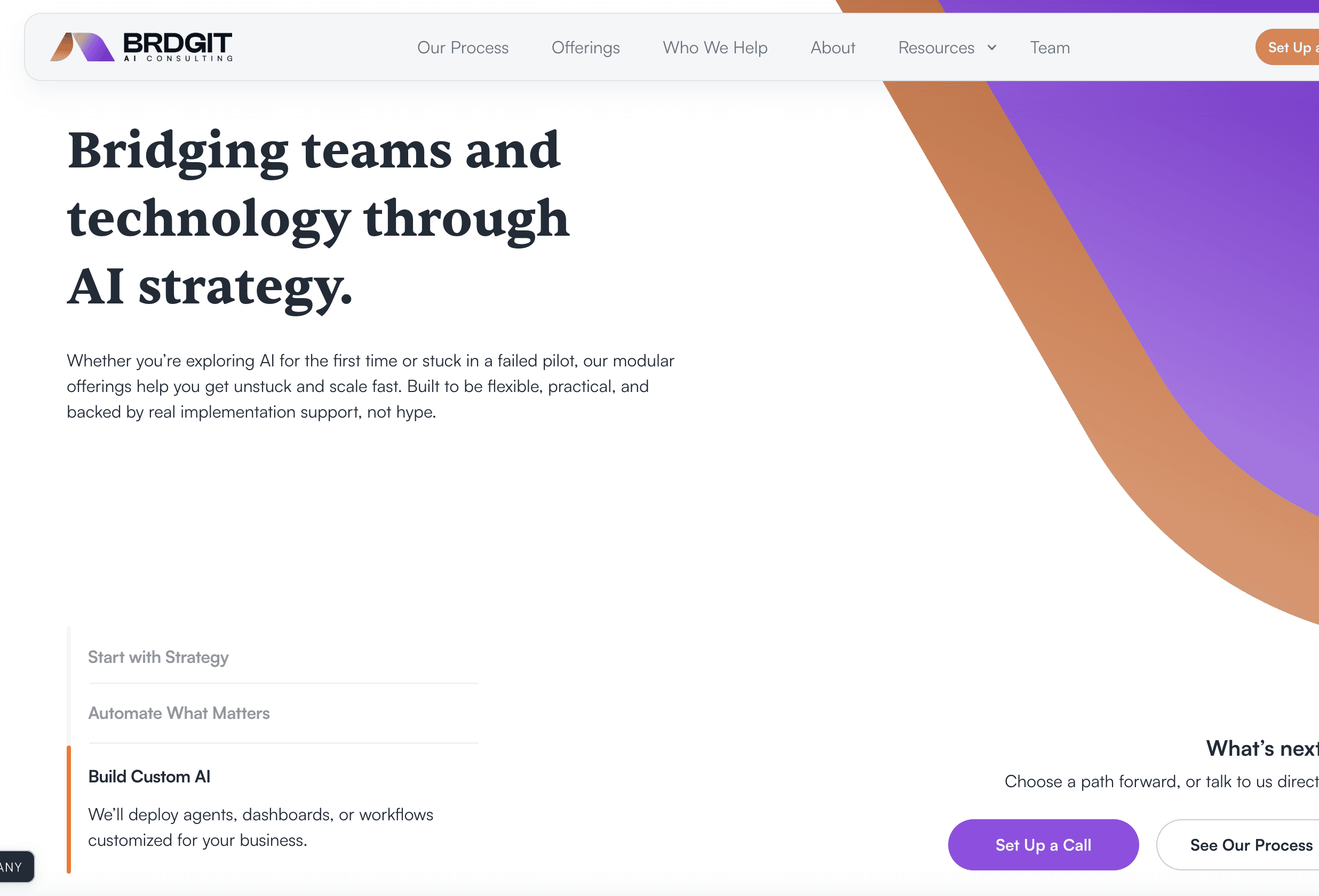
Rather than selling a platform license or a multi-year consulting contract, BRDGIT deploys fractional AI engineers who work inside your organization on a defined scope. The engagement starts with an AI readiness assessment, moves through roadmapping and workflow automation, and continues with ongoing execution support for as long as you need it. No full-time hire. No long-term retainer. Just experienced AI talent matched to your actual needs at each stage. For enterprises that want to move from strategy to real execution without the overhead of a large consulting program, that model removes a real barrier. You can learn more about elevating AI performance for business leaders on the BRDGIT site.
Key Takeaways
The best InitializeAI alternative is the one that matches your enterprise’s current readiness level, governance requirements, and execution capacity, not the one with the largest brand name.
Point | Details |
|---|---|
Readiness before platform | Run an internal AI readiness diagnostic before selecting any vendor to avoid low adoption and wasted investment. |
Governance is architectural | Choose platforms that enforce policies, produce audit logs, and handle PII at the workflow level, not just the model level. |
Pricing varies widely | InitializeAI pilots offer structured proof-of-concept engagements; alternative providers have pricing models varying from subscription tiers to custom enterprise contracts. |
Match platform to task complexity | Chat tools suit brainstorming; agentic platforms suit multi-step workflows that touch real business systems. |
BRDGIT for flexible execution | BRDGIT’s fractional engineer model delivers AI strategy and execution without full-time hires or long-term consulting contracts. |