


Published on
Execution First Dispatch Optimization for Field Service Teams
The fastest way to cut failed visits and travel time is to prioritize feasibility at booking and pair that with AI-driven scheduling and real-time routing. When service data is unified and every job is checked against skills, parts, and realistic durations before it hits a schedule, first-time fix rates climb, mean time to repair drops, and dispatchers stop fighting yesterday’s bad bookings. Two levers do most of the work: shift-left diagnostics that resolve issues before a truck leaves the yard, and dynamic rerouting that adjusts plans as the day changes.
TL;DR:
Fragmented data can cause dispatch algorithms to optimize infeasible plans, so consolidating work orders, parts, and technician records is essential.
Enforcing feasibility at booking—by capturing skills, parts, and realistic durations—significantly reduces failed visits and related costs, especially in bottom-tier operations.
Advanced optimization methods like LBBD drastically cut computation time and improve schedule accuracy, especially at large scales with hundreds of technicians and thousands of jobs.
Quick improvements, such as remote diagnostics and drive-time remapping, can show tangible results within weeks, while full system integration takes several months.
Success depends on starting with an AI readiness assessment and a tightly scoped pilot, not rushing into platform purchase or software deployment without proper groundwork.
BRDGITbrdgit.aiTurn Dispatch Ideas Into ExecutionBRDGIT helps field service teams assess AI readiness, identify opportunities, build roadmaps, and implement practical systems.Explore BRDGIT
Table of Contents
Why Dispatch Optimization Matters Now: Benchmarks and Cost Impact
Core Components That Determine Dispatch Performance
Algorithms and Technologies That Improve Dispatch
Implementation Readiness: Data, Integrations, KPIs, and Pilot Design
Operational Best Practices to Reduce Truck Rolls and Improve FTF
How BRDGIT Helps Teams Move From Readiness to Execution
Team BRDGIT’s Perspective: Common Pitfalls and Realistic Timelines
Start With an Assessment, Not a Platform Purchase
FAQ
Sources
Why Dispatch Optimization Matters Now: Benchmarks and Cost Impact
Field service leaders have treated routing as the main lever for efficiency for years. The numbers suggest that is backward. The 2026 Field Service Benchmark Report puts the industry average first-time-fix rates varying notably across performance levels. That gap is not cosmetic.
For bottom-tier operations, failed visits can consume a significant portion of total service costs, according to the 2026 Field Service Benchmark Report, compared with a much smaller share for top performers. Every failed visit means a second truck roll, a second technician, and a customer who now expects an apology along with a fix.
Mean time to repair significantly differs, with top performers resolving issues faster than average and bottom performers taking longer, per the same benchmark data. A single failed visit does not just cost one extra trip. It resets the clock on the entire repair cycle, which is why the companies narrowing this gap are not buying better maps. They are consolidating scattered service data (work orders, parts history, technician skills, equipment records) into one intelligence layer that any optimization tool, human or automated, can actually trust.
That consolidation matters for three reasons:
It gives scheduling algorithms accurate inputs instead of guesses about duration and parts.
It lets dispatchers see the same picture technicians see in the field.
It turns every closed ticket into training data for the next job, instead of a dead record.
Routing software layered on top of fragmented data will always optimize the wrong plan faster. The data layer comes first.
Core Components That Determine Dispatch Performance
Dispatch performance breaks down into five components, and most operations have a weak link in one or two of them rather than all five. Auditing them separately is the fastest way to find where to invest first.
Booking and triage. This is where feasibility gets decided or lost. If the intake process does not capture required skills, likely parts, and a realistic time estimate, no amount of downstream optimization can fix a job that was booked wrong from the start.
Scheduling logic. Constraint-aware assignment engines weigh skills, parts, time windows, and technician location simultaneously. Manual heuristics (same technician, same territory, same time of day) tend to ignore at least one of those constraints under pressure.
Routing. This is a downstream sequencer. It decides the order of stops once the day’s jobs are already assigned. A booking process that enforces feasibility upstream determines whether routing has a workable plan to sequence or an infeasible one to reshuffle.
Hard constraints. Parts availability, vehicle capacity, and certified skills are not preferences. A technician without the right part or certification cannot complete the job regardless of how efficient the drive time looks on paper.
Time and legal windows. Customer-promised windows, labor rules, and realistic service-time profiles (not optimistic averages) need to be built into the schedule rather than bolted on after the fact.
Pro Tip: Before evaluating any new dispatch software, pull a sample of last month’s failed visits and tag each one by which of these five components broke down. The pattern usually points straight at the fix.
Algorithms and Technologies That Improve Dispatch
Once feasibility is enforced at booking, the choice of optimization method starts to matter, because real field service involves uncertainty that simple routing math ignores: traffic that varies by the hour, job durations that run longer than quoted, and technicians who call in sick. Static route plans break down fast under those conditions, which is why stochastic optimization, methods that explicitly model uncertainty rather than assume a fixed world, has become the more serious approach for scheduling under real conditions.
One of the more practical advances here is Logic-Based Benders Decomposition, or LBBD. Rather than solving one enormous, unwieldy optimization problem, LBBD splits the work into an assignment layer (who does what) and a routing feasibility layer (can they actually get there on time), then passes information back and forth until both layers agree. In benchmark testing described in academic research on LBBD for technician routing, this approach reduced average optimality gaps to about 6.8%, compared with 31.8% for traditional branch-and-cut methods, and cut average computation time from 2,493 seconds to 1,616 seconds across 210 test instances. LBBD solved 202 of those instances to full optimality, versus 161 for branch-and-cut.
A related body of work, the CIRRELT technician routing and scheduling research, confirms why this decomposition approach matters at scale: explicitly modeling skills, vehicle capacity, and time-sensitive service benefits alongside uncertainty produces schedules that are not just mathematically clean but operationally workable, and decomposing the problem is what keeps the computation tractable once an operation reaches hundreds of technicians and thousands of weekly jobs.
Route optimization is fundamentally a feasibility and sequencing step. If booking logic does not enforce skills and parts feasibility, optimizers only reshuffle an already infeasible plan.
Metaheuristics (genetic algorithms, simulated annealing, and similar search methods) fill the gap when exact methods like LBBD become too slow for real-time use, trading a small amount of optimality for speed. And at the top of the stack sits what some in the industry call agentic AI: specialized software agents working off that same unified intelligence layer, handling diagnostics, parts prediction, and dynamic dispatch adjustments as a coordinated system rather than isolated point tools.
Stochastic models account for traffic, duration variance, and technician availability instead of assuming a static day.
LBBD and similar decomposition methods make large-scale, constraint-heavy scheduling computationally practical.
Metaheuristics trade a little precision for the speed real-time rerouting demands.
Agentic AI layers coordinate diagnostics, parts forecasting, and dispatch decisions from one shared data source.
Implementation Readiness: Data, Integrations, KPIs, and Pilot Design
None of the methods above deliver results without the right groundwork. A practical readiness checklist keeps a pilot from stalling on avoidable gaps.
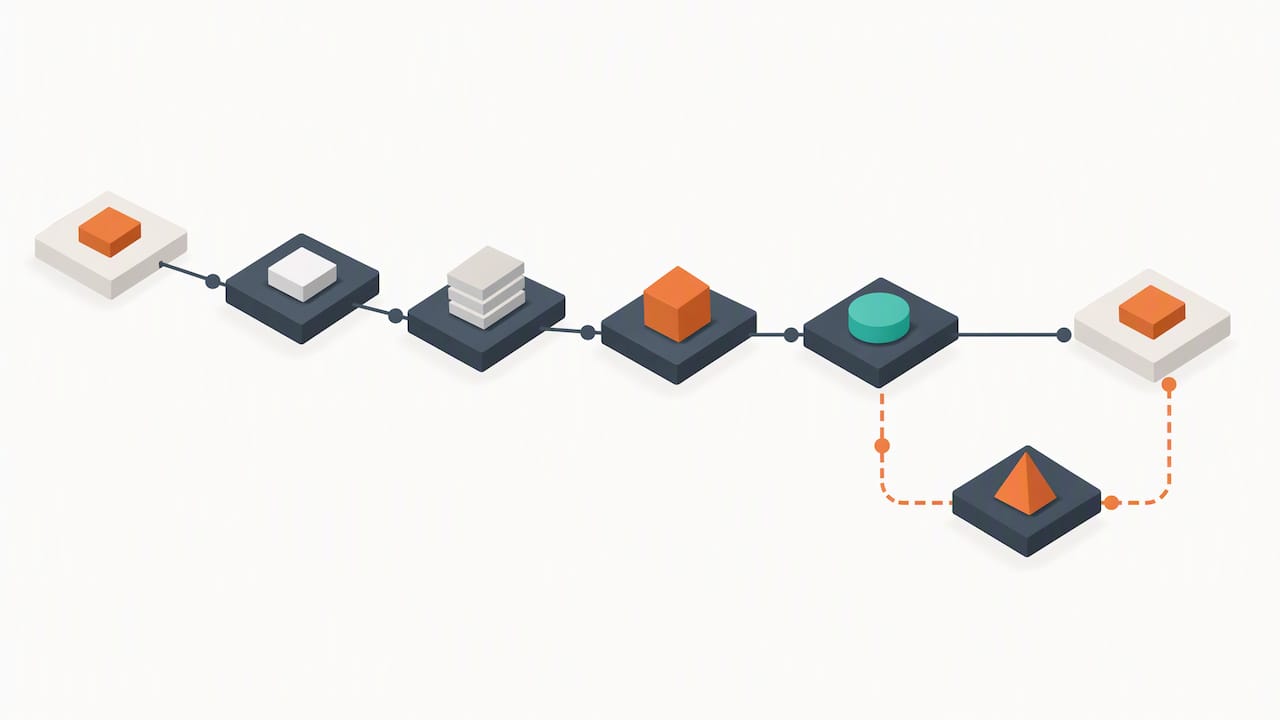
Unify the data first. Work orders, asset history, parts inventory, a technician skill matrix, and live telematics or GPS feeds all need to sit in a shared system, not five disconnected ones.
Map the integrations. Field service management and CRM platforms, ERP and parts systems, telematics providers, ticketing tools, and any knowledge base need defined connection points before automation can act on them.
Set baseline KPIs. First-time-fix rate, failed-visit rate, mean time to repair, travel time per ticket, technician utilization, and remote-resolution rate all need a measured starting point.
Scope the pilot tightly. Pick one geographic zone or job type, set a fixed duration, define success criteria in advance, and agree on a rollback plan if the numbers do not move.
Build governance around it. Dispatchers need to be part of the design, not just the rollout, with training and a regular cadence for reviewing what the data shows.
Pro Tip: Run the pilot’s KPI baseline for at least two full weeks before changing anything. A baseline measured during an unusually quiet or unusually chaotic stretch will make every post-pilot number look better or worse than it really is.
The temptation is to skip straight to the algorithm. Resist it. A work order workflow with clear, auditable states is what makes the KPI data trustworthy enough to act on in the first place.
Operational Best Practices to Reduce Truck Rolls and Improve FTF
While the longer automation work is underway, several tactics pay off almost immediately and do not require a new platform.
Shift-left diagnostics. Remote troubleshooting, guided video calls, and pre-visit questionnaires resolve a meaningful share of issues before a technician is ever dispatched.
Territory and drive-time mapping. Realistic zone boundaries based on actual drive times, not straight-line distance, prevent dispatchers from building itineraries that look fine on a map and fall apart in traffic.
Dynamic dispatch with guardrails. Real-time rerouting and live ETA updates help the day adjust itself, but unlimited reassignment churn overwhelms dispatchers. A reassignment cost cap or a minimum time-to-complete threshold keeps changes useful instead of chaotic.
Parts staging and pre-visit verification. Confirming the right part is in the van before departure avoids what technicians sometimes call “shotgunning,” showing up with a guess instead of a confirmed fix.
Capture tribal knowledge. Field-accessible playbooks and quick-reference diagnostics spread the expertise of senior technicians across the whole team, narrowing the skills gap that drives much of the FTF variance between top and bottom performers.
Smart stocking policies that route high-failure parts to the technicians most likely to need them, modeled on the kind of slotting and pick-path logic used in warehouse operations, work the same way in the field: put the right item closer to the point of use, and the whole system moves faster.
How BRDGIT Helps Teams Move From Readiness to Execution
Moving from a benchmark gap to a working dispatch system is a sequence, not a single purchase. We typically walk teams through an AI Readiness Assessment first, to see where the data and process gaps actually sit, followed by an AI Blueprint that prioritizes which use cases are worth automating first.
From there, most teams run a focused pilot through service offerings for process automation or specialized diagnostics and dispatch logic, before scaling with ongoing engineering or AI support services.
A pilot engagement generally includes:
A KPI baseline covering first-time-fix rate, failed-visit rate, and travel time per ticket.
Prioritized use cases, often starting with remote resolution and dynamic rerouting.
Dashboards that give dispatchers and managers a shared view of what is happening in real time.
Engineering support to build and adjust the system as real-world data comes in.
When data is unified and feasibility is enforced at booking, the operations in the 2026 Field Service Benchmark Report that reach top-tier performance show an 11-point gap in first-time fix rate over the industry average, a difference that compounds every week a crew is in the field.
Team BRDGIT’s Perspective: Common Pitfalls and Realistic Timelines
The biggest mistake we see is treating routing software as the fix for a scheduling problem. Routing can only sequence what booking already made feasible or infeasible. Skipping data cleanup is the second most common shortcut, and it is the one that quietly undermines every KPI a team reports afterward.
Quick wins (shift-left diagnostics, drive-time remapping) can show results within weeks. Integration work with ERP and telematics systems takes longer, often a full quarter or more, and should be planned as such rather than squeezed into a pilot timeline.
Dispatchers are not a rollout afterthought. The best results come from teams that let automated recommendations inform human judgment rather than replace it, especially in the first few months.
— Team BRDGIT
Start With an Assessment, Not a Platform Purchase
We built our engagement model around the sequence described above because buying a routing tool before fixing booking feasibility wastes budget on a problem it cannot solve. Our path starts with a readiness assessment to find the real gap, then moves through a blueprint, a scoped pilot, and engineering support for the long haul.

What that looks like in practice:
An AI Readiness Assessment that maps your current data, booking process, and skills gaps.
A Workflow Crew or Custom Agent Build pilot scoped to one zone or job type.
Fractional Engineer Services to keep the system improving after the pilot ends.
Visit BRDGIT to start a readiness assessment, or go directly to our fractional engineering services if your team already knows it needs hands-on technical support to execute.
FAQ
What is field service dispatch optimization?
Field service dispatch optimization is the practice of assigning the right technician, with the right skills and parts, to the right job at the right time, then sequencing routes efficiently around that assignment. The strongest results come from enforcing feasibility at the booking stage before applying routing or scheduling algorithms.
Does route optimization alone fix failed visits?
No. Routing only sequences stops after jobs are already assigned, so it cannot correct a booking that lacked the right skill or part from the start. Fixing failed visits requires enforcing feasibility earlier, at booking and scheduling, as described in academic technician routing research.
What is Logic-Based Benders Decomposition (LBBD)?
LBBD is an optimization method that splits technician scheduling into an assignment problem and a routing feasibility problem, solving them together more efficiently than traditional methods. In benchmark testing, LBBD reduced optimality gaps to about 6.8% versus 31.8% for branch-and-cut approaches.
How much can poor dispatch efficiency cost a service operation?
For the weakest-performing operations, failed visits can account for a significant portion of total service costs, compared with a much smaller share for top performers. The gap comes largely from repeat truck rolls and extended repair timelines.
What does BRDGIT charge for a dispatch optimization pilot?
Pricing for our AI Readiness Assessment, pilot work, and fractional engineering support is available on request and depends on the scope of the engagement. You can review our service offerings at BRDGIT or request details directly.



