


Published on
Board Ready AI Vendor Selection: 7 Dimension Scorecard, 4 Week Sprint
Use a weighted vendor scorecard plus a paid proof of concept on your own representative data. Prioritize capability fit, data practices, and contract terms over demo polish and sales pitch. Before signing anything, check three things: does the vendor map cleanly to your actual use case, can they show real compliance evidence, and will they let you own what you build. Start by defining your use case in concrete terms, then run a focused four-week evaluation sprint.
TL;DR:
Vendors should be evaluated with a weighted scorecard and tested on your own data, focusing on capability fit, data practices, and compliance, not demo quality.
Request written confirmation on critical points such as data handling, model training on your data, and adherence to industry certifications like SOC 2 Type II.
Conduct a focused four-week evaluation sprint, including a paid proof of concept on your representative data that measures actual business outcomes and edge case performance.
Avoid contracts lacking ownership rights, clear SLAs, and transparency on usage metrics, and be wary of vendors who refuse to run a PoC or produce certification evidence upfront.
Consider engaging fractional AI support for vendor scoring, PoC execution, and negotiations if internal capacity is limited or data is sensitive.
BRDGITBring Structure to AI Vendor SelectionBRDGIT.ai helps teams assess AI readiness, identify practical opportunities, and build a clear path from vendor evaluation to execution.Explore BRDGIT.ai
Table of Contents
What Is a Structured AI Vendor Evaluation Process?
What Should You Demand in an RFP or Vendor Questionnaire?
How Do You Run a Paid PoC and a Four-Week Sprint?
Which Contract Terms and Red Flags Should Kill a Deal?
When Should You Bring In Outside Help for Vendor Selection?
Get Help Running Your Vendor Selection Process
Templates and Checklists Worth Downloading
Sources
FAQ
What Is a Structured AI Vendor Evaluation Process?
A structured AI vendor evaluation process replaces gut instinct with a repeatable scoring method. It weighs capability fit, data handling, integration depth, pricing, compliance, and vendor stability against each other, then forces every finalist through the same paid test on your own data before any contract gets signed. This is the difference between choosing a vendor because the demo looked good and choosing one because it actually performed on your problem, with your data, under your constraints.
APQC’s AI vendor selection criteria frames this as a checklist spanning business alignment, technical capabilities, security and ethics, partnership support, commercial viability, and adoption readiness. That framing matters because most procurement teams default to comparing price sheets and feature lists, which tells you almost nothing about whether a vendor will still be reliable eighteen months into a production deployment.
A seven dimension scorecard, popularized in ReWork’s CIO evaluation framework, gives procurement teams a rubric that survives stakeholder scrutiny. Score each vendor from 1 to 5 on:
Capability fit. Map the use case to what the framework calls ACE, meaning whether the tool actually Ingests, Analyzes, Predicts, Generates, or Executes the specific task you need. A vendor that generates great copy is useless if you need predictive maintenance scheduling.
Data practices. Where does your data live, who can access it, and does the vendor train on it without consent.
Integration and MLOps. How deep does the tool sit in your stack, and what happens when a model update breaks something.
Model flexibility. Can you swap underlying models or is the vendor locking you into one provider’s roadmap.
Pricing and total cost of ownership. What does year two look like once usage scales past the pilot tier.
Compliance and certifications. SOC 2, ISO standards, industry-specific requirements.
Vendor stability. Funding, customer retention, leadership continuity.
Weight these differently depending on your risk profile. Deciding those thresholds before you see any vendor’s score keeps the process defensible when a favorite internal candidate scores poorly.
What Should You Demand in an RFP or Vendor Questionnaire?
Every claim a vendor makes verbally needs to show up in writing, because sales conversations do not hold up in a legal dispute. ARDURA Consulting’s vendor evaluation framework recommends structuring your RFP around the same criteria you scored the shortlist on, so answers translate directly into scorecard updates rather than sitting in a separate document nobody rereads.
Require written responses to:
Does the vendor train models on your data, and can you opt out in writing.
Where is data stored, how long is it retained, and which subprocessors touch it.
What is the MLOps process for monitoring, updates, and rolling back a bad model release.
Can the vendor explain model decisions, and do they run adversarial test harnesses before shipping updates.
What connectors and APIs exist for your specific stack, and what are the performance SLAs.
Can they provide named production references with real usage metrics, not just logos on a slide.
Do they hold SOC 2 Type II, ISO/IEC 42001, or industry certifications like HIPAA or FedRAMP if your sector requires them.
Pro Tip: Ask for the reference’s actual usage metrics before the call, not during it. A vendor stalling on this request before you even talk to their customer is usually stalling because the numbers are not great.
How Do You Run a Paid PoC and a Four-Week Sprint?
A proof of concept only proves something if it runs on your representative data and measures business outcomes, not technical benchmarks in isolation. FutureProofing.dev’s CTO guide is blunt about this: a paid pilot on your own data is the only way to separate genuine production readiness from a rehearsed demo. Adversarial testing, meaning deliberately feeding the system edge cases and messy inputs, belongs in the pilot design, not as an afterthought.
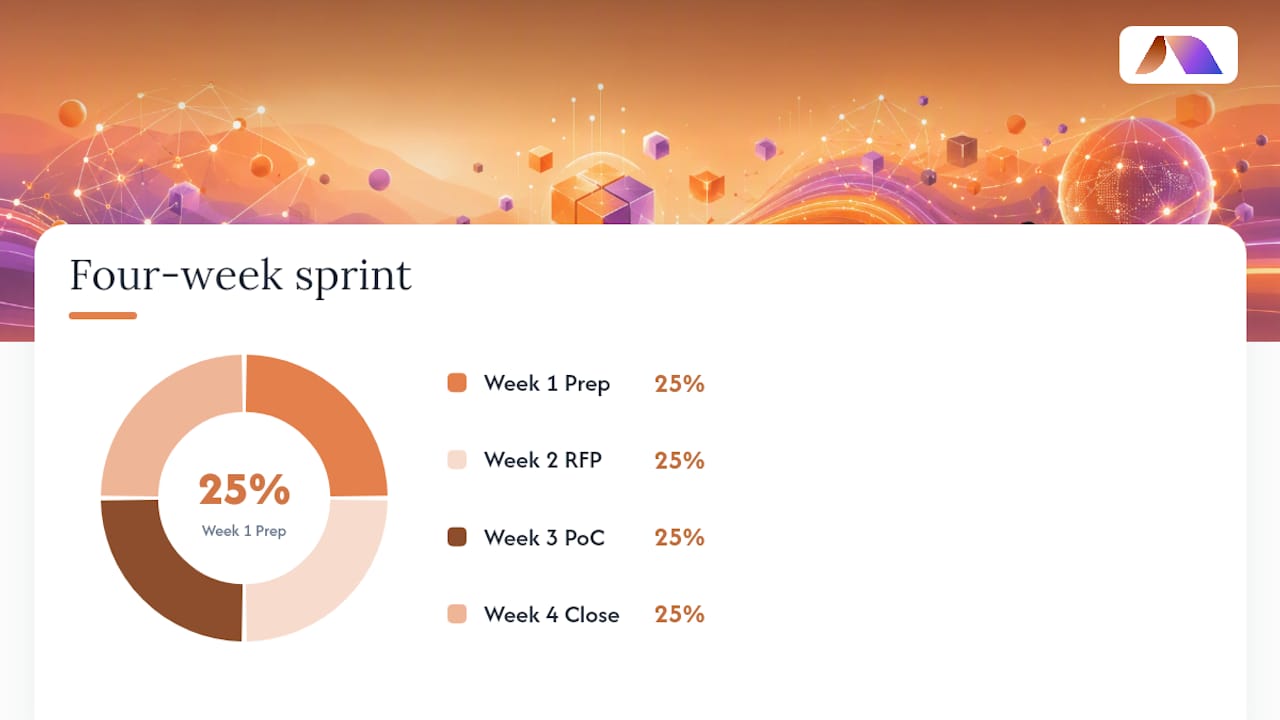
The ReWork sprint model compresses this into four weeks:
Week 1. Clarify ACE-mapped requirements, shortlist three to five vendors, and assign a dimension owner for each scorecard category so no single person is grading everything.
Week 2. Distribute the RFP, start the security questionnaire, and flag any vendor that hedges on data or compliance questions.
Week 3. Run the paid PoC on representative data. Measure actual business outcomes and document where the system fails on edge cases.
Week 4. Complete reference checks, negotiate commercial and IP terms, and write down the decision rationale while the reasoning is still fresh.
Full security reviews for highly regulated data sometimes need more than four weeks, but a confident shortlist rarely does when ownership is assigned clearly from day one.
Which Contract Terms and Red Flags Should Kill a Deal?
Your contract needs to state, in plain language, that you own the outputs and any models trained specifically on your data, and that the vendor cannot use your data to train its general-purpose models without explicit consent. Add indemnity language for IP infringement claims, an exit and data portability clause that does not trap you, and SLAs tied to actual production reliability rather than vague uptime language.
Procurement guides on AI vendor contract negotiation consistently name the same handful of clauses as the ones that get skipped under deadline pressure, and skipped clauses become expensive later.
Watch for these red flags:
Opaque or undefined usage metrics that make it impossible to predict your bill at scale.
Automatic price escalators above 10% annually with no negotiation window.
No baseline compliance evidence, meaning certifications, offered before contract signature.
Refusal to run a PoC on your own data.
No SOC 2 Type II report for any vendor handling sensitive or regulated data.
Inability to describe their own MLOps and monitoring process in specific terms.
Morgan Lewis’s guidance on evaluating AI vendors names SOC 2 Type II, ISO/IEC 27001, and the newer ISO/IEC 42001 as the baseline set worth requesting before deeper industry-specific certifications like HIPAA or FINRA even enter the conversation. A vendor that cannot produce these on request, or gets vague about timelines for obtaining them, has told you something important about how seriously they take governance.
When Should You Bring In Outside Help for Vendor Selection?
Running this whole process internally works fine if you have people who can own MLOps evaluation, security review, and contract negotiation simultaneously. Most mid-sized operations do not. That gap is exactly where AI vendor selection stalls, not because the framework is complicated, but because nobody inside the building has the bandwidth to run a scorecard, chase compliance evidence, and design a paid PoC in the same month.
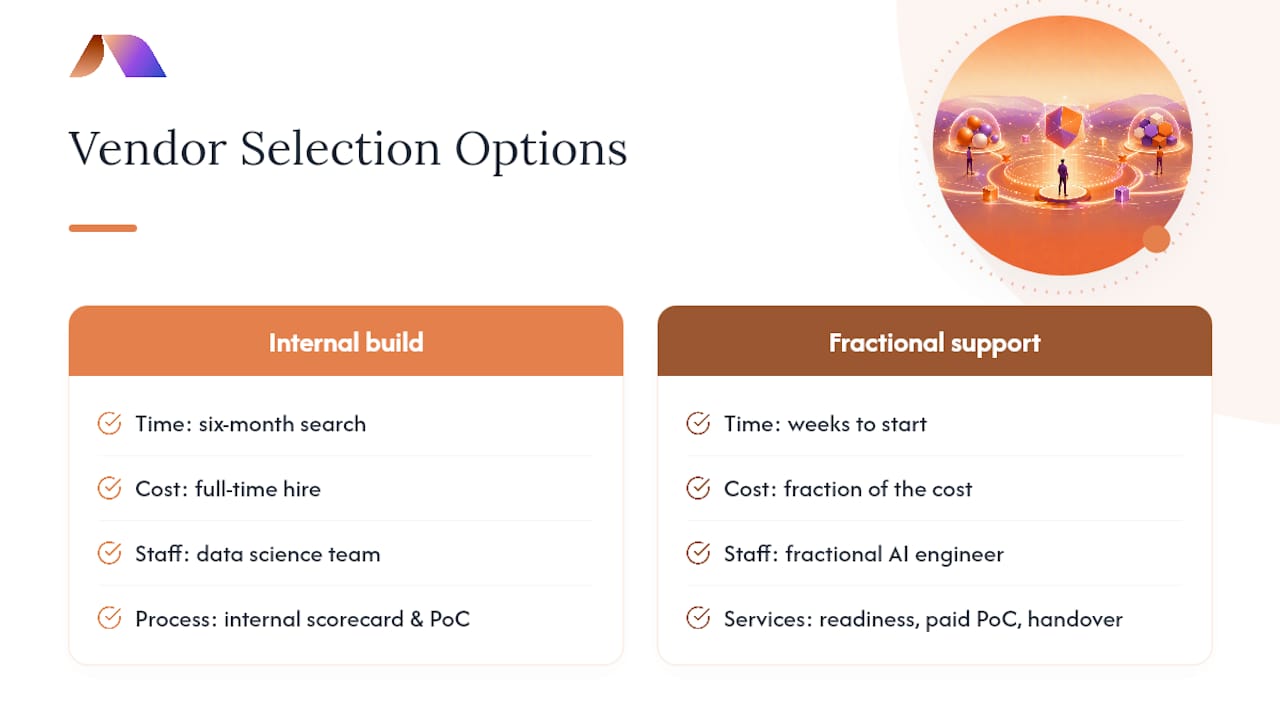
BRDGIT built its readiness assessment work around exactly this gap. When internal machine learning capacity is thin, data is regulated, or leadership needs a defensible decision fast, a fractional AI engineer can run the scorecard, execute the PoC, and support contract negotiation without the six-month hiring cycle a full-time role requires. A retained engagement typically means someone helping design your scoring weights, actually running the pilot against your data, and sitting in on the contract review before you sign.
Get Help Running Your Vendor Selection Process
You do not need a full data science team to run a defensible AI vendor selection. Fractional AI engineering support offers an alternative to hiring a full-time team: instead of a six-month search for a full-time ML engineer, some providers can supply experienced personnel to run your scorecard and PoC within weeks, often at a fraction of the cost of a permanent hire.

Some providers offer readiness assessments to confirm your use case is well defined, design and execute paid proofs of concept against your actual data, and can support contract negotiation and handover so your team inherits a working system, not a science project. For manufacturing, distribution, staffing, or professional services teams weighing whether to build this evaluation internally or bring in support, the first call typically covers your use case, your current data constraints, and where your timeline is tightest.
If you want a fractional AI engineer to run your scorecard, manage the PoC, and help you walk into contract negotiation with actual production evidence instead of a vendor’s slide deck, that page is the place to start.
Templates and Checklists Worth Downloading
A few resources are worth pulling before you build your own scorecard from scratch:
APQC’s vendor selection criteria for the underlying checklist structure.
ARDURA Consulting’s scoring matrix and RFP framework for sample RFP language.
CisoSafe’s vendor cybersecurity assessment guide for security questionnaire structure.
Treat every template as a starting point. Your weights and questions should reflect your own risk tolerance, not a generic default.
Sources
Vendor Evaluation Framework for AI Tools: A CIO’s 7-Dimension Scorecard
AI Vendor Selection: Evaluation Criteria and Checklist | ARDURA Consulting
FAQ
What Is the 30% Rule in AI Vendor Selection?
If you encounter the term, ask the source what it specifically measures before applying it to your scorecard.
How Can AI Be Used in Vendor Management?
AI supports vendor management by automating risk scoring, flagging contract renewal windows, and monitoring supplier performance data in real time, which is distinct from selecting the AI vendor itself. BRDGIT’s supplier management resources cover how these workflows get built once a vendor is chosen.
Do I Really Need a Paid Proof of Concept?
Yes, for any vendor whose tool will touch production data or workflows. A paid PoC on your representative data is the only reliable way to distinguish a polished demo from a system that will actually hold up under your real conditions.
What Are the Biggest Red Flags When Evaluating an AI Vendor?
The clearest warning signs are a refusal to run a PoC on your own data, no SOC 2 Type II certification for sensitive data handling, and vague or opaque usage-based pricing that makes cost at scale impossible to predict.
Who Are the Top AI Vendors?
There is no single “top vendor” list that fits every use case, because capability fit depends entirely on your specific ACE mapping, data constraints, and compliance requirements. A weighted scorecard run against your own shortlist will produce a more useful answer than any generic ranking.



