


Published on
Leaders: Use an AI Maturity Model to Turn Assessments Into a Roadmap
An AI maturity model is a multi-domain assessment framework that converts capability gaps into a prioritized roadmap, producing measurable business value rather than isolated pilots. The immediate action for leaders: run a structured capability assessment against pillars like strategy, data, governance, and talent, then translate the gaps into a sequenced roadmap. Frameworks from Gartner, MITRE, and SEI/CMU give you the scaffolding. BRDGIT gives you a way to execute it.
TL;DR:
Most mature AI capability assessments break down pillars into specific dimensions, like model ownership and data controls, for actionable improvements.
Using a five-stage maturity scale helps determine if your AI efforts are merely experimenting or truly integrated into core business operations.
Conducting a thorough assessment involves gathering evidence from policies, inventories, and stakeholder interviews, then validating scores with your team.
Achieving higher maturity levels requires discipline, focusing on securing data access, establishing clear ownership, and linking AI use cases to measurable business metrics.
Fractional AI engineering support can accelerate progress by turning assessments into concrete, scalable projects without full-time hiring.
BRDGITTurn AI Readiness Into ActionBRDGIT helps businesses assess AI readiness, identify opportunities, build roadmaps, and move from strategy into practical execution.Explore BRDGIT
Table of Contents
What Robust AI Capability Models Actually Measure
How Are AI Maturity Levels Typically Defined?
How Do You Run an AI Readiness Assessment and Build a Roadmap?
What Trade-Offs and Pitfalls Slow AI Maturity Down?
Team BRDGIT’s Perspective: Where Organizations Actually Stall
How BRDGIT Turns Your Assessment Into a Working Roadmap
Where to Go Deeper on AI Maturity Models
Sources
What Robust AI Capability Models Actually Measure
Most credible frameworks break AI capability into a consistent set of pillars: strategy and resources, data, technology enablers, governance and responsible use, organization and talent, and performance or applied business value. Each pillar sounds abstract until you break it into dimensions, which is where an ai capability assessment earns its keep. MITRE’s model, for instance, spans six pillars across 20 distinct dimensions, scored across five readiness levels. That granularity matters because “governance” alone tells you nothing actionable. Split into dimensions, it tells you whether you have a model registry, a defined risk owner, an incident response process, or none of those.
Dimension-level evidence is what separates a real assessment from a survey exercise. Ask these questions instead of vague ones:
Do you have documented data access controls and lineage tracking, or is data pulled ad hoc?
Is there a named owner for each production AI system, or does accountability dissolve after launch?
Do you track model performance against a business KPI, or only against technical accuracy?
Is there a model registry, or does every team keep its own spreadsheet?
Answering these turns fuzzy pillar scores into concrete roadmap line items. “Improve governance” becomes “assign model ownership and stand up a lightweight registry by Q2.”
How Are AI Maturity Levels Typically Defined?
Nearly every enterprise ai maturity model uses a four or five stage scale, and translating between vendor terminology is easier than it looks once you know what each stage actually implies.
Foundational. Isolated experiments, no shared data infrastructure, no ownership beyond the individual who ran the pilot.
Emerging. A few functional teams run repeatable projects, but there’s no enterprise coordination or shared metrics.
Operational. AI systems are in production with defined owners, monitoring, and at least one tie to a business KPI.
Scaled. Multiple production systems, shared platforms, and consistent governance across business units.
Transformational. AI is embedded in how the organization operates, with measurable ROI tracked at the portfolio level.
Gartner’s model uses this exact five-stage naming. Some frameworks, including AWS’s guidance for generative AI adoption, compress this into four levels: Envision, Experiment, Launch, and Scale, which works well if your focus is narrowly generative AI rather than the full ai capability model spectrum. Use a five-level scale for enterprise-wide assessments; use a four-level scale when you’re scoping a single initiative like a chatbot rollout or document automation.
How Do You Run an AI Readiness Assessment and Build a Roadmap?
Turning a maturity model from a wall chart into a working plan takes discipline, not just a questionnaire. Here’s the sequence that produces a defensible roadmap instead of a shelf document.
Scope the assessment. Decide whether you’re assessing the whole enterprise or a single function, then pull together a cross-functional team, including IT, data, operations, and at least one business unit leader who owns budget.
Collect evidence per pillar. Gather AI and data policies, a model inventory if one exists, data pipeline documentation, current KPIs tied to AI use, and a skills matrix showing who can build, deploy, and monitor systems.
Score qualitatively, then convert to numbers. Map each dimension’s qualitative description to a 1 to 5 score and average within each pillar. MITRE’s approach shows that a simple averaged score is usually sufficient. Complex weighting only helps if your organization already runs mature portfolio management.
Validate with stakeholders. Walk the scores past the people who supplied evidence. Self-reported maturity almost always runs higher than what the artifacts support.
Prioritize with impact times effort. Plot each gap on a simple grid. Quick wins get fixed first; platform-level bets (data infrastructure, MLOps tooling) get sequenced with clear owners and timelines.
The output should be four concrete deliverables: a maturity heat map by pillar, a prioritized backlog with named owners, a governance playbook, and a measurement dashboard tracking progress against baseline. A strategy execution framework built around accountable owners and deliverable workstreams applies directly here. If you want a template for structuring the assessment itself, this breakdown of what an AI readiness assessment involves walks through the stakeholder and evidence-gathering steps in more depth.
Pro Tip: Score the assessment twice, once from artifacts and once from stakeholder interviews. The gap between the two scores is usually your biggest political obstacle, not your biggest technical one.
What Trade-Offs and Pitfalls Slow AI Maturity Down?
The most common failure mode isn’t a lack of ambition. It’s experimentation at scale without engineering discipline: dozens of pilots running in parallel with no shared data access, no governance, and no path to production. SEI/CMU’s research frames this directly, warning that speed without discipline produces experimentation at enterprise scale rather than sustainable value.
Other recurring pitfalls include poor data access controls, missing governance ownership, and talent gaps where the people who understand the business don’t understand the technology, and vice versa. DORA’s research, based on nearly 5,000 respondents, found that cultural conditions like a clear AI stance and healthy data ecosystems predict AI-assisted development success as strongly as technical investment does.
Not every pillar needs level-5 maturity. Aiming for top-level scores everywhere wastes resources; set target levels by mission and expected ROI instead. Three priority rules cut through the noise: secure data access and clear ownership first, tie at least one use case directly to a business metric, and build one repeatable production pattern before chasing broader scale.
Team BRDGIT’s Perspective: Where Organizations Actually Stall
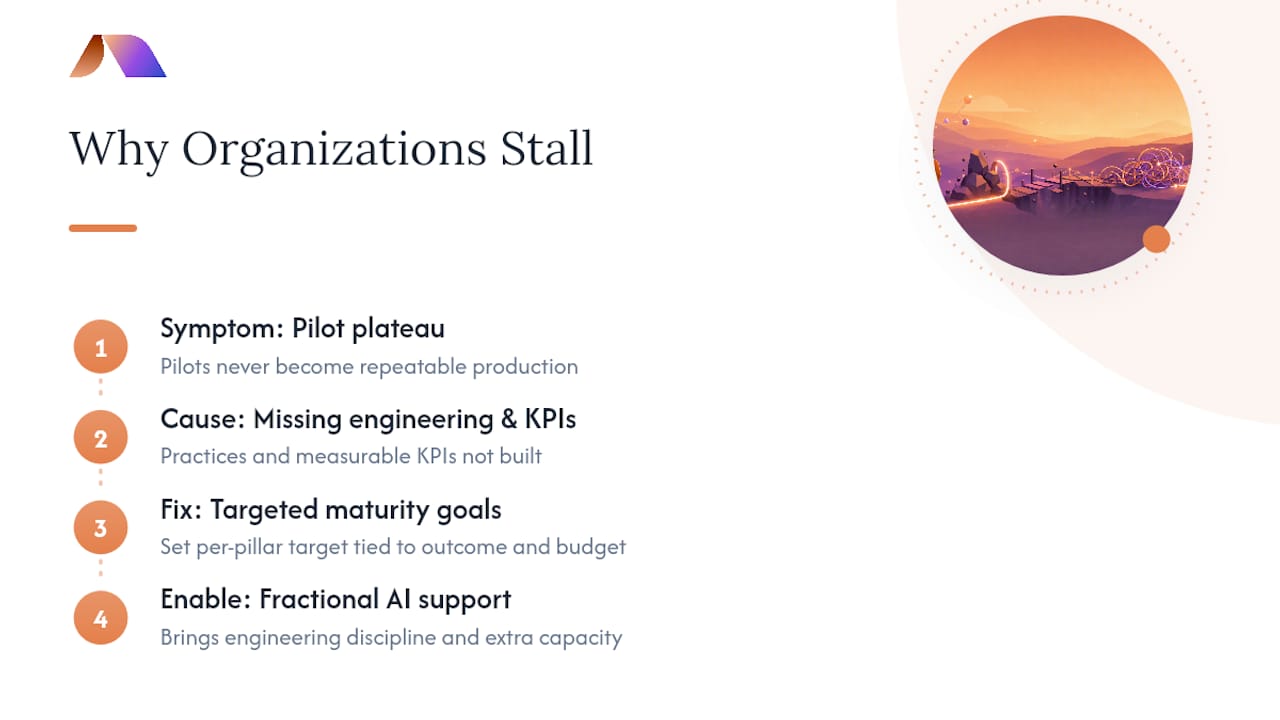
We see the same plateau across manufacturing, distribution, and professional services clients: organizations get stuck at the pilot stage because engineering practices and measurable KPIs never get built in from the start. Pilots feel like progress, but without a repeatable production pattern behind them, they stay pilots indefinitely.
The fix isn’t more experimentation. It’s setting a pragmatic target maturity for each pillar, tied to a specific outcome and a real budget line, rather than chasing uniform excellence across the board. Fractional AI support tends to accelerate this because it brings the engineering discipline that internal teams often lack the bandwidth to build alone.
— Team BRDGIT
How BRDGIT Turns Your Assessment Into a Working Roadmap
BRDGIT is the direct route from assessment to execution for teams that don’t want to hire a full AI engineering staff just to get past the pilot stage. Our work covers AI readiness assessments, roadmap creation tied to business KPIs, workflow automation, custom AI systems, staff training, and fractional AI engineering for ongoing delivery.

Doing this entirely in-house makes sense if you already have data engineers, a governance function, and spare capacity to run the assessment methodology described above. Most small and mid-sized teams don’t have all three at once, which is exactly where fractional support closes the gap without the cost of a full-time hire. If your assessment surfaced a backlog you don’t have the internal bandwidth to build, our fractional AI engineers can take the prioritized roadmap and start executing against it, from data pipeline fixes to production-grade model deployment. Reach out to scope which pillar needs attention first.
Where to Go Deeper on AI Maturity Models
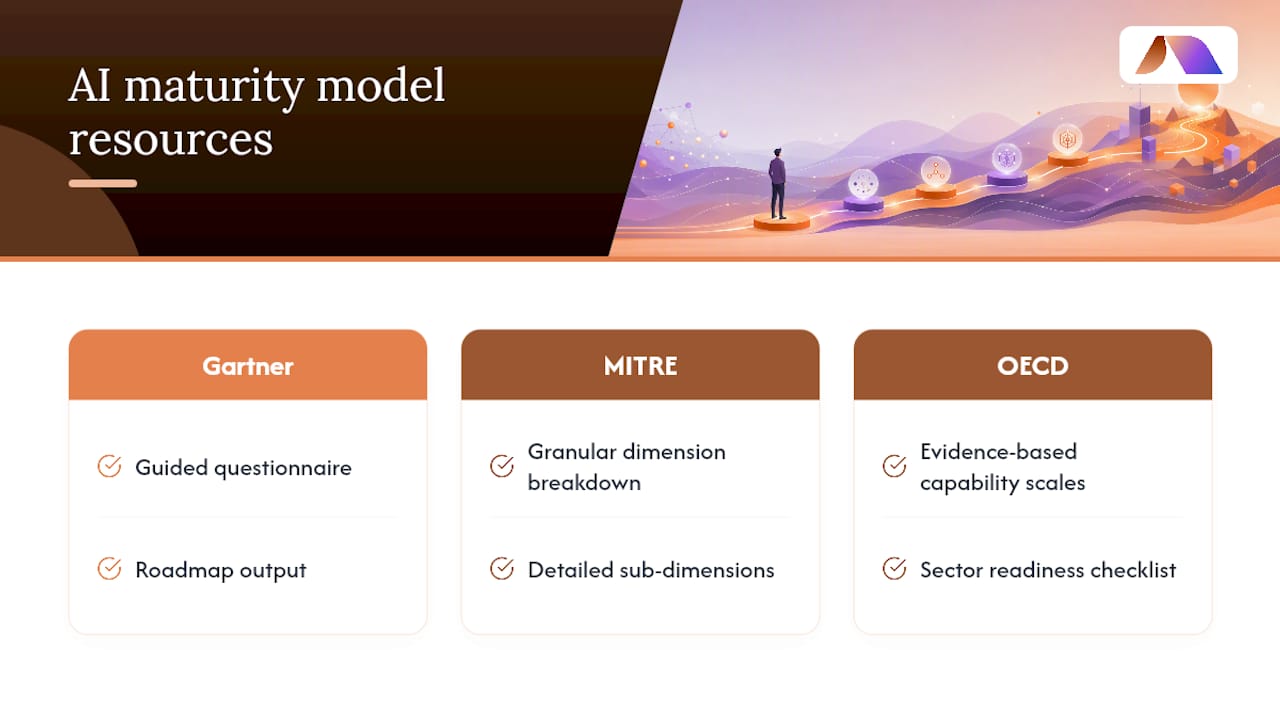
For the templates and assessment tools referenced above: Gartner’s AI Maturity Model toolkit offers a guided questionnaire and roadmap output. MITRE’s model provides the most granular dimension-level breakdown. The OECD AI Capability Indicators ground technical capability claims in evidence-based scales, useful context if you also want a tailored readiness assessment checklist for your own sector.



