


Published on
Developers: Six Stages to a Production AI Data Extraction Pipeline
An AI data extraction pipeline turns unstructured inputs like PDFs, scanned forms, or HTML pages into validated, schema-conformant structured data using a combination of OCR, NLP, and large language models, paired with validation and provenance controls. Choose this approach over rigid rule-based parsers when document formats vary or evolve. Watch for two recurring risks: model drift and weak provenance tracking.
TL;DR:
Model drift and evolving document formats require ongoing model maintenance and regular accuracy audits to sustain extraction quality over time.
Schema-first design and provenance tracking are critical, as they prevent costly retrofits caused by document template changes or errors going undetected.
Efficient production pipelines should incorporate caching, retries, and cost monitoring, with validation and human review for uncertain extractions to reduce failures and expenses.
Using schema-constrained structured outputs from models like OpenAI or Anthropic enhances reliability and simplifies validation compared to free-form text parsing.
Data security practices, including minimal data sharing, encryption, and strict access controls, are essential to protect sensitive information processed in extraction pipelines.
BRDGITbrdgit.aiTurn Extraction Ideas Into ExecutionBRDGIT helps teams assess AI opportunities, build practical roadmaps, implement custom systems, and support ongoing execution.Explore BRDGIT
Table of Contents
What is an AI data extraction pipeline?
How AI extraction differs from traditional ETL
Core architecture: ingest, preprocess, extract, validate, store, orchestrate
Choosing models and output formats for reliable extraction
Production engineering: caching, retries, and cost control
Validation and governance under NIST-aligned risk management
A minimal blueprint to get an MVP running
Security and privacy considerations for extraction pipelines
Common pitfalls that undermine extraction pipelines
Monitoring and maintaining extraction pipelines after launch
Tools and frameworks for building extraction pipelines
What experience building these pipelines actually teaches
How BRDGIT helps teams build reliable extraction pipelines
FAQ
Sources
What is an AI data extraction pipeline?
An AI data extraction pipeline ingests unstructured or semi-structured content and outputs structured records a downstream system can consume. Inputs run the gamut: PDFs, HTML pages, scanned images, EHR documents, invoices, contracts. Outputs typically land as JSON objects, database rows, or CSV files ready for a warehouse or application.
Success gets measured in concrete terms, not vibes. Teams track precision and recall on extracted fields, often summarized as F1 score
Throughput, meaning documents processed per hour at acceptable cost
Error rate on schema conformance, since a malformed JSON object breaks downstream code just as badly as a wrong value
The decision point is ambiguity. Rule-based extraction (regex, fixed-position parsing) works when documents share a rigid template, like a single vendor’s invoice layout. The moment formats vary, a new vendor appears, or language shifts mid-document, AI-based extraction earns its cost. A systematic review of automated extraction methods found that automated approaches can reach strong accuracy on many fields, with F-scores commonly exceeding 70%, but plenty of data elements remain under-explored. That is the honest baseline: automation assists, it does not replace a human reviewer outright.
How AI extraction differs from traditional ETL
Traditional ETL assumes tabular, predictable source structure. AI extraction pipelines start from the opposite assumption: inputs are messy, inconsistent, and sometimes outright ambiguous. A scanned invoice with a coffee stain over the total line is not a data quality exception, it is Tuesday.
Three distinctions matter for teams used to conventional data engineering:
Ambiguity management replaces simple validation, since the model must infer intent from context rather than just checking a field type
Continuous model maintenance is required, because drift and dataset shifts degrade accuracy as document styles or domains change over time
Schema enforcement and human-in-the-loop review become load-bearing, not optional, since a confident but wrong model output looks identical to a correct one without a validation layer
Treat an AI extraction pipeline like ordinary ETL and it will quietly degrade until someone notices the numbers are wrong.
Core architecture: ingest, preprocess, extract, validate, store, orchestrate
A production pipeline breaks into six stages, each with its own engineering decisions.
Ingestion: build connectors for each source type (email attachments, document management systems, scanned uploads) and define chunking rules so long documents split at natural boundaries like page or section breaks rather than mid-sentence.
Preprocessing: apply OCR for scanned content and segment documents into logical units (tables, paragraphs, headers) before extraction begins, since feeding a model an unsegmented wall of text degrades accuracy.
Extraction: choose the right technique for the job. Named entity recognition handles simple field pulls, relation extraction connects entities across a document, and LLM-based schema extraction handles complex, context-dependent fields where a prompt or a structured-output API call does the work.
Validation: enforce schema conformance against a defined JSON Schema or equivalent, and set confidence thresholds that flag low-certainty extractions for review rather than letting them pass silently.
Storage: persist extracted records alongside provenance metadata: source document identifier, extraction timestamp, model version, and confidence score, so every value is traceable to its origin.
Orchestration: batch documents for cost efficiency, checkpoint progress so a failure partway through a run does not force a full restart, and design for resumability from the start rather than bolting it on later.
Each stage deserves its own monitoring and its own failure mode analysis, because a pipeline that works on a hundred test documents and breaks on ten thousand production documents has usually skipped one of these steps, most often validation or orchestration.
Choosing models and output formats for reliable extraction
Model choice and output format decisions shape reliability more than almost anything else in the pipeline. The practical move is schema-first: define the target structure in Pydantic, Zod, or plain JSON Schema before writing a single prompt, then build extraction logic against that contract rather than improvising field names after the fact.
Native structured-output features change the reliability math. OpenAI’s structured outputs and Anthropic’s structured outputs both support constrained decoding against a supplied schema, which cuts post-processing errors compared to parsing free-form text and hoping for valid JSON.
Key trade-offs to weigh:
Larger general-purpose LLMs handle complex, context-dependent relations better but cost more per token
Smaller specialized NER models run cheaper and faster for narrow, well-defined field extraction
Confidence scoring lets you route uncertain outputs to human review instead of accepting them blind
Pro Tip: Build your schema and your test corpus before you write a single prompt. Prompts change constantly; schemas should not.
Production engineering: caching, retries, and cost control
Extraction pipelines fail quietly at scale unless specific safeguards are built in from the start. The DELM extraction toolkit documents a reproducible pattern worth copying directly: semantic caching keyed deterministically to the full prompt, schema, model identifier, and generation parameters, so identical extraction requests never trigger duplicate API calls.
Four patterns do most of the work:
Deterministic cache keys built from prompt text, schema, model, and parameters, guaranteeing correctness across repeated runs
Automatic retries with exponential backoff paired with checkpointed batching, so a failure mid-run does not force a full restart
A relevance-scoring filter stage ahead of extraction, so the model only processes documents likely to contain target fields
Logging and cost tracking tied to provenance metadata, so every output traces back to the run that produced it
These engineering safeguards materially lower failure rates and unexpected costs at scale, according to the DELM paper, which frames extraction pipelines as reproducible experiments rather than one-off scripts. That framing matters: a pipeline without run metadata is nearly impossible to debug once something goes wrong three weeks after deployment.
Validation and governance under NIST-aligned risk management
The NIST AI Risk Management Framework (AI RMF 1.0) gives extraction pipelines a structure worth adopting wholesale rather than reinventing. Its MAP, MEASURE, and MANAGE functions translate directly into operational controls: document who owns each stage, trace data lineage from source document to stored output, and maintain a written test plan for extraction quality.
NIST calls for TEVV, meaning test, evaluation, verification, and validation, applied across the AI lifecycle, not just at launch. In practice that means:
Scheduled accuracy audits comparing extracted fields against a human-reviewed sample
A documented low-confidence routing policy that sends uncertain extractions to a human reviewer automatically
An incident response plan for extraction failures, including how corrected records get backfilled
NIST specifically recommends logging human-oversight decisions on low-confidence outputs for auditability. That log is what turns a pipeline from a black box into something a compliance team can actually review.
A minimal blueprint to get an MVP running
Getting from zero to a working pipeline does not require the full architecture on day one. A lean build order:
Define the target schema and assemble a sample corpus of real documents, including the messy ones
Pick a minimal ingestion and OCR stack that covers your actual document types, not every hypothetical one
Build a relevance scorer that filters out documents unlikely to contain target fields
Add batched extraction with schema validation and semantic caching from the start
Pilot with a human reviewer checking every output, measure precision and recall against that review, then iterate before widening rollout
This order matters because it front-loads the schema decision, which is the hardest thing to change later. Teams that start with prompts and add schema validation afterward tend to rebuild the whole extraction layer once real documents expose edge cases the prompt never anticipated.
Security and privacy considerations for extraction pipelines
Extraction pipelines routinely touch sensitive content: invoices with banking details, EHR documents with patient information, contracts with confidential terms. That reality makes data handling a design constraint, not an afterthought bolted on before launch.
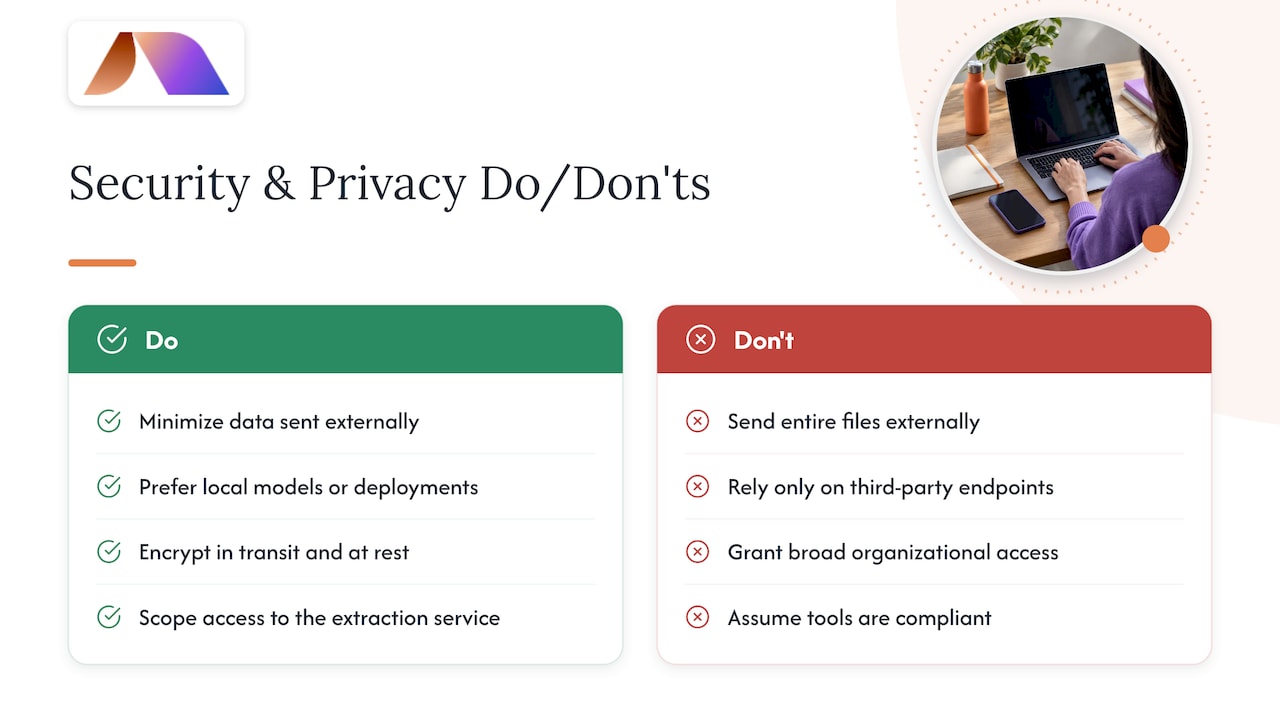
A few practices reduce exposure meaningfully. Minimize what leaves your infrastructure: send only the document segments needed for a given extraction task rather than entire files to an external API. Where regulatory scope allows, prefer models or deployment options that keep data within your own environment over sending every request to a third-party endpoint. Encrypt data in transit and at rest, and apply access controls scoped tightly to the extraction service rather than broad organizational access.
Vendor assessment deserves its own checklist, since external model APIs introduce a dependency most teams have not fully mapped. A guide on preventing data leakage through public AI tools covers the practical controls worth reviewing before sending production documents to any external endpoint.
Compliance requirements depend entirely on the data type and jurisdiction involved, so treat any specific claim about what is “compliant” or “approved” with caution. Document retention policies, consult counsel for regulated data categories like health or financial records, and build audit logs from day one so a compliance review does not require reconstructing history after the fact.
Common pitfalls that undermine extraction pipelines
A handful of mistakes show up repeatedly across extraction builds, and most are avoidable with earlier planning.
Skipping schema-first design is the most common one. Teams that write prompts before defining a schema end up retrofitting validation later, usually after a production incident makes the gap obvious. Treating confidence scores as optional is another: a model that returns a wrong value with high apparent confidence is more dangerous than one that flags uncertainty, because the wrong value passes silently downstream.
Document drift catches teams off guard too. A vendor changes an invoice template, a new document type appears, and extraction accuracy drops without anyone noticing until someone downstream flags bad data weeks later. Without scheduled accuracy audits, that drift compounds.
Cost blowouts happen when teams skip relevance filtering and caching, sending every document through the most expensive model available regardless of whether it actually needs that capability. And under-provisioned human review, meaning no clear path for low-confidence outputs to reach a reviewer, turns a manageable error rate into a trust problem across the organization.
Each of these traces back to the same root cause: treating extraction as a one-time build rather than an ongoing operational system that needs monitoring, feedback, and periodic revalidation against new document samples.
Monitoring and maintaining extraction pipelines after launch
A pipeline that works at launch will not stay accurate without deliberate maintenance. Document formats shift, vendors change templates, and language use evolves, all of which degrade extraction quality gradually enough to go unnoticed without active monitoring.
Build a monitoring routine around a few core signals: confidence score distributions over time, schema validation failure rates, and a recurring sample audit comparing extracted fields against human review. A sudden rise in low-confidence outputs or validation failures is usually the earliest sign something upstream has changed.
Cost tracking deserves the same ongoing attention as accuracy. Token usage per document, cache hit rates, and retry counts all signal whether the pipeline is running efficiently or quietly burning budget on duplicate calls. Provenance logs, tied back to the model version and schema used for each extraction, make root-cause analysis far faster when something breaks.
Set a cadence for re-running TEVV-style evaluation cycles rather than treating validation as a launch-day activity, as NIST’s framework recommends across the full AI lifecycle. Quarterly reviews work for stable document types, monthly for anything undergoing active format changes.
Tools and frameworks for building extraction pipelines
The extraction toolchain has matured quickly. Open-source and academic toolkits like DELM demonstrate reproducible pipeline patterns: loaders, preprocessing hooks, batched executors, schema validation, caching, and cost tracking, all designed to reduce custom boilerplate that teams would otherwise build from scratch.
On the model side, OpenAI’s structured outputs and Anthropic’s structured outputs have become close to standard practice, since both provide schema-constrained decoding through their APIs rather than relying on prompt instructions alone. Pairing either with a validation library like Pydantic or Zod on the client side closes the loop between what the model returns and what your downstream system expects.
For teams wanting a productized reference point, a guide to AI data extraction workflows walks through practical examples of pipeline design aimed at business use cases rather than pure research settings, useful as a second perspective alongside the more academic toolkits.
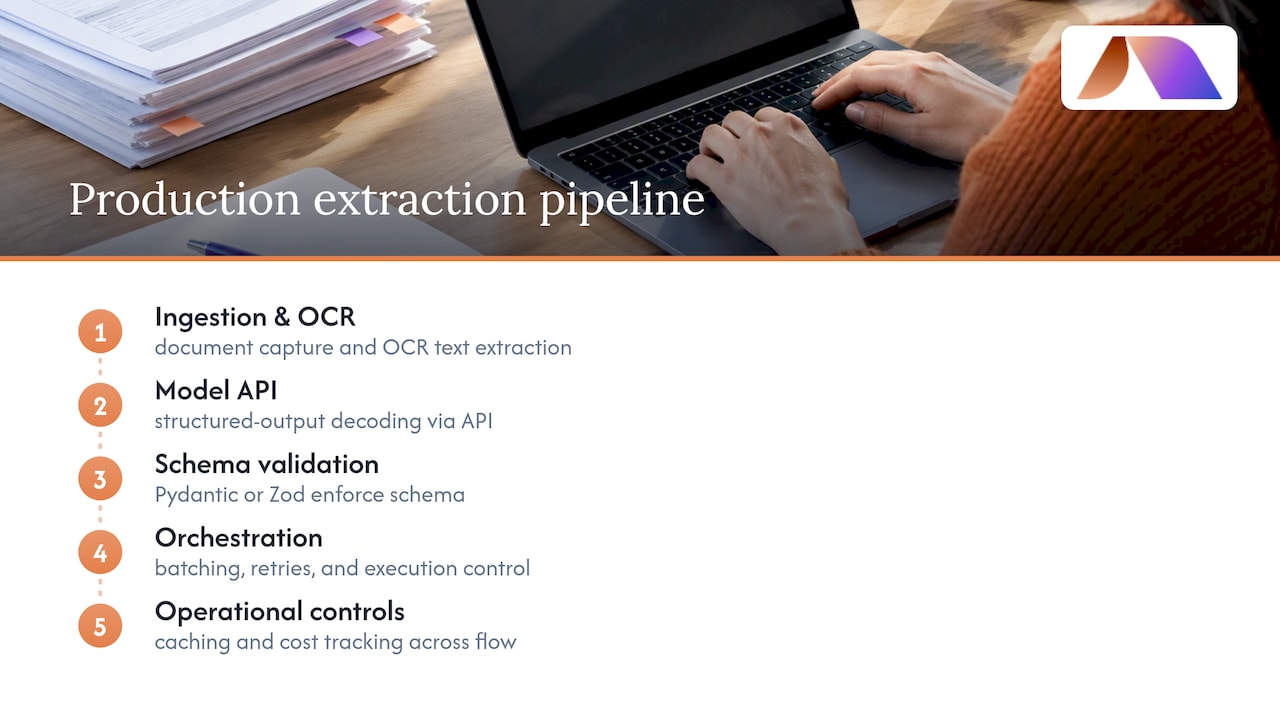
The honest takeaway is that no single tool solves the whole problem. A working pipeline usually combines an ingestion and OCR layer, a model API with structured-output support, a schema validation library, and an orchestration layer handling batching and retries, stitched together rather than bought off a shelf.
What experience building these pipelines actually teaches
The gap between a demo and a production pipeline is almost always governance, not model quality. Teams that skip schema-first design and provenance logging hit a wall the moment a document format shifts, and by then the fix costs far more than it would have upfront.
— Team BRDGIT
How BRDGIT helps teams build reliable extraction pipelines
The service works with small and mid-sized teams who need a pipeline that runs reliably without the overhead of a bloated enterprise platform. The process typically includes readiness assessments to identify where extraction fits into actual workflows, blueprinting schemas and architectures before coding begins, and fractional engineer services that provide experienced engineers on the build without a full-time hire.

If you are scoping an extraction project and want a second set of eyes on the schema or the architecture, explore BRDGIT’s services or look into fractional engineering support for hands-on delivery help.
FAQ
Can AI create data pipelines?
AI can help design and partially automate data pipelines, particularly extraction and transformation steps, but a working production pipeline still needs engineers to define schemas, build connectors, and set up orchestration and validation layers. Tools like DELM show how LLM-assisted pipelines can be structured reproducibly, though human oversight remains part of the design.
Can AI do data extraction?
Yes, AI handles data extraction from unstructured sources like PDFs, scanned documents, and HTML with reasonable accuracy, especially when paired with structured-output features from model APIs. A systematic review found automated methods often reach F-scores above 70% on many fields, though human validation still matters for under-explored data elements.
Which AI model is best for data extraction?
There is no single best model since the right choice depends on document complexity and budget. Smaller specialized NER models suit narrow, well-defined fields cheaply, while larger LLMs with structured-output support, such as those from OpenAI or Anthropic, handle complex or context-dependent relations more reliably.
Where does AI pull its data from?
In an extraction pipeline, the model processes whatever source documents your ingestion layer feeds it, such as PDFs, scanned images, HTML pages, or database records, rather than pulling data from the open internet. Provenance metadata should track exactly which source document and version produced each extracted value.



