


Published on
Run AI Cost Modeling This Quarter: FinOps Steps to Cut Token Spend
AI cost modeling is the discipline of converting raw usage and infrastructure data into cost per unit of business outcome, the dollars spent per resolved ticket, per generated report, per automated decision. Done right, it gives you cost-per-use-case visibility instead of a single alarming cloud bill. The three levers that move the needle fastest are prompt caching, model tiering, or routing, and batching.
TL;DR:
Prompt caching can reduce costs by storing stable prompt components and maximizing cache efficiency, especially when input structure is predictable and reusable.
Routing simple queries to cheaper models and escalating only uncertain requests significantly lowers average inference costs for mixed workload environments.
Batching non-urgent tasks can cut inference expenses by up to 50%, but only if latency delays are acceptable and workload volume justifies it.
Building an accurate cost model requires real usage data, segmented workloads, and regularly updated rates, with actual invoices used for validation and adjustment.
Self-hosting is economically viable only with high, sustained throughput and the capacity to manage infrastructure, while most teams benefit from hybrid approaches combining API and private deployment.
BRDGITTurn AI Costs Into Clearer DecisionsBRDGIT helps you assess AI readiness, identify opportunities, and build practical roadmaps for sustainable execution.Explore AI execution support
Table of Contents
Practical techniques to cut LLM and AI operational costs
A step-by-step cost-modeling process you can run this quarter
Pricing and vendor billing nuances to model correctly
Infrastructure economics: API, managed cloud, self-host, and hybrid tradeoffs
Measurement, governance, and FinOps operationalization
Tools, templates, and calculators (practical resources for teams)
How BRDGIT operationalizes AI cost modeling for enterprise clients
Energy consumption and environmental cost considerations in AI modeling
Why cost modeling must be owned as an operating discipline
How BRDGIT can help implement cost modeling
Sources
FAQ
Practical techniques to cut LLM and AI operational costs
Most teams discover their AI costs the hard way, by opening an invoice that triples what they expected. The fix is not a single audit. It is a set of operational habits that compound.
Prompt caching is the lowest-effort win available. Providers offer separate, lower rates for cached input tokens, the parts of a prompt that repeat across calls, like system instructions or long reference documents. Structure prompts so the stable, reusable portion sits first and the variable, per-request content comes last, which maximizes what the cache can capture.
Model routing, sometimes called cascading, means sending easy queries to a cheap, fast model and escalating only the low-confidence cases to a more expensive one. Mixed-complexity workloads see meaningful reductions in average inference cost when routing logic is tuned well, since most real traffic skews toward simpler requests (FinOps Foundation).
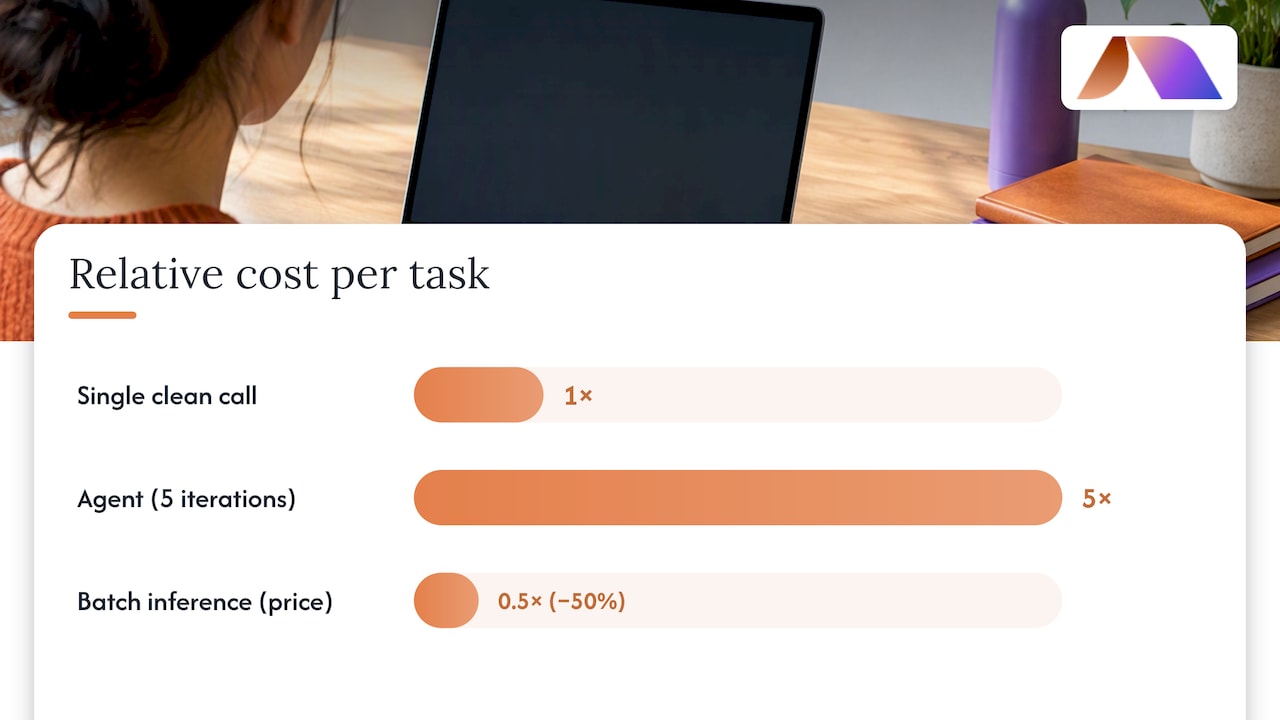
Batching trades latency for price. Non-interactive workloads, overnight processing, bulk classification, scheduled report generation, are strong batch candidates, and providers like Amazon Bedrock price batch inference at rates up to 50% below on-demand (Amazon Bedrock pricing). The tradeoff is turnaround time measured in hours, not seconds, so batching only fits workloads that can tolerate that delay.
Beyond pricing mechanics, prompt engineering matters. Pruning unnecessary context, demanding structured outputs instead of freeform text, and reducing retry loops all cut token volume directly.
Cache the stable parts of a prompt, not the variable parts.
Route simple queries to cheap models and escalate only when confidence is low.
Batch anything that does not require an immediate response.
Cap agent iterations and set hard budget ceilings per task.
Trace every agent run so you can attribute token consumption back to outcomes.
Agentic systems deserve particular caution. An agent that loops five times before completing a task burns five times the tokens of a single clean call, and without iteration caps and tracing, that waste hides inside an aggregate bill.
Pro Tip: Set a hard token or dollar budget per agent task and kill the run if it’s exceeded, rather than discovering the runaway loop at the end of the month.
A step-by-step cost-modeling process you can run this quarter
A credible cost model is not a spreadsheet guess. It follows a sequence that finance can audit and engineering can maintain.
Define your unit economics. Pick the business outcome you’re pricing, cost per support ticket resolved, per document summarized, per lead qualified, and treat everything else as a means to that number.
Collect representative traces. Pull real production prompts and responses, not synthetic examples, and compute actual input, output, and cached-token ratios from them rather than assuming a generic rule of thumb (Meta deployment guides).
Segment workloads. Separate interactive traffic from batch jobs, training runs, evaluation passes, and retrieval calls, since each carries different pricing and different volume patterns.
Build a dated rate card. Record on-demand rates, batch rates, cached-input read and write rates, and any regional or contract-specific adjustments, with the date you pulled them, because provider pricing changes.
Run low, base, and high scenarios. Model a conservative, expected, and worst-case volume projection for each segment, then compare the spread to your budget tolerance.
Reconcile against invoices. Once real bills arrive, check them against your model’s predictions and adjust the assumptions that were wrong.
Assign ownership and a review cadence. Name who updates the rate card and who reviews variance, monthly at minimum, so the model doesn’t go stale.
This sequence matters because agentic workflows and long outputs compound costs in ways simple request-count math misses: autoregressive output generation and multi-step agent calls can generate far more billable work per user interaction than a naive estimate assumes (Meta cost projection guidance).
Pricing and vendor billing nuances to model correctly
Naive cost models treat every token the same. Real vendor pricing does not, and the gaps between the two are where budgets quietly blow out.
Input and output tokens are priced differently, and output is typically the more expensive side of the ledger.
Cached inputs carry their own read and write rates, distinct from fresh input pricing.
Batch processing is priced separately from on-demand, often substantially lower, but with eligibility rules tied to latency tolerance.
Context-length tiers change per-token cost as conversations or documents grow longer.
Processing modes, batch, priority, flex, shift the effective rate even for the same underlying model.
Amazon Bedrock publishes batch inference pricing at up to 50% lower than on-demand rates (Amazon Bedrock pricing), which means a workload that tolerates delayed processing can roughly halve its inference line item without changing the model at all.
OpenAI’s published API pricing similarly separates input, cached-input, and output rates, and offers batch and flex processing tiers that change the effective per-token cost depending on how a request is routed (OpenAI API pricing). None of this is static. Contract terms, committed-use discounts, and regional processing options all shift realized rates away from the public list price, which is why every rate card in your model needs a pull date attached. A model built on a six-month-old screenshot of a pricing page is already wrong.
Infrastructure economics: API, managed cloud, self-host, and hybrid tradeoffs
Where you run inference changes the shape of your cost curve more than which model you choose. API access scales cost linearly with usage and carries no infrastructure burden, which makes it the right default for variable or unproven workloads. Self-hosting flips that relationship: fixed costs dominate, and the economics only improve once utilization is high and sustained.
Utilization is the hinge variable. A GPU sitting idle half the day costs the same as one running at full tilt, so batching requests and autoscaling to match demand are what determine whether self-hosted inference actually beats API pricing per outcome (FinOps infrastructure guidance).
Self-hosting only pencils out when throughput is sustained and high, when utilization stays consistently above the idle-capacity threshold, and when the team has the staffing to own it.
Sustained, high, predictable throughput is the first precondition, not occasional spikes.
Security patching, model version updates, and monitoring require ongoing engineering attention that API access does not.
Accelerator provisioning and capacity planning add lead time that cloud APIs skip entirely.
Placement levers like spot or preemptible instances, scale-to-zero for idle periods, and provisioned throughput for guaranteed capacity can each shift the break-even point.
For most teams below a certain volume, a hybrid approach, API for variable or experimental workloads and self-hosted or provisioned capacity for a few high-volume, stable use cases, captures most of the savings without the full operational burden of running everything in-house.
Measurement, governance, and FinOps operationalization
A cost model that lives in one engineer’s spreadsheet dies the day that engineer changes teams. Turning it into an operating discipline is what the FinOps Foundation frames as the real work: cross-functional collaboration, accessible cost data, and assigned ownership, not a one-time estimate (FinOps Framework).
Define spend scopes. Split cost tracking by product, team, and environment so nobody is guessing which group owns which line item.
Instrument for visibility. Build dashboards that show cost per use case, token breakdowns by type, and model-routing traces, not just a total monthly spend figure.
Forecast and watch for anomalies. Set expected ranges per workload so a sudden spike gets flagged before the invoice arrives, not after.
Reconcile monthly. Compare predicted to actual spend and feed the difference back into your rate card and volume assumptions.
The KPIs worth tracking are narrower than most dashboards attempt: cost per unit outcome, GPU or accelerator utilization, retry and failure rates, and variance against budget. Everything else is noise dressed up as insight.
Pro Tip: Assign a named owner to every cost scope before you build the dashboard, not after, or the dashboard becomes a report nobody acts on.
Tools, templates, and calculators (practical resources for teams)
A trustworthy estimator needs three ingredients: a dated rate card, a trace sample with real input, output, and cached-token counts, and segmentation fields that split interactive from batch and training workloads. Without all three, the output is a guess with decimal points.
Per-use-case spreadsheet templates that map each workload to its own cost line.
Batch-scenario calculators that model the delayed-processing discount against latency tolerance.
Sensitivity analysis patterns that show how cost shifts if token ratios or volume move by 20% or 50%.
Validate any estimator the same way every time: reconcile against a real invoice, run a sensitivity test on your riskiest assumption, and walk through a worst-case scenario before you trust the base case.
How BRDGIT operationalizes AI cost modeling for enterprise clients
BRDGIT builds cost modeling into the adoption path rather than treating it as an afterthought: a readiness assessment identifies and prioritizes use cases, then modeling defines expected unit economics before implementation begins. Outcomes are tracked through dashboards showing cost per use case alongside the governance structure needed to keep that number accurate as usage grows. Fractional AI engineers can then carry that model forward post-launch, adjusting it as workloads shift.
Energy consumption and environmental cost considerations in AI modeling
Dollar cost is not the only cost. Every inference call and training run consumes electricity, and that consumption scales with model size, context length, and the number of calls an agent makes per task, the same variables that drive your billing line. A cost model that ignores energy intensity is incomplete even if the invoice reconciliation is perfect.
Practically, the levers that cut dollar cost also cut energy draw. Model routing sends simple queries to smaller models that require less compute per call. Batching improves hardware utilization, which reduces idle energy waste from accelerators sitting half-loaded. Caching avoids recomputing the same context repeatedly. None of these require a separate sustainability initiative, they fall out of the same optimization work you’re already doing for cost.
For organizations reporting on environmental impact, tracking energy intensity per use case alongside dollar cost per use case gives a fuller picture than either metric alone, and it keeps procurement decisions, including accelerator choice and data center region, grounded in more than price. As AI workloads scale into training larger models and running more agentic pipelines, the energy line item will only grow more visible on both the budget and the sustainability report.

Why cost modeling must be owned as an operating discipline
The mistake I see most often is teams measuring total AI spend instead of cost per outcome. A number without a denominator tells you nothing about whether the spend is working. Engineering, product, and finance need to co-own the model and its review cadence, not hand it off after launch. The workloads will keep changing, and the model has to keep up.
— Team BRDGIT
How BRDGIT can help implement cost modeling
If you’re staring at an AI bill you can’t explain, BRDGIT’s AI Readiness Assessment and AI Blueprint turn that confusion into a prioritized, costed roadmap before you spend another dollar on implementation.

For teams that need the model built and maintained without a full-time hire, BRDGIT’s fractional AI engineers can stand up the dashboards, the rate card, and the governance cadence, then keep adjusting it as your workloads change. Get in touch to scope an assessment.
Sources
FAQ
How much do AI models cost?
Cost depends entirely on the model, the volume of input and output tokens, and whether requests run on-demand or in batch, so there is no single figure that applies across providers. Published rate cards from providers like OpenAI and Amazon Bedrock show separate input, output, and cached-token rates that you need to model against your own traffic.
What is the 30% rule for AI?
The more reliable approach is measuring your own input, output, and cached-token ratios from real traces rather than relying on a fixed percentage rule of thumb.
Which AI tool is best for pricing comparisons?
The most reliable approach is not a single tool but a model you build from dated vendor rate cards, real usage traces, and segmented workload data, then validate against your own invoices. Spreadsheet templates with sensitivity analysis and batch-scenario calculators, built on data from providers like Bedrock and OpenAI, tend to outperform generic calculators that don’t reflect your actual traffic.
How do prompt caching and batching reduce AI costs?
Prompt caching charges a lower rate for the repeated, stable portions of a prompt, while batching processes non-urgent requests at a discount, up to 50% lower than on-demand pricing on platforms like Amazon Bedrock. Both work by shifting cost structure rather than changing the model itself, which makes them among the fastest wins available to most teams.
When does self-hosting an AI model become cheaper than using an API?
Self-hosting tends to become economical only when throughput is sustained and high enough to keep accelerators consistently utilized, since idle GPU capacity erases any savings. Teams also need the staffing to handle security patching, monitoring, and capacity planning, which is why many organizations stick with API access until volume and operational readiness both clear that bar.



